How Predictive Analytics Is Transforming Modern Healthcare?
by
vikas weaddo
The problem is not that hospital leaders lack reports.
The problem is that reports arrive after the damage is done.
The no-show already happened. The OPD queue already overflowed. The patient has already dropped out of the journey. The campaign has already spent the budget. The discharge delay already hurt the experience. The follow-up has already slipped.
If the report arrives tomorrow, the leak has already happened.
The gap your board eventually sees
MHealthcare boards do not usually ask for “predictive analytics” first.
They ask:
Why did growth slow?
Why did campaign ROI drop?
Why are OPD numbers unstable?
Why are patients not returning?
Why is the call center overloaded?
Why are discharge complaints rising?
Why is portal adoption weak?
By the time these questions reach the board, the gap has already been operating for weeks or months.
Predictive analytics gives leaders earlier visibility into the signals behind those questions. It does not replace leadership judgment. It improves timing.
Because in hospital growth, late truth is expensive.
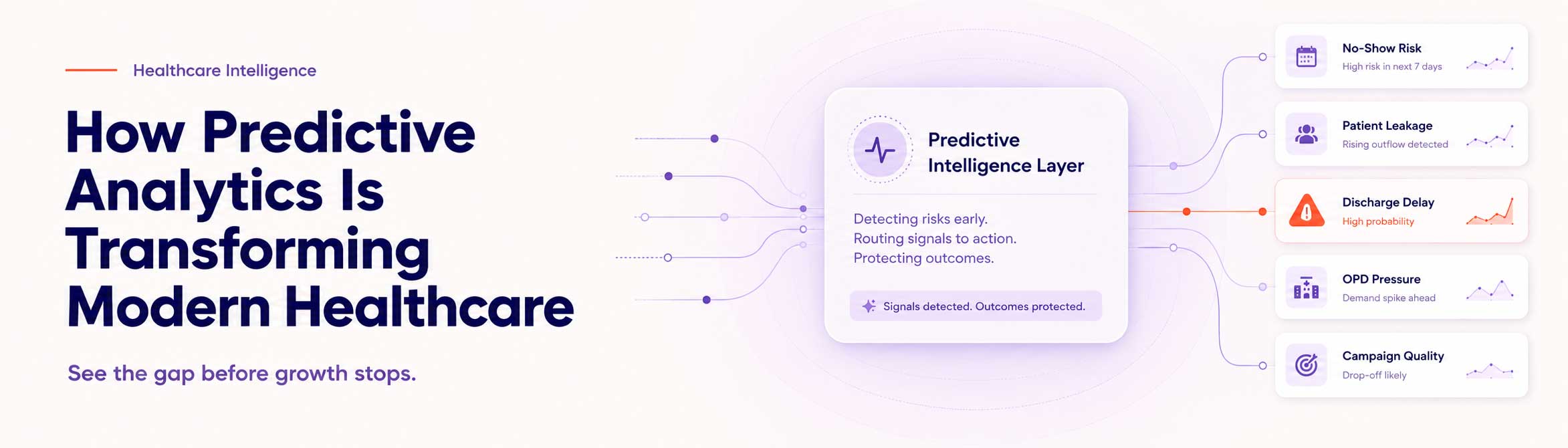
It helps hospitals move from “what happened?” to “what is likely to happen next?” It uses connected data, operational signals, patient behavior, and AI healthcare analytics to identify patterns early enough for leadership and teams to act.
Not a guess.
Act.
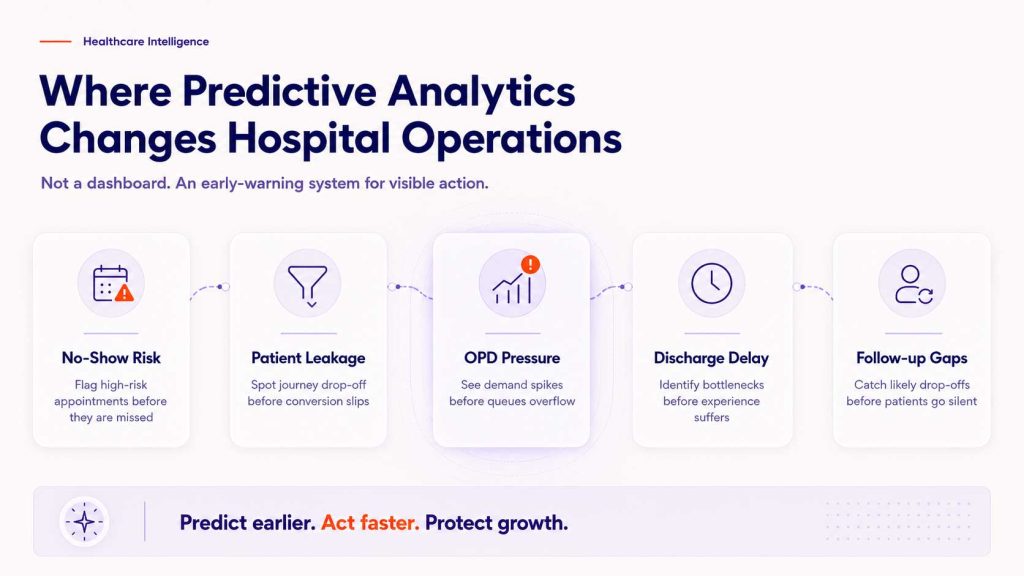
Predictive analytics is not a dashboard. It is an early-warning system.
Most hospital dashboards are rear-view mirrors.
They show yesterday’s appointments, last week’s campaign performance, last month’s revenue, and last quarter’s patient volumes.
Useful? Yes.
Enough? No.
Predictive analytics in healthcare helps leaders answer sharper questions:
Which patients are likely to miss appointments?
Which campaigns may produce low-quality or leaking leads?
Which departments may face OPD pressure next week?
Which patients may not complete follow-up?
Which discharge workflows are likely to delay?
Which service lines are showing early demand shifts?
Which patient segments need retention action?
Which locations or specialties are seeing leakage?
This is where modern healthcare analytics becomes strategic.
Not “make a chart.”
Spot the gap before growth stops.
Where predictive analytics changes hospital operations
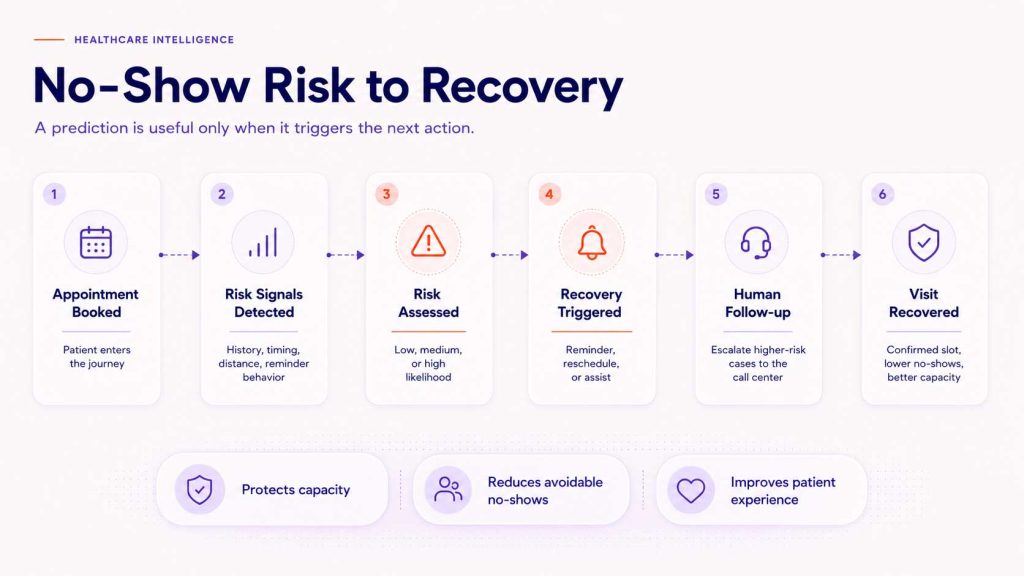
1. Appointment no-show prediction
No-shows are rarely random.
They may be influenced by appointment type, patient history, booking channel, reminder engagement, distance, time slot, doctor availability, payment status, or prior behavior.
Predictive analytics can help hospitals identify higher-risk appointments and trigger stronger recovery workflows.
For example:
Signal
Possible Risk
Action
Patient has missed before
Higher no-show probability
Confirmation and call center task
No reminder engagement
Weak intent
Additional reminder or WhatsApp prompt
Long gap between booking and visit
Forgetting or plan change
Mid-cycle reminder
High-demand doctor slot
Capacity loss risk
Early confirmation
Campaign lead with no portal login
Weak journey engagement
Assisted booking support
This is not about blaming patients.
It is about designing better operating systems around real behaviour.
2. Patient leakage detection
Patient leakage does not always look like leakage.
Sometimes it looks like “lead quality issue.” Sometimes it looks like “front desk load.” Sometimes it looks like “marketing underperformance.” Sometimes it looks like “patients are not ready.”
But often, leakage happens because systems do not move together.
A patient clicks an ad, lands on a page, submits a form, misses the call, receives no helpful follow-up, does not get doctor availability, and books elsewhere.
Leadership sees a conversion drop.
The patient experienced a broken journey.
Predictive analytics can help identify where patients are likely to drop based on journey signals.
One patient. One journey. One view.
That is what leadership needs.
AI healthcare analytics depends on data quality
Here is the part many AI conversations avoid.
Predictive analytics is only as strong as the data foundation beneath it.
If HIS, EMR, CRM, labs, pharmacy, billing, patient portal, telehealth, chatbot, and call center data are fragmented, duplicated, incomplete, or inconsistent, predictions become unreliable.
That is not AI readiness.
That is AI decoration.
Before hospitals expect predictive intelligence, they need to ask:
Are patient records deduplicated?
Are appointment and visit statuses consistent?
Is campaign source data reliable?
Are billing and clinical events connected?
Are lab report statuses structured?
Are call center outcomes captured properly?
Are patient portal interactions linked to the same patient identity?
Are governance and access controls in place?
Predictive analytics starts before the model.
It starts with the operating layer.
Practical use cases of predictive analytics in healthcare
Predictive analytics can support many hospital leadership priorities.
But the best starting points are practical, visible, and tied to growth or patient experience.
Use Case
What It Predicts
Who Uses It
Why It Matters
No-show risk
Likelihood of missed appointment
Operations, call center
Protects capacity and revenue opportunity
OPD demand
Department or doctor-level volume pressure
COOs, operations heads
Improves staffing and queue planning
Patient leakage
Drop-off risk across journey stages
CMOs, patient experience teams
Improves conversion and retention
Follow-up completion
Patients likely to miss next step
Care coordinators
Supports continuity of care
Discharge delay risk
Cases likely to get delayed
IPD operations
Improves experience and bed readiness
Campaign quality
Leads likely to convert or leak
Marketing and growth teams
Better spend decisions
Retention risk
Patients unlikely to return
CXOs, CRM teams
Helps build proactive engagement
Billing friction
Cases likely to face payment or query delays
CFOs, billing teams
Improves financial visibility
The point is not to predict everything.
The point is to predict what leadership can act on.
A prediction without a workflow is just a fancy warning.
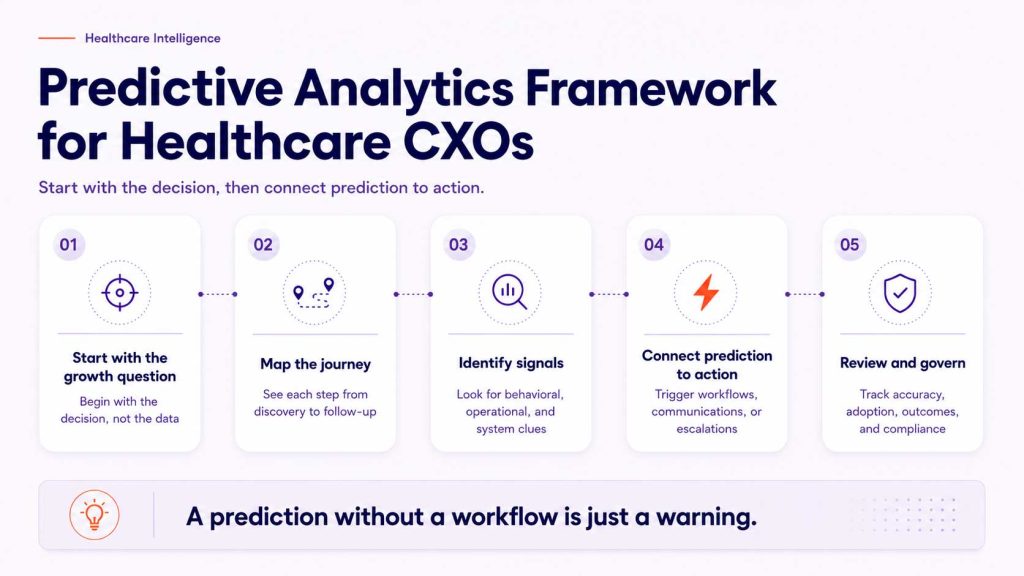
Predictive analytics framework for healthcare CXOs
Hospitals can use a five-step framework.
1. Start with the growth question
Do not begin with data.
Begin with the decision.
For example: “Where are we losing booked patients?” or “Which discharge workflows create the most delay risk?”
2. Map the patient or operational journey
Identify every step from discovery to booking, visit, lab, billing, discharge, feedback, and follow-up.
3. Identify signals
Look for behavioral, operational, and system signals that appear before the outcome.
4. Connect prediction to action
Every prediction should trigger a workflow, escalation, communication, or decision.
5. Review and govern
Track accuracy, adoption, outcomes, and compliance. Predictive analytics must be governed, not blindly trusted.
This is how AI healthcare analytics becomes useful.
Not by sounding advanced.
By changing the next action.
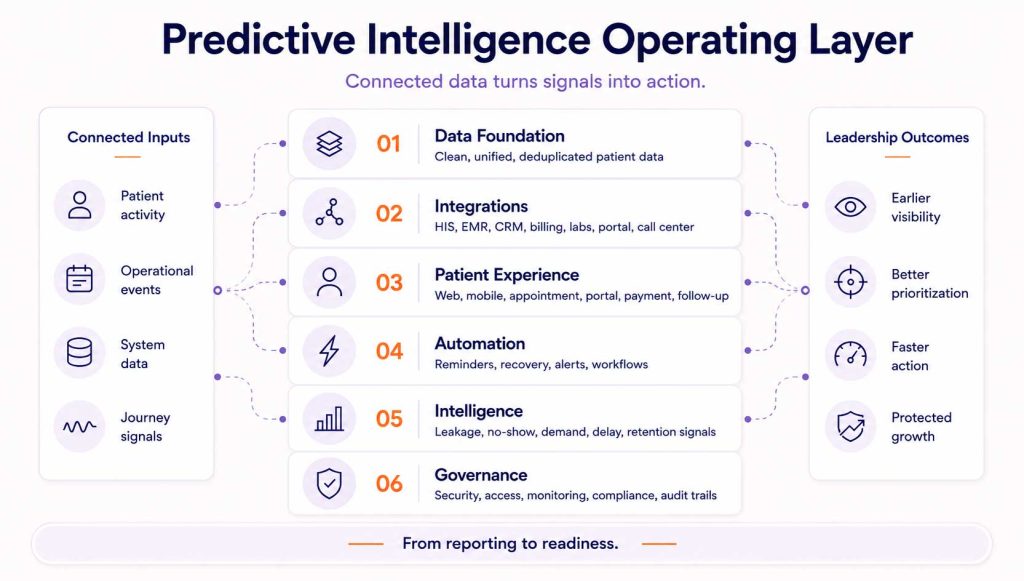
The WeAddo way: predictive intelligence on a connected operating layer
WeAddo helps healthcare businesses become future-ready and AI-ready by unifying fragmented data, systems, patient journeys, workflows, content, intelligence, and governance into one connected operating layer.
For predictive analytics in healthcare, this foundation matters.
The Data Warehousing Layer helps clean, migrate, deduplicate, and unify patient data into one connected foundation.
The Integrations Layer connects HIS, EMR, CRM, labs, pharmacy, billing, call center, telehealth, chatbot, portal, and other systems.
The Patient Experience Layer connects patient touchpoints across web, mobile, in-clinic, appointment, portal, payment, feedback, and post-care journeys.
The Automation Layer helps turn predictions into actions: reminders, no-show recovery, lab alerts, discharge flows, feedback, and follow-ups.
The Intelligence Layer gives real-time visibility into growth, leakage, campaign performance, patient journeys, retention, attribution, and operational signals.
The Governance Layer adds security, access control, monitoring, uptime, compliance, audit trails, and reliability.
That is the shift from reporting to readiness.
Not “Here is what happened.”
But “Here is where the gap is forming, and here is what to do next.”
Key takeaways
Predictive analytics in healthcare helps hospitals act before leakage becomes a boardroom problem.
The most practical use cases include no-show risk, patient leakage, OPD demand, discharge delays, follow-up gaps, campaign quality, and retention risk.
AI healthcare analytics depends on clean, connected, governed data.
Predictions are useful only when connected to workflows and accountability.
WeAddo helps hospitals unify data, systems, journeys, automation, intelligence, and governance into one AI-ready operating layer.
FAQs
1. What is predictive analytics in healthcare?
Predictive analytics in healthcare uses historical data, operational signals, patient behavior, and analytical models to estimate what is likely to happen next, such as no-shows, leakage, demand shifts, follow-up gaps, or discharge delays.
2. How does predictive analytics help hospitals?
It helps hospitals identify risks earlier, improve planning, reduce patient leakage, support operational decisions, prioritize outreach, and improve visibility for leadership teams.
3. What is the difference between healthcare analytics and predictive analytics?
Healthcare analytics can include descriptive reporting about what happened. Predictive analytics focuses on what is likely to happen next and what action should follow.
4. Is predictive analytics the same as AI healthcare analytics?
Not always. Predictive analytics may use statistical models, machine learning, or AI-assisted methods. AI healthcare analytics is broader and may include prediction, segmentation, automation, recommendations, and decision support.
5. What data is needed for predictive analytics in healthcare?
Useful data may come from HIS, EMR, CRM, appointment systems, labs, pharmacy, billing, call center, patient portals, campaign platforms, feedback systems, and operational workflows. Data quality and governance are critical.
6. Can predictive analytics improve patient retention?
Yes, when connected to patient journey data and follow-up workflows. It can help identify patients who may not return, miss follow-ups, or drop from care journeys, allowing teams to act earlier.
A Final Thought
Where does your growth stop?
If it stops at delayed reporting, invisible leakage, no-show surprises, campaign guesswork, OPD pressure, discharge delays, or poor data quality, the gap is already costing you.
Book a Meeting with us to know more about how WeAddo helps hospitals use predictive analytics in healthcare through one unified, intelligent, AI-ready operating layer.







Leave a Reply