

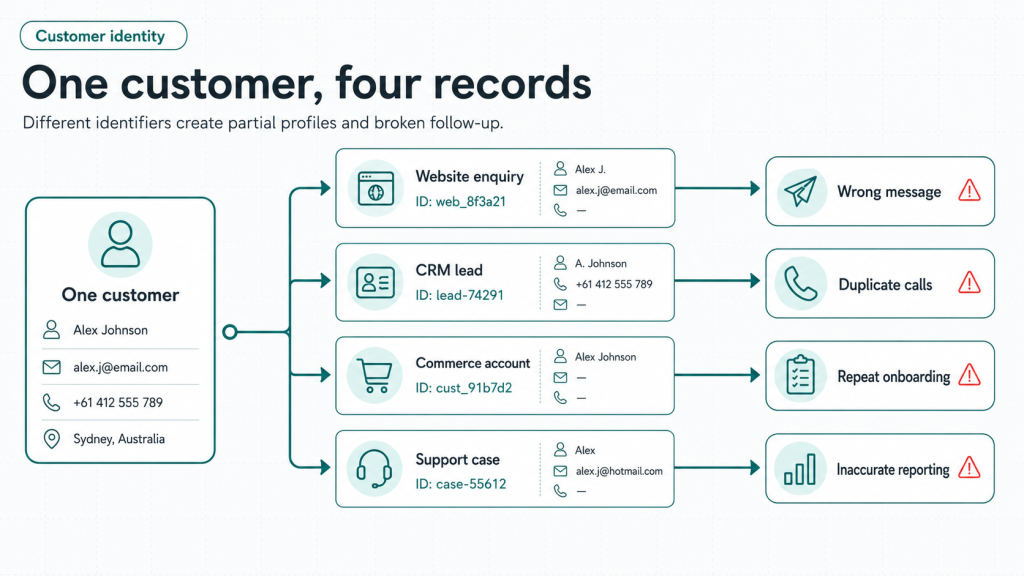
One Customer. Four IDs. Four Different Journeys.
A customer submits an enquiry through your website using a work email address. They later purchase using a personal phone number, create a portal account with another email address and contact support through a branch.
Your CRM sees a lead. Your commerce system sees a buyer. Your portal sees a new user. Your support platform sees a separate case.
The customer sees one company. Your systems see four people.
That is why someone who has already purchased may receive a first-time buyer offer. A returning customer may be asked to complete onboarding again. A service agent may have no visibility into the original purchase, and leadership may count one customer several times.
The data exists. The customer does not exist as one usable business record.
The Customer Is Not Changing. Your Systems Are Losing the Connection.
Customers do not use one perfectly consistent identifier throughout a relationship. They change phone numbers, use personal and work email addresses, purchase on behalf of family members or businesses, visit different locations and contact the company through assisted channels.
A customer may appear as:
- A website enquiry linked to an email address
- A CRM lead linked to a mobile number
- A commerce customer linked to an order ID
- A portal user linked to a login ID
- An ERP account linked to a customer code
- A support case linked to a ticket number
- A branch visitor recorded in a local spreadsheet
Each record may be valid. The failure begins when the organisation cannot determine that the records belong to the same person or account.
A customer data platform should help connect these interactions into a usable customer view. But the value is not the number of records it collects. The value is whether the business can recognise the same customer across systems and continue the correct journey.
What Breaks When One Customer Has Several Identities?
The customer receives the wrong communication
A customer completes a purchase but remains inside a lead-nurturing sequence because the purchase event is connected to another profile. They receive introductory offers, abandoned-enquiry reminders or product recommendations that ignore what they already bought.
The automation may be working exactly as configured. It is acting on the wrong identity.
Employees ask customers to repeat information
A customer contacts support after purchasing through another channel. The service agent cannot see the order, previous enquiry or account history because the records are separated.
The customer must explain when they purchased, which branch handled the request and what information they already submitted.
Reporting counts activity instead of customers
Leadership may ask how many unique customers purchased, returned, complained or renewed. The answer becomes unreliable when the same person appears under several IDs.
A campaign may seem to generate more new customers than it actually did. Retention may appear lower because repeat purchases are assigned to new profiles. Support volume may be overstated because connected cases are treated as unrelated incidents.
Follow-up reaches the wrong person
Duplicate profiles can cause multiple teams to contact the same customer. One salesperson follows the original enquiry while another handles the later registration. A branch and central call centre both believe they own the relationship.
The customer receives repeated calls while another genuine lead receives none.
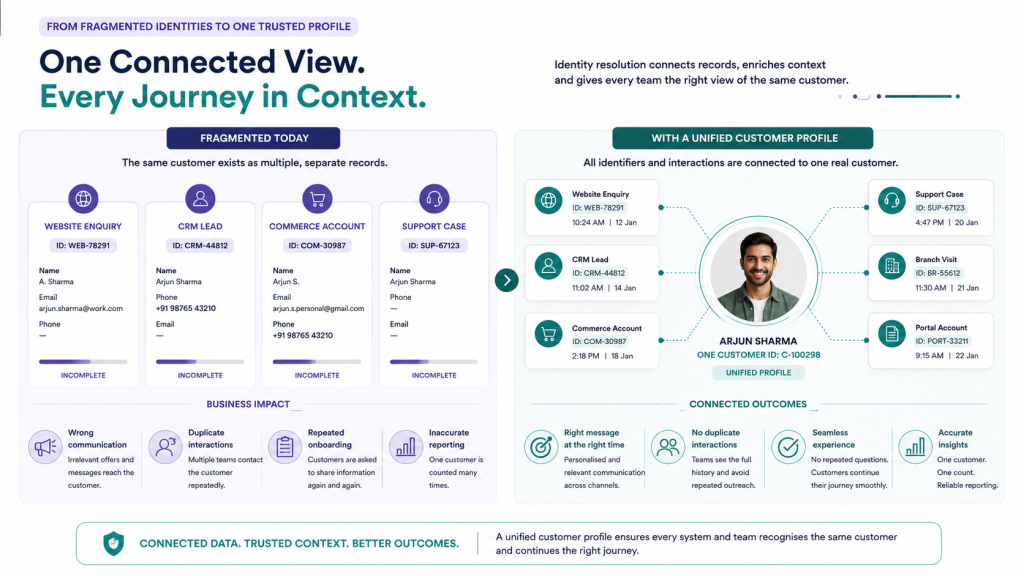
A Unified Customer Profile Is Not Just a Bigger Database
Businesses often assume that moving data into one warehouse or dashboard automatically creates one customer view.
It does not.
Putting four disconnected records in one place still leaves four disconnected records.
A unified customer profile requires the business to determine which records belong together, which information is current, which source owns each field and which teams are allowed to use it.
For example, the CRM may own sales status. The ERP may own completed transaction value. The portal may own the customer’s latest contact preference. The support platform may own open cases.
The objective is not to make every system identical. It is to create enough shared context for each system and team to understand whom they are dealing with.
How Identity Resolution Works in Business Terms
Identity resolution is the process of determining when different records are likely to represent the same customer, account or household.
The system may compare signals such as:
- Email address
- Phone number
- Customer or account code
- Portal login
- Device or cookie identifiers
- Order history
- Address
- Branch or location relationship
- Consent records
- Business account associations
Some matches are direct. The same verified phone number appears in two systems. Others require rules. Two records may share an address and purchase history but use different email addresses.
The business also needs safeguards. Two family members may share a phone number. One employee may purchase for several business accounts. A customer may deliberately keep personal and professional transactions separate.
Good identity resolution should therefore combine clear matching rules, confidence levels, review processes and governance. The goal is not to merge every similar record. It is to connect records accurately enough to improve the journey without creating privacy or ownership problems.
Where Customer Identity Usually Breaks
Website to CRM
The website captures an email address, campaign source and service interest. The CRM creates a lead using a phone number, but the original browser or enquiry context is not retained.
CRM to transaction system
A salesperson closes a deal, but the ERP or commerce platform creates a separate customer code. The purchase never updates the original lead record.
Transaction to portal
The customer registers for the portal using different details from those used during purchase. The portal treats them as a new user and shows no history.
Branch to central systems
A branch creates a local customer record because it cannot find the existing one quickly. The central business now has another version of the same person.
Support to customer history
The support tool receives a new ticket but cannot connect it to the correct order, account or previous case. The agent works without the context needed to resolve the issue.
These are not isolated data problems. They become experience, operations and reporting problems at the same time.
What a Connected Customer Record Should Make Possible
A reliable unified customer profile should help the business answer practical questions:
- Is this person already a customer?
- What have they enquired about, purchased or booked?
- Which location or account owns the relationship?
- Is there an active complaint or service request?
- What communication have they already received?
- What consent and channel preferences apply?
- What action should happen next?
- Which information can this employee access?
The profile does not need to display every available data point to every employee. It should provide the right context to the right role.
A salesperson may need purchase and enquiry history. A support agent may need orders, open cases and current service status. Marketing may need consented behaviour and segment membership. Leadership may need customer-level conversion, retention and value reporting.
What a Connected Data Flow Should Look Like
1. Define the customer and account objects
Agree on what the business means by customer, prospect, account, household, patient, student or member. Without shared definitions, every system will continue counting differently.
2. Connect the important source systems
Start with the systems that carry the highest-value journey: website, CRM, commerce or booking, ERP, portal and support.
3. Apply identity resolution
Use verified identifiers and controlled matching rules to connect records. Keep uncertain matches available for review rather than merging them automatically.
4. Build the unified customer profile
Combine relevant journey, transaction, service and consent information while preserving the system that owns each field.
5. Send the context back into action
A customer data platform should not become another place where information sits. The connected profile should improve routing, communication, portal experiences, service recovery and reporting.
6. Maintain governance
Record access, changes, source history, consent and retention rules. Customer unification without governance can create a larger risk than the original fragmentation.
Do Not Begin by Connecting Everything
A large customer-data programme can become another long technology project. Start with one journey where duplicate identity has a visible cost.
Examples include:
- Enquiry to purchase
- Booking to service completion
- Application to enrolment
- First purchase to repeat purchase
- Complaint to resolution
- Dealer lead to vehicle sale
- Policy enquiry to renewal
Choose the systems involved in that journey and measure the existing duplication. How many records cannot be connected? How many customers receive repeated communication? How much manual matching happens before reporting?
This creates a practical first use case for the customer data platform rather than a vague promise of a 360-degree view.
Where Does Your Growth Stop?
Growth can stop when a returning customer is treated like a stranger. It can stop when several teams contact the same person, when the portal forgets a previous transaction or when leadership cannot separate unique customers from duplicate activity.
WeAddo’s Data Suite is designed to bring information from different systems into one management and customer view through data warehousing, customer-data management, data engineering and analytics. The Experience Suite can then use that connected context across customer-facing journeys, while governance controls access, history and usage.
The underlying problem statement is specific: different IDs, spellings and system records create partial customers, making follow-up, segmentation and reporting unreliable. The practical mechanism is identity resolution and an actionable customer view rather than another disconnected dashboard.
Conclusion
One customer should not have to rebuild their relationship every time they move from website to branch, portal, purchase or support.
A working customer data platform connects relevant records without forcing every system to be replaced. Reliable identity resolution determines which records belong together. A governed unified customer profile gives each team enough current context to continue the relationship correctly.
Choose one recent customer and trace every ID associated with them across your major systems. Then count how many teams see an incomplete version.
That is where the customer journey is breaking.
Audit 100 recent customers and identify how many exist under more than one unconnected ID.
FAQs
A customer data platform connects customer information from multiple systems and makes it available for analysis, segmentation and customer-facing action.
A unified customer profile is a governed view that connects relevant identity, journey, transaction and service information for the same customer.
Identity resolution uses identifiers and matching rules to determine when records from different systems belong to the same person, account or household.
The purchase may be connected to a different customer record from the one used by the marketing or CRM system.
Start with one high-value journey, connect the systems involved and measure duplicate records, repeated communication and manual matching before expanding further.

Leave a Reply