How to Keep Doctor Profiles Updated Across a Multi-Location Hospital Website?
by
vikas weaddo
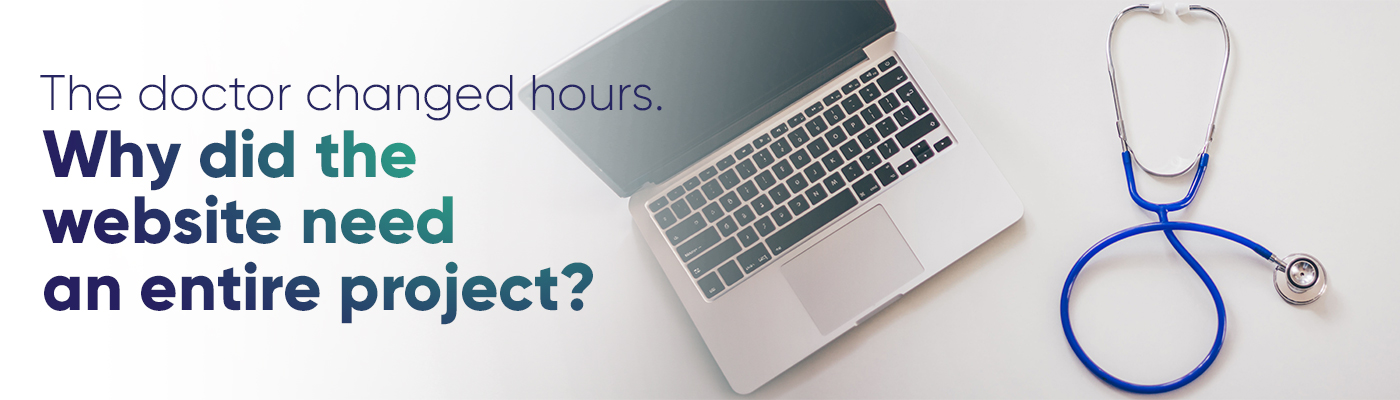
A doctor changes consultation hours. Someone updates the main profile. The location page still shows the old timing. A campaign page has an older bio. A speciality page lists the doctor at the wrong branch.
None of these errors looks dramatic on its own. Together, they create a basic trust problem: the hospital knows the correct information, but the website does not show it consistently.
For growing hospital groups, this is less a writing problem and more a content-operations problem. A CMS for hospital chains should make routine doctor information easy to update once, govern properly and reuse wherever it is needed. If every change still creates tickets, follow-ups and repeated edits, the underlying content model is doing too much manual work.
Quick answer: doctor information should be managed as a reusable business record, not copied page by page.
Why do doctor profile updates become slow?
Doctor profiles rarely live in only one place. The same clinician may appear on a profile page, speciality page, hospital-location page, search result, campaign landing page and booking journey. The more locations a network adds, the more copies teams have to keep aligned.
This is where a CMS for hospital chains can either reduce work or quietly multiply it. If each page owns its own version of the doctor’s speciality, credentials, location and availability, every operational change becomes a publishing exercise.
A Clinical content management system should separate the information itself from the pages that display it. The doctor’s approved information becomes the source record. Pages and experiences then reuse the relevant fields instead of recreating them every time.
That sounds like a technical distinction. Operationally, it changes a lot. A timing update can become one controlled change instead of a search across the website for every place that may contain the old timing. A good CMS for hospital chains should make that difference visible in the amount of work a routine change creates.
What information should be treated as structured doctor data?
Not every sentence needs to become a database field. The useful starting point is information that changes, repeats, affects discovery or influences the patient’s next action.
For a doctor profile, that usually includes name, speciality, credentials, services, hospital or clinic location, consultation availability, languages, profile image, booking route and other approved attributes relevant to the hospital’s journey.
A Healthcare content hub can then provide a governed place for that information to be maintained and reused. The aim is not to centralise content for the sake of centralisation. It is to reduce the number of independent versions that teams need to remember, check and correct.
The same principle helps a Clinical content management system support search, filters and location experiences. In practice, a Clinical content management system works best when repeated facts are maintained as fields rather than buried in page-specific copy.
If speciality, location and availability exist as consistent fields, the website can use them in more predictable ways than if the same facts are buried inside free-text page copy.
What does a better doctor-profile update workflow look like?
A practical content model starts with ownership. The hospital decides which team can request a change, who can edit specific information, which fields require medical, brand or operational review, and what can publish after approval.
From there, a CMS for hospital chains should support a simple sequence:
Source information changes → approved record is reviewed → relevant experiences receive the new value → team verifies that the change is live.
This is also where a Healthcare content hub becomes more useful than another shared folder. A folder can store the latest document. It does not automatically tell every digital experience which approved fact to use. A Healthcare content hub becomes valuable when approved information can be reused by the experiences that depend on it.
Within WeAddo’s Experience Suite, Content Manager & Structured Content follows this model: doctor, speciality and location information can be managed as structured records and used through reusable experience patterns and controlled publishing.
The value is mechanical rather than cosmetic: fewer independent copies to maintain, clearer ownership and a shorter route from approved change to customer-facing update.
The point is not to replace every hospital system. It is to make the customer-facing information layer easier to operate around the systems already in place.
Start with one KPI: doctor profile update cycle time
The cleanest way to measure this problem is doctor profile update cycle time: how long it takes from an approved change being requested to the correct information being live across all relevant customer-facing experiences.
A CMS for hospital chains should help shorten that cycle by reducing repeated editing and unnecessary specialist dependency. But the KPI needs a clear start and finish.
Measuring only the time an editor spends inside the CMS misses the waiting, checking and coordination that often create most of the delay.
Track the full route:
Approved change received → content updated → required review completed → affected experiences refreshed → final verification completed.
A Clinical content management system is valuable when it reduces the work between those points, not merely when it gives editors another interface.
What else should a hospital measure?
Update speed is only one part of the picture. Hospitals should also watch stale or incorrect information rate, profile completeness, consistency errors across repeated doctor information, and the number of manual edits required for one underlying change.
Those measures expose different weaknesses. For a CMS for hospital chains, they also reveal whether centralisation is actually reducing operational work or simply moving it into a new interface.
Fast publishing is not useful if profiles remain incomplete. A complete profile is not reliable if another page shows conflicting information. And an accurate website may still be expensive to operate if every change requires five separate edits.
A Healthcare content hubshould therefore be judged by what it removes from the operating model: duplicate maintenance, unnecessary checks, avoidable tickets and uncertainty about which version is current.
A second-order measure is discovery quality. A CMS for hospital chains should make it easier to connect reliable doctor information with the discovery experience rather than treating content maintenance and patient discovery as separate jobs.
If structured information improves how patients find the right doctor by speciality, location or availability, teams can then examine search success, profile engagement and progression toward booking.
These are downstream signals, not automatic outcomes. They should be measured rather than promised.
How do you know whether the current setup needs fixing?
There is a simple test. Pick one common doctor change from the last month and trace what happened.
Ask how many people touched it, how many pages were edited, whether a developer or agency was required, how long approval took, whether every affected location was checked, and whether an old version remained live afterwards.
If the answers are difficult to reconstruct, the problem is already larger than the page itself. A Healthcare content hub should make the source, ownership and reuse of important doctor information easier to trace.
A CMS for hospital chains should make the route of a routine change clearer, not force teams to remember where information might have been copied.
A well-designed Clinical content management system should also make governance visible. Teams should know who owns each field, what needs approval and which experiences depend on the record.
That becomes especially important in a multi-location network, where local teams need speed without creating a separate version of the truth for every hospital.
The better model is simple
Doctor profiles should not behave like individual mini projects.
The hospital should maintain approved doctor information once, reuse it intelligently, govern changes and measure how quickly the correct information reaches the patient.
That is the real job of a CMS for hospital chains. A Healthcare content hub provides the reusable information layer. A Clinical content management system gives teams the structure and controls to manage it.
The Experience Suite capability adds the customer-facing mechanics that allow approved records to support pages, search and related journeys without turning every change into another rebuild.
The question for digital and content teams is therefore not: “How many doctor pages do we manage?”
It is: “How much work does one doctor change create?”






Leave a Reply