Compliance Is Designing the B2B Customer Journey Now
by
vikas weaddo
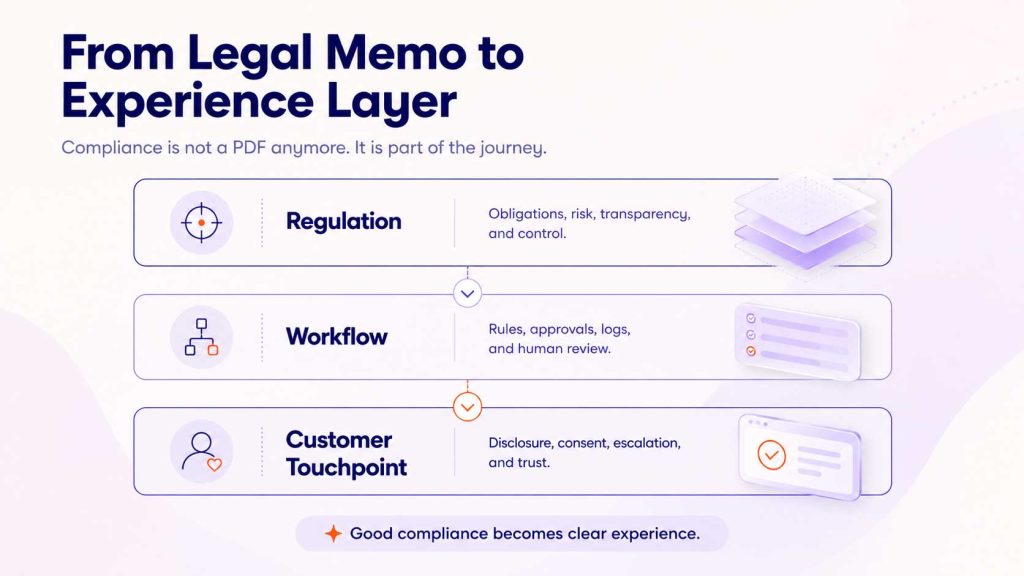
Compliance used to arrive as a PDF. Now it arrives inside the customer journey.
For years, compliance lived in policy folders, legal reviews, approval chains, risk checklists, and documents nobody opened unless something had already gone wrong. In B2B, that model is breaking. AI is pushing compliance into the actual customer journey.
It now appears in onboarding flows, sales qualification, support triage, product recommendations, customer health scores, renewal alerts, pricing approvals, consent moments, escalation rules, and audit logs.
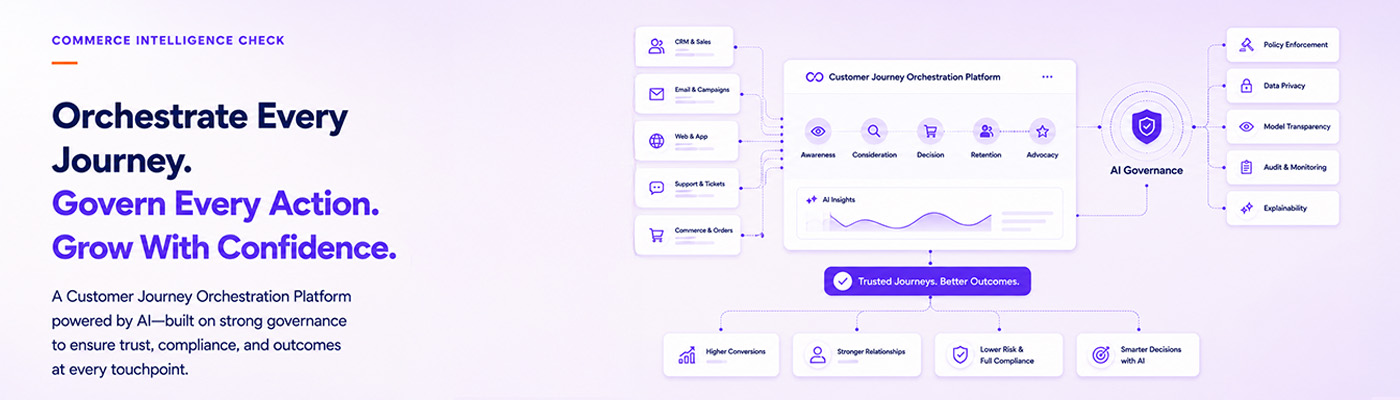
This is why a customer journey orchestration platform is no longer just a CX or automation conversation. It is becoming a governance conversation. If AI is influencing what a customer sees, what a rep does, what a workflow triggers, or what a system recommends, then compliance cannot sit outside the journey. It has to be designed into it.
The next compliance failure may not look like a missing policy. It may look like a customer who cannot tell whether a decision was made by AI, a support workflow that never escalates, a renewal recommendation that used the wrong data, or an audit trail nobody can reconstruct.
That is where growth stops: not because the AI feature failed, but because the operating layer behind it was not ready.
Legal, product, RevOps, CX, and data teams are now designing the same journey.
A B2B company using AI has to answer practical questions. When should a prospect know they are interacting with AI? What can AI recommend without human review? What customer data is it allowed to use? Which actions need consent? Which workflows require approval? What gets logged? Who can override a decision? What changes for enterprise accounts, regulated customers, different geographies, or different contract types?
These are not only legal questions. They are workflow management platform questions. They affect CRM rules, customer success playbooks, support workflows, onboarding journeys, product UX, pricing approvals, renewal processes, and data permissions.
This is where many companies create risk without realizing it. They add AI to a workflow, but the workflow itself is not governed. They automate a recommendation, but nobody has defined the approval path. They add a chatbot, but the escalation rules are weak. They build a scoring model, but customer-facing teams do not understand how to explain it. That is not an AI-ready enterprise platform. That is AI running inside disconnected operations.
The lazy approach is to staple compliance onto the end.
Many B2B teams still build first and ask compliance to approve later. That sounds fast, until the product is live and the disclosure feels awkward, the audit trail is incomplete, the escalation path is unclear, and the policy does not match how the workflow actually behaves.
A post-launch disclaimer cannot fix a badly designed decision path. A policy page cannot rescue a customer who does not know whether a bot, agent, algorithm, or human made the call. A legal review cannot rebuild trust after an enterprise buyer feels trapped inside an automated process with no clear owner.
This is why compliance cannot be decoration. A governance risk and compliance platform (GRC) mindset has to connect with the actual customer journey. The business needs rules, controls, approvals, logs, human review, and policy logic built into the flow itself. Otherwise, compliance protects the PDF, not the customer experience.
The practical question is simple: can your compliance experience protect the business without making the customer feel punished for using your product?
Compliance is becoming part of journey orchestration.
Every AI-enabled B2B journey now needs compliance moments built into the flow. Sales qualification, onboarding, product setup, support triage, customer success alerts, renewal risk, expansion recommendations, and account management should all be mapped.
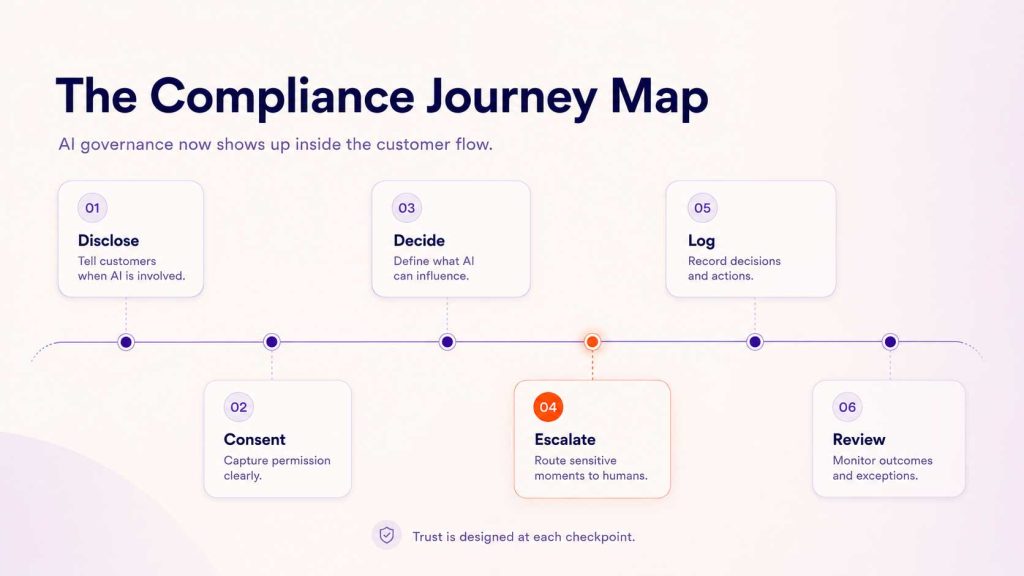
Where does AI enter the journey? What data does it use? What decision does it influence? What does the customer need to know? When should the system escalate? What should be logged? Who approves exceptions? What is the policy? What changes across regions, products, account tiers, and risk categories?
This is where a unified customer journey platform becomes important. The issue is not only whether each workflow works in isolation. The issue is whether the entire customer journey can carry context, policy, consent, escalation, and accountability from one step to the next.
If sales, product, support, success, legal, data, and operations all work from different rules, the customer feels the gap. If each team has its own tools, approvals, dashboards, and exceptions, the business cannot prove what happened clearly. Compliance becomes a scavenger hunt. Trust becomes fragile.
Where B2B AI journeys usually break.
The first break happens in sales. AI qualifies leads, scores accounts, summarizes intent, drafts outreach, or recommends next actions. But if the data is incomplete, the scoring logic is unclear, or the approval path is missing; RevOps inherits the mess.
The second break happens onboarding. AI can personalize setups, guide users, suggest workflows, and answer product questions. But if customers do not understand what is automated, what is stored, and when a human steps in, trust weakens during the most fragile phase of adoption.
The third break happens in support and customer success. AI can triage tickets, route cases, detect churn risk, and recommend interventions. But if sensitive accounts are treated like standard tickets, if escalation rules are weak, or if customer context is scattered, automation becomes risk with a friendly interface.
The fourth break happens in governance. A policy management system may define the rule, but if the CRM, support tool, product workflow, success platform, and audit trail do not carry that rule into daily execution, the business still cannot prove what happened, why it happened, who controlled it, and what changed.
What B2B leaders should fix now.
First, map the AI touchpoints across the full customer journey: sales, onboarding, product usage, support, customer success, renewals, expansion, and account management.
Second, define what each AI system is allowed to do: inform, recommend, draft, route, trigger, approve, or act. These carry different levels of risk.
Third, connect risk & compliance management to journey design. Risk cannot be managed only in a document if the customer experiences it inside the product.
Fourth, build clear disclosure and consent moments. Customers do not need legal clutter, but they do need to understand when AI is involved and what it means for them.
Fifth, design escalation rules for sensitive moments: enterprise accounts, complaints, pricing decisions, regulated customers, renewal risk, support failures, and exceptions.
Sixth, make the journey auditable. Audit management is not just about having records. It is about being able to trace what the AI used, what it recommended, what action was taken, who approved it, and what happened next.
This is what separates AI adoption from AI readiness.
Where Weaddo can be Instrumental?
Weaddo helps B2B companies connect the operating layer behind AI-enabled customer journeys. This includes customer data, CRM, workflow logic, content, automation, approval paths, dashboards, governance, and intelligence.
For CIOs and CTOs, Weaddo helps connect the systems and data AI depends on. For Digital Transformation Heads, it helps turn AI ambition into governed execution. For RevOps and Customer Success, it helps connect customer context, workflow automation, escalation rules, and visibility. For Product and CX leaders, it helps make compliance part of the experience instead of a blocker added after launch. For Legal and Compliance, it helps make governance visible inside the journey, not buried inside policy folders.
The goal is not to slow innovation. The goal is to stop innovation from becoming operational risk. Weaddo helps businesses move toward a connected AI-ready enterprise platform where customer journeys are unified, workflows are intelligent, and governance is designed into the way the business operates.
That is the grown-up version of AI transformation: not more tools, not more PDFs, not more manual approvals, but a connected journey that customers can understand, teams can operate, and leadership can trust.
The rule is simple.
Compliance is no longer just a legal checkpoint. It is now part of the B2B customer journey. If AI is inside your product, sales motion, onboarding flow, support process, success workflow, or renewal journey, then disclosure, consent, escalation, logs, policy logic, review, permissions, and accountability must be inside the journey too.
The companies that win will not be the ones that ship AI fastest and patch the risk later. They will be the ones that build AI journeys customers can understand, teams can operate, and regulators can inspect.
Where does your growth stop? For many B2B companies, it stops where AI ambition outruns operating readiness. To Bridge the Future Gap, the business needs to become Unified. Intelligent. Ready. Unified, so customer context and policy logic travel. Intelligent, so signals turn into better decisions. Ready, so AI can scale without creating trust debt.
What to do now?
Talk to Weaddo to identify where your AI-enabled customer journeys need stronger orchestration, clearer governance, better escalation, and a connected operating layer before they scale.






Leave a Reply