

The Adtech Middleman Trial Will Rewrite the E-Commerce Growth Stack
The biggest e-commerce growth story may not be another AI launch.
AI gets the attention because it is shiny, dramatic, and easy to package into launch videos. But one of the bigger growth stories for e-commerce is happening in a less glamorous place: adtech pressure, antitrust scrutiny, and the future of the middle layers that decide how digital advertising actually works.
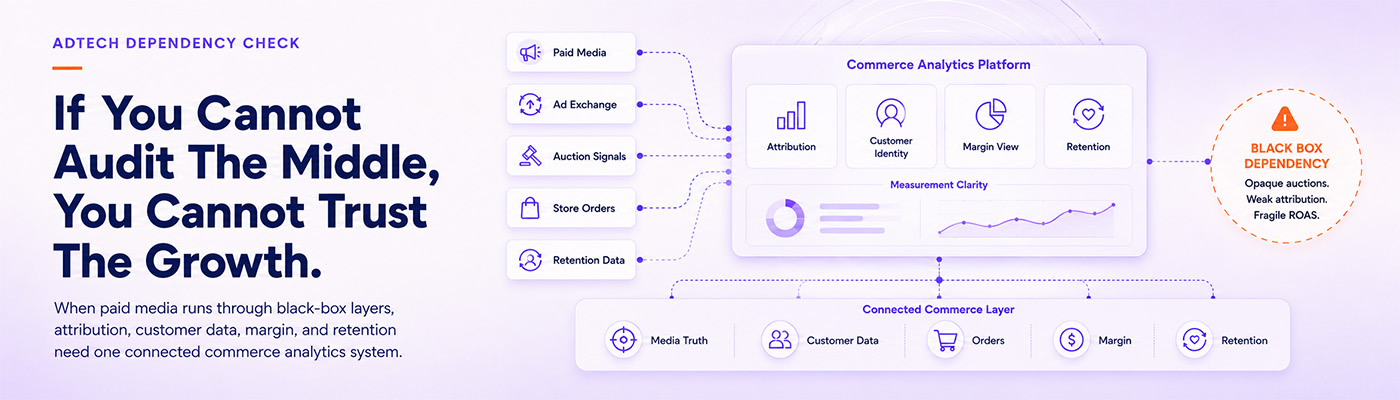
For e-commerce brands, this is not just a legal story. It is a growth stack story. Paid media, ad exchanges, auction dynamics, measurement, publisher access, platform dependency, attribution, and pricing power all affect how customer acquisition works. If the tollbooth changes, the growth stack changes with it.
That matters for every Head of E-commerce who depends on paid acquisition to drive traffic, orders, repeat purchase, and revenue. If your brand cannot explain how media spend turns into customers, how platform signals connect to owned data, or how attribution survives platform turbulence, growth is sitting on rented infrastructure.
The uncomfortable truth is simple: adtech plumbing feels boring only while it works. When the rules shift, the brands with a connected commerce analytics platform and cleaner growth architecture will move faster than brands waiting for dashboards to tell them what already broke.
Adtech is the plumbing nobody wants to understand until ROAS gets weird.
E-commerce teams often think in campaign terms: audience, creative, bid, product page, cart, checkout, conversion, repeat purchase. Under that visible layer sits a dense network of intermediaries deciding how ads are bought, sold, priced, routed, measured, and monetized.
Complexity is not automatically bad. But opacity is expensive. When e-commerce teams cannot clearly see how money moves, who takes what cut, what inventory is actually being bought, which signals influence delivery, and which systems control visibility, media strategy becomes partly a guessing game with dashboards.
The issue is not that middlemen exist. The issue is when the middle becomes the market. For a commerce brand, that means your growth engine may depend on infrastructure you cannot fully audit, explain, or replace.
That is where growth stops. Not at the ad creative. Not at the product page. Not even at checkout. It stops where the brand cannot see which parts of the acquisition engine are driving real customers, real orders, repeat purchase, and margin.
Why this matters for e-commerce, not just publishers.
It is easy to treat adtech antitrust pressure as a publisher problem or Big Tech drama. That is lazy. E-commerce brands are exposed to the same architecture through media buying, auction pricing, measurement quality, platform dependency, and customer acquisition cost.
If remedies, market pressure, or platform changes alter interoperability, auction transparency, data flows, inventory access, or platform bundles, e-commerce teams may need to rethink how they buy, measure, and govern growth. Performance marketing will not disappear. But the operating assumptions behind it may change.
The useful anxiety is this: if your growth model depends on intermediaries, you cannot explain, audit, or replace, that is not scale. It is dependency with better reporting.
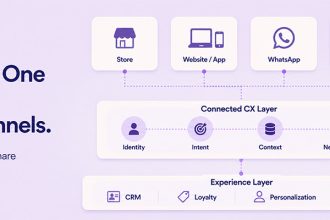
This is why a commerce orchestration platform matters. E-commerce growth is no longer just about buying media and sending traffic to a store. It is about connecting media, product discovery, customer data, inventory, order behavior, CRM, retention, support, returns, and margin signals into one operating layer.
The biggest e-commerce growth story may not be another AI launch.
AI gets the attention because it is shiny, dramatic, and easy to package into launch videos. But one of the bigger growth stories for e-commerce is happening in a less glamorous place: adtech pressure, antitrust scrutiny, and the future of the middle layers that decide how digital advertising actually works.
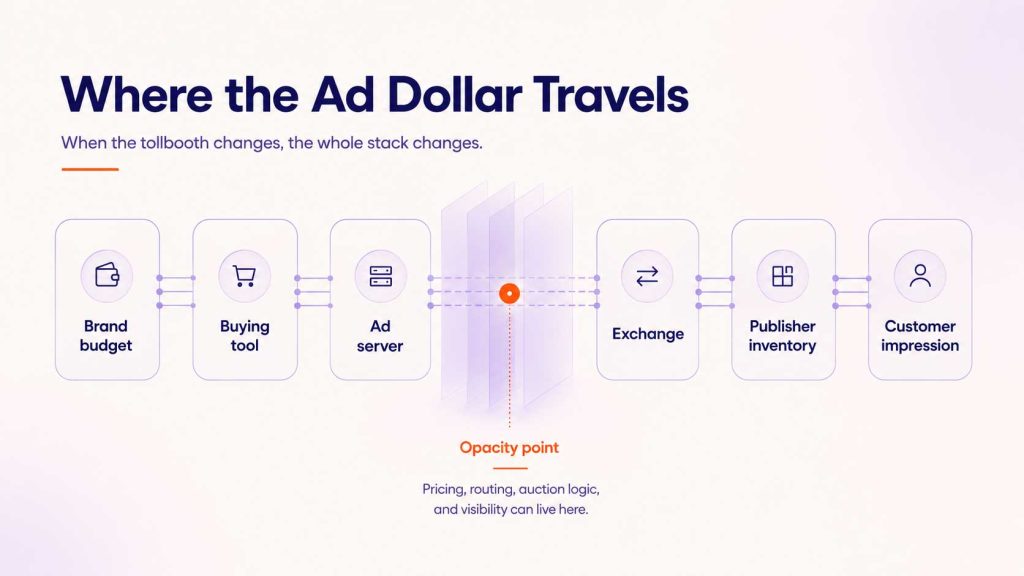
For e-commerce brands, this is not just a legal story. It is a growth stack story. Paid media, ad exchanges, auction dynamics, measurement, publisher access, platform dependency, attribution, and pricing power all affect how customer acquisition works. If the tollbooth changes, the growth stack changes with it.
That matters for every Head of E-commerce who depends on paid acquisition to drive traffic, orders, repeat purchase, and revenue. If your brand cannot explain how media spend turns into customers, how platform signals connect to owned data, or how attribution survives platform turbulence, growth is sitting on rented infrastructure.
The uncomfortable truth is simple: adtech plumbing feels boring only while it works. When the rules shift, the brands with a connected commerce analytics platform and cleaner growth architecture will move faster than brands waiting for dashboards to tell them what already broke.
Adtech is the plumbing nobody wants to understand until ROAS gets weird.
E-commerce teams often think in campaign terms: audience, creative, bid, product page, cart, checkout, conversion, repeat purchase. Under that visible layer sits a dense network of intermediaries deciding how ads are bought, sold, priced, routed, measured, and monetized.
Complexity is not automatically bad. But opacity is expensive. When e-commerce teams cannot clearly see how money moves, who takes what cut, what inventory is actually being bought, which signals influence delivery, and which systems control visibility, media strategy becomes partly a guessing game with dashboards.
The issue is not that middlemen exist. The issue is when the middle becomes the market. For a commerce brand, that means your growth engine may depend on infrastructure you cannot fully audit, explain, or replace.
That is where growth stops. Not at the ad creative. Not at the product page. Not even at checkout. It stops where the brand cannot see which parts of the acquisition engine are driving real customers, real orders, repeat purchase, and margin.
Why this matters for e-commerce, not just publishers.
It is easy to treat adtech antitrust pressure as a publisher problem or Big Tech drama. That is lazy. E-commerce brands are exposed to the same architecture through media buying, auction pricing, measurement quality, platform dependency, and customer acquisition cost.
If remedies, market pressure, or platform changes alter interoperability, auction transparency, data flows, inventory access, or platform bundles, e-commerce teams may need to rethink how they buy, measure, and govern growth. Performance marketing will not disappear. But the operating assumptions behind it may change.
The useful anxiety is this: if your growth model depends on intermediaries, you cannot explain, audit, or replace, that is not scale. It is dependency on better reporting.
This is why a commerce orchestration platform matters. E-commerce growth is no longer just about buying media and sending traffic to a store. It is about connecting media, product discovery, customer data, inventory, order behavior, CRM, retention, support, returns, and margin signals into one operating layer.
The mistake is waiting until the verdict hits the dashboard.
Many e-commerce teams wait until platform changes show up in CAC, ROAS, attribution, or conversion reporting. That is how every structural shift gets misdiagnosed as a campaign problem, a creative issue, or another mysterious algorithm update.
The smarter move is scenario planning. What happens if buying and selling tools become more separated? What happens if auction transparency improves? What happens if measurement signals shift again? What happens if platform bundles lose some gravity? What happens if publisher leverage changes? What happens if nothing dramatic changes legally, but scrutiny keeps rising and the ad ecosystem keeps moving anyway?
E-commerce leaders do not need to become lawyers. But they do need to know where acquisition depends on infrastructure the brand does not control.
A retail customer data platform, retail CDP platform, or customer data platform retail becomes more important in this environment because owned customer data gives the brand more control. It does not eliminate paid media dependency, but it reduces blind dependency. It helps the business understand which customers came in, what they bought, whether they returned, what they cost to acquire, and whether the relationship was worth it.
A better media stack is less enchanted by black boxes.
The fix is not abandoning paid media. That would be theatre. The fix is building a commerce growth model that can survive platform turbulence.
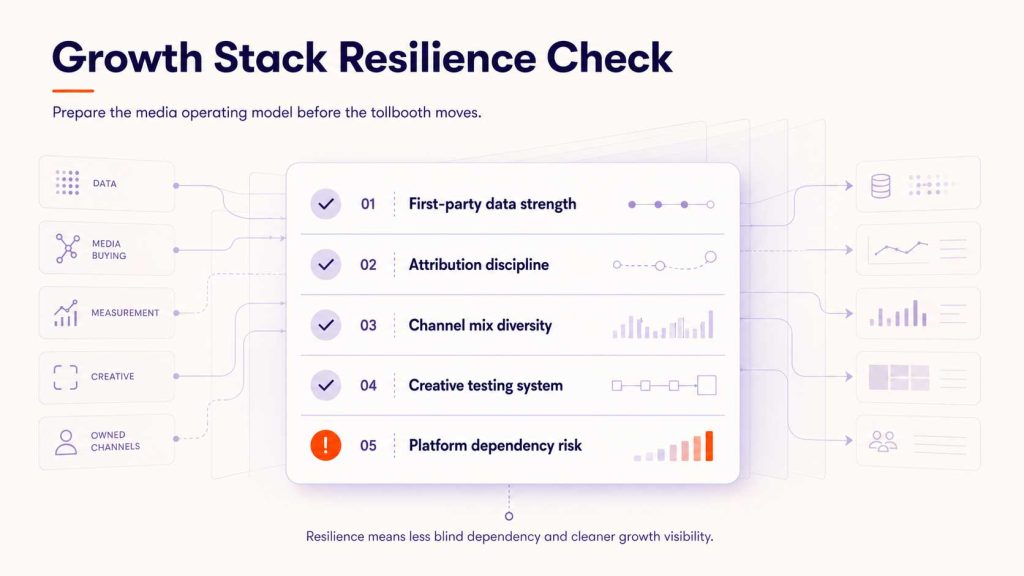
That means stronger first-party data, cleaner conversion architecture, better creative testing, stronger product feed discipline, more channel diversification, clearer incrementality thinking, better landing page and PDP intelligence, stronger retention journeys, and a sharper understanding of where the brand is paying rent versus building assets.
If your growth stack only works when the middle layer stays opaque and friendly, it is not a strategy. It is a dependency with good screenshots.
This is where a commerce analytics platform earns its place. It should help the business answer harder questions: which channels create profitable customers, which products drive repeat purchase, which campaigns create margin instead of just traffic, where returns damage paid acquisition, where support affects retention, and where the customer journey breaks after the click.
Where e-commerce growth usually leaks when media gets shaky.
The first leak is attribution. The ad platform reports performance, the store reports orders, CRM reports retention, finance reports margin, and leadership is left trying to reconcile different truths.
The second leak is customer identity. A shopper may arrive through paid search, social, marketplace, affiliate, influencer, email, WhatsApp, or organic search. If these signals do not connect into a customer 360 platform retail or shopper 360 platform, the brand cannot clearly see the customer journey.
The third leak is post-purchase. Paid media may create the first order, but delivery, support, returns, product experience, replenishment, loyalty, and retention decide real value. If those signals sit outside the media view, the brand keeps optimizing for acquisition while ignoring lifetime economics.
The fourth leak is operations. Inventory, offers, pricing, fulfilment, returns, and product availability all affect campaign performance. If marketing does not see operational reality, the brand spends money driving demand into friction.
This is why e-commerce growth needs a connected ecommerce operations platform, not just another media dashboard.
What e-commerce leaders should fix before the stack shifts.
- First, map the paid media journey from ad impression to product page, checkout, order, fulfilment, support, return, repeat purchase, and retention. Do not stop at ROAS. Follow the money until margin and customer value.
- Second, connect media performance to owned customer data. A retail customer insights platform, customer intelligence platform retail, and retail data intelligence platform should help the brand see which traffic becomes valuable to customers, not just which ads drive clicks.
- Third, reduce single-platform dependence. Diversify channels, but do not confuse diversification with scattering spend everywhere. Build a system where signals return to the brand and can be used across journeys.
- Fourth, tighten the commerce journey after the click. If product pages, inventory, checkout, support, returns, and retention are weak, no media strategy can fully save the economics. Use ecommerce automation platform thinking to connect follow-ups, replenishment, abandoned carts, post-purchase journeys, return recovery, loyalty, and customer service triggers.
- Fifth, build better workflow around growth decisions. Ecommerce workflow automation should not just automate emails. It should help teams act when campaigns overspend; products go out of stock, returns spike, support complaints to rise, or repeat purchase drops.
Where Weaddo fits.
Weaddo helps e-commerce and D2C brands prepare for a growth stack that is less dependent on black boxes and more connected across the customer journey. That means connecting media, customer data, product data, CRM, automation, analytics, content, support, returns, and retention into one operating layer.
For a Head of E-commerce, Weaddo helps connect acquisition to orders, margin, fulfilment, repeat purchase, and customer value. For a CMO or Growth Head, it helps reduce blind paid media dependency by connecting campaign signals with owned customer intelligence. For Retention and CRM teams, it helps turn first-order customers into repeat buyers through clearer segmentation and journey orchestration. For CIOs and CTOs, it helps create the integration and data foundation needed before AI and automation scale.
This is not about replacing paid media. It is about making the business less fragile when paid media changes. A connected omnichannel commerce platform, unified commerce platform retail, and commerce experience platform approach helps the brand carry customer context across paid, owned, earned, marketplace, support, loyalty, and retention journeys.
That is how e-commerce businesses become Unified. Intelligent. Ready. Unified, because media, customer, order, and retention signals connect. Intelligent, because teams see what is really driving profitable growth. Ready, because the brand can adapt when the adtech tollbooth moves.
The rule is simple.
The adtech middle layer may change. The market may become more transparent, more fragmented, more regulated, or simply more complicated. But e-commerce brands do not need to wait for the final verdict to prepare.
Before the tollbooth moves, map how much of your growth depends on it.
If your acquisition engine only works when paid media platforms explain themselves, your growth model is fragile. If your customer data, attribution, retention, product data, and commerce operations do not connect, platform turbulence will hit harder.
Where does your growth stop? It may stop where paid media creates demand but the commerce operating layer cannot carry it into profitable, repeatable customer growth.
The e-commerce brands that win the next stage will Bridge the Future Gap by building growth systems with stronger owned data, clearer attribution, connected journeys, and less blind dependency on middlemen.
What to do Next?
Talk to Weaddo to identify where your e-commerce growth stack depends too heavily on paid media black boxes, and how to connect media, customer data, commerce operations, automation, analytics, and retention into one future-ready operating layer.





Leave a Reply