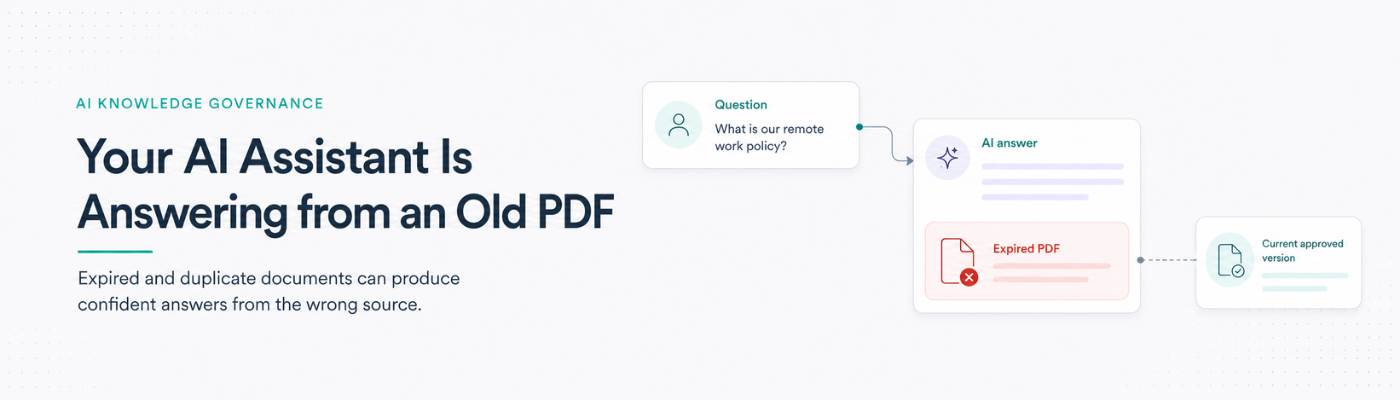
Your AI Assistant Is Answering from an Old PDF
An employee asks the company’s AI assistant a straightforward question: “What documents are required for this application?”
The assistant responds immediately. The answer is clear, confident and wrong.
It has retrieved the requirement from a policy PDF that expired eight months ago. A newer version exists, but it is stored in another folder with a different filename. The old document was never marked as withdrawn, so the AI treated both versions as valid.
The problem is not that the AI failed to read the document. It read the wrong document perfectly.
This is what happens when businesses introduce AI before establishing AI knowledge governance.
AI Does Not Know Which File Your Company Considers Official
Most AI assistants do not understand organizational authority automatically. They retrieve information from the sources they can access and generate an answer based on what appears relevant.
If the system contains four versions of the same policy, the AI needs rules that distinguish:
- Draft from approved
- Current from expired
- Global from regional
- Internal from customer-facing
- General guidance from legally binding policy
- Master document from downloaded copy
Without those rules, relevance can be mistaken for authority.
The newest file may not have the clearest title. The approved policy may sit deeper inside a restricted folder. An outdated document may contain stronger keyword matches than the current version. A locally edited copy may look more specific than the official master.
An enterprise AI knowledge base is not reliable simply because many documents have been uploaded. It becomes reliable when the organization can identify which documents are valid, who owns them and when they should be used.
The Documents Most Likely to Produce Wrong Answers
The greatest risk usually comes from information that changes regularly but remains copied across systems.
Common examples include:
- Policies and circulars
- Standard operating procedures
- Product specifications
- Price lists and offers
- Eligibility rules
- Service terms
- Employee guidelines
- Sales presentations
- Compliance FAQs
- Application and onboarding requirements
A policy may exist in the intranet, a shared drive, an email attachment, a departmental folder and an employee’s desktop. Updating the master does not update every copy.
The AI may therefore find several answers to the same question. Without AI document governance, it cannot reliably know which one the organization still stands behind.
A Confident Answer Can Hide a Weak Source
Traditional search results show users a list of documents. The user can inspect titles, dates and sources before choosing one.
AI assistants often collapse that process into a single response. This is convenient, but it can hide uncertainty.
The answer may sound authoritative even when it was generated from:
- An expired document
- An unapproved draft
- A file without an owner
- A regional policy applied globally
- A duplicated document with conflicting content
- A presentation that summarized the policy incorrectly
- A scanned PDF with missing pages
- A document the user was not meant to access
This is why AI content accuracy cannot be assessed only by checking whether the generated sentence is grammatically correct. The organization must also check whether the source was current, approved and applicable.
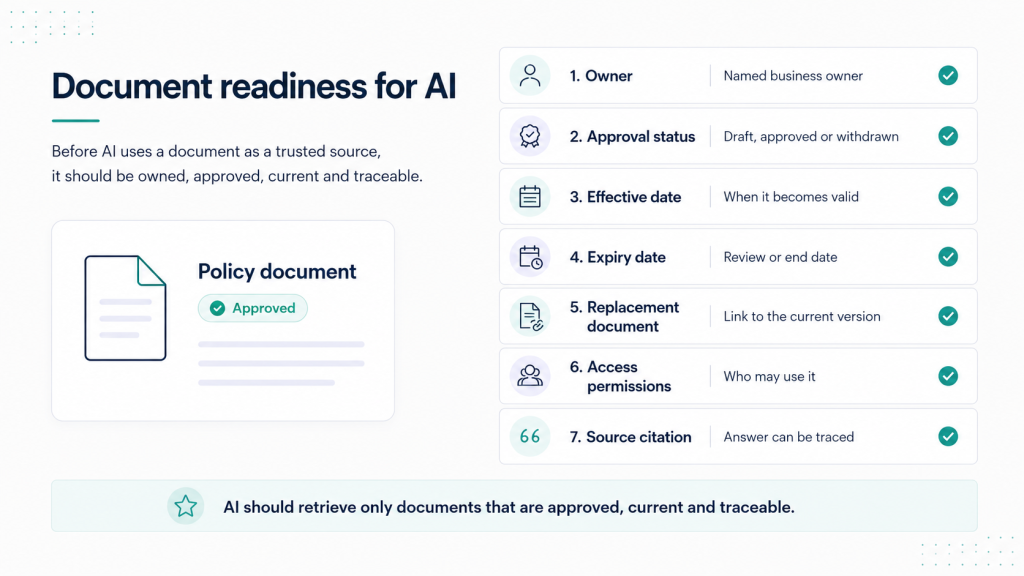
Seven Questions to Ask Before Connecting AI to Internal Documents
Before adding a document collection to an AI assistant, the business should answer seven questions.
- Who owns the document?
Every important document needs a named business owner responsible for accuracy, review and replacement. “Operations” or “HR” is not enough if no individual role is accountable.
- Is it approved?
The system should distinguish drafts, review copies, approved versions, published versions and withdrawn documents. An AI assistant should not treat every accessible file as approved knowledge.
- When did it become effective?
Approval date and effective date may differ. A policy approved today may apply from next month. The AI needs the date on which the document becomes authoritative.
- When does it expire or require review?
Policies, prices, offers and procedures should carry expiry or review dates. A document without a lifecycle can remain searchable long after the business has stopped using it.
- Which document replaced it?
When a new version is published, the old version should point to its replacement and be removed from normal retrieval. This is a core requirement of AI document governance.
- Who may access it?
The AI should respect employee roles, departments, regions and customer permissions. Shared knowledge does not mean unlimited access.
- Can the answer be traced?
The user should be able to see which approved source supported the answer. Traceability is essential for retrieval-augmented generation governance, especially when the answer affects customers, compliance, payments or operational decisions.
Folder Cleanup Is Not Enough
Many organizations respond by running a one-time document cleanup. They delete obvious duplicates, rename files and create a “final approved” folder.
That helps, but it does not create a sustainable process.
New versions will still be created. Policies will change. Teams will download files. Agencies will retain copies. Employees will produce summaries. Regional variations will appear. Unless creation, review, publication, replacement and archive are governed continuously, the same problem returns.
Effective knowledge management for AI requires a document lifecycle:
- A document is created by a named owner.
- It moves through the correct review process.
- Approval status and applicable audience are recorded.
- Effective and expiry dates are assigned.
- The approved version is published to the correct knowledge source.
- The previous version is withdrawn from normal retrieval.
- AI access and answer usage are monitored.
- The document returns for review when required.
The objective is not a perfectly clean folder. It is a knowledge system that remains current as the business changes.
What Governed AI Retrieval Should Look Like
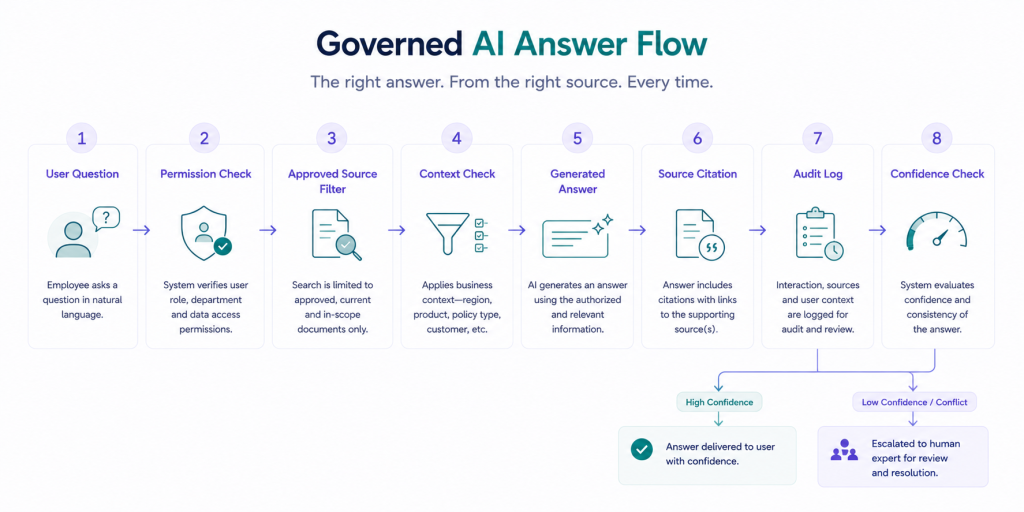
A reliable process should work like this:
- The user asks a question.
- The system checks the user’s access rights.
- The system searches only approved and currently effective sources.
- Regional, departmental or customer context is applied.
- The AI generates an answer from the authorized material.
- The answer displays or links to the supporting source.
- The interaction is logged for review.
- Low-confidence or conflicting results are escalated to a human.
This is the practical side of retrieval-augmented generation governance. It is not only about connecting an AI model to documents. It is about controlling which documents may influence the answer.
Start with One Controlled Knowledge Domain
Do not begin by connecting the AI assistant to every company folder.
Choose one area where documents are important, ownership is clear, and outcomes can be reviewed. Good starting points include:
- One employee-policy category
- One product line
- One customer-service process
- One branch-operations manual
- One set of onboarding documents
- One regulated service
- One sales-support knowledge area
For that domain, identify every active document, remove or restrict obsolete copies, assign owners and define approval and expiry rules. Then test whether the AI retrieves the correct source across common and unusual questions.
This produces stronger enterprise AI readiness than uploading thousands of uncontrolled files and hoping the model can sort them out.
Measure More Than Answer Speed
AI programmes often measure response time, usage and employee adoption. Those metrics do not prove that the answers are safe.
Add measures such as:
- Percentage of answers linked to approved sources
- Number of conflicting documents found
- Expired documents retrieved
- Answers requiring human correction
- Documents without owners
- Sources overdue for review
- Permission violations prevented
- Questions the assistant could not answer confidently
- Recurring questions with no approved content
These measures turn AI content accuracy into an operational responsibility rather than a vague quality goal.
Where Does Your Growth Stop?
Growth may stop when a salesperson gives the wrong product information, when a service agent quotes an expired policy or when an employee follows an outdated process generated by AI.
The AI did not create the inconsistency. It scaled the inconsistency that already existed.
WeAddo’s Operations Suite, Data Suite and Governance Foundation address this underlying problem through document governance, asset centralization, knowledge management, access controls, data transformation and system reliability. The platform positioning is clear: businesses cannot become AI-ready while their content, data and workflows remain fragmented.
The question is not whether the AI can answer quickly.
The question is whether the organization can prove that the answer came from the correct version of the truth.
Conclusion
An AI assistant is only as trustworthy as the knowledge it is allowed to use.
A dependable enterprise AI knowledge base needs document owners, approval status, effective dates, expiry rules, replacement links, permissions and source traceability. Strong AI knowledge governance ensures that current and approved information influences the answer. Practical AI document governance prevents old files from remaining quietly authoritative. Effective knowledge management for AI keeps the source material current as the organization changes.
Before connecting another folder to AI, choose one important question and trace every document that could answer it. If the business cannot identify the official source, the AI will not solve that uncertainty.
It will answer from it.
Audit one AI use case and identify every accessible document that has no owner, approval status or expiry date.
AI knowledge governance is the process of controlling which documents, data and knowledge sources an AI system may use, including ownership, approval, permissions, validity and traceability.
An AI assistant may retrieve outdated files when old and current documents remain accessible without clear metadata, expiry rules or AI document governance.
An enterprise AI knowledge base is a governed collection of approved organizational information that AI systems can retrieve according to user permissions and business context.
Retrieval-augmented generation governance controls the sources an AI system retrieves, how access is applied, how answers are cited and how conflicts or low-confidence results are handled.
Businesses can improve AI content accuracy by removing expired sources, assigning document owners, recording approval status, enforcing access controls and requiring source citations.




Leave a Reply