SaaS Sprawl Is Not a Tech Problem. It Is a Customer Journey Problem.
by
vikas weaddo
SaaS sprawl is usually described as a technology or procurement problem: too many subscriptions, duplicated tools, unmanaged licences and security risk. For a CMO, there is another cost that is easier to feel and harder to see. When customer journeys cross fragmented systems, teams spend time waiting, copying, chasing, and reconciling. The software may work individually while the journey between tools becomes slow and expensive.
The tools are not necessarily the problem
Most software gets bought for a sensible reason. A team needs a better CRM, a faster form builder, a specialist analytics product, a project tool or a commerce service. Point solutions can be excellent. The issue starts when the business assumes that a collection of good tools automatically creates a good operating system.
IBM describes SaaS sprawl as the unchecked proliferation of SaaS products and links it to inefficient workflows, data silos, waste and risk. The useful marketing question is narrower: what does the customer experience pay when the business has to coordinate across disconnected systems manually?
A lead submits a request in one tool. Someone exports it into another. A product choice is stored in a form of platform but does not reach the CRM. A campaign change needs an asset from a separate repository, an approval in email, and a developer ticket in another system. No single tool is “broken”. The cost appears in the spaces between them.
The hidden second bill
The first bill is visible: licences, implementation and support. The second bill is operational. It includes the hours people spend moving information, checking whether something happened, rebuilding context, resolving mismatched fields, and chasing approvals. It also includes the customer’s cost of waiting or repeating information.
That is the practical “fragmentation tax”. Fragmented systems create this tax when transitions require human effort that adds no customer value. The tax is not automatically a reason to consolidate every application. Sometimes the cheaper answer is to improve the journey between tools.
How SaaS sprawl becomes a customer journey issue
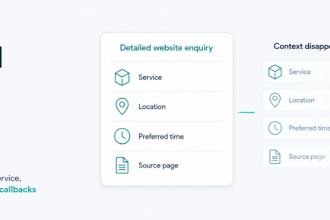
Picture a prospect who requests a demo from a campaign landing page. The form data enters one system, attribution data stays in another, routing happens in a CRM, and the follow-up is sent from an email platform. If the source context is lost, the salesperson starts to catch a cold. If the lead status is not sent back, marketing keeps nurturing someone already in conversation. If a field mapping fails, reporting undercounts campaign value.
This is why SaaS sprawl should be diagnosed through journeys, not application counts alone. Two organisations can have the same number of tools and very different levels of friction. The important variable is how many dependencies sit between customer action and business response.
Disconnected systems become commercially expensive when they create delays at high-frequency moments. One manual fix performed once a quarter may be harmless. The same fix performed hundreds of times a week can become a serious operational cost.
A fragmentation tax worksheet
Choose one customer-facing journey and map every system it touches. Then record: the transition, the person involved, what information moves, whether it moves automatically, what can go wrong, and how long the correction usually takes. Do not start with theoretical integration architecture. Start with observable work.
Ask seven questions.
Where is information copied manually?
Where does someone check another tool before acting?
Where is the same status recorded twice?
Where does the customer repeat information?
Where does a team wait for approval or access?
Where do reports need reconciliation?
Where does a failure create rework?
This makes fragmented setup measurable. It also stops the conversation from becoming “we need one platform for everything”. You may discover that only one transition is causing most of the pain.
Which KPIs matter?
Cycle time is the simplest: how long from customer action to useful business response? Manual touches per journey show how much coordination is required. Reconciliation time shows the cost of making reports agree. Dependency count shows how many people or systems must cooperate for a routine outcome. Duplicate-entry rate shows how often information is re-keyed.
Use those measures to understand SaaS sprawl from a business perspective. The goal is not to punish teams for adopting useful software. It is to identify repeated coordination costs and decide whether that cost is worth fixing.
When consolidation is the wrong first move
Replacing several applications can be expensive, risky, and slow. If the tools are performing their core jobs, a full consolidation programme may create more disruption than value. A better first question is whether the journey can be improved while the systems stay.
That is especially true when disconnected systems are connected poorly rather than inherently unsuitable. A focused integration, shared event, journey layer or workflow change may remove the expensive transition without forcing the business to relearn every tool.
Where WeAddo fixes this issue?
If customer-facing pages, forms, bookings, commerce or personalisation are the visible break, Experience Suite can improve that route around existing systems.
If the problem is internal tasks, approvals, or assets, Operations Suite may become relevant.
If the problem is visibility or context, Data Suite may be the next constraint.
This sequence respects the fact that fragmented setups can still contain good investments. The aim is to make the business act like one journey where it matters, then measure whether the change reduced delay or improved conversion.
A simple decision rule
Keep the tool if it does its job well. Fix the transition if the customer or team pays for the gap. Replace the tool only when its core capability, risk, or economics are the problem. That decision rule turns software sprawl from a vague technology complaint into a commercial prioritisation exercise.
No. A large SaaS portfolio can reflect legitimate specialist needs. SaaS sprawl becomes a problem when adoption is unmanaged or when the combined environment creates unnecessary cost, risk, workflow friction or data silos.
Not necessarily. Fragmented systems can often be improved through better integration, shared context, clearer ownership, or a journey layer. Consolidation should be justified by the problem, not treated as the default answer.
Disconnected systems can slow campaign changes, lose attribution context, create duplicate work, and make follow–up less relevant. The best evidence is your own journey data: response time, manual touches, reconciliation effort, and completion rates.
Take one journey with clear commercial value. Count every stop, person and manual fix between customer intent and outcome. That gives you a practical baseline for the cost of software to sprawl before you buy or replace anything.
Prioritise the expensive transitions
Not every gap deserves a project. Rank each transition by frequency, delay, and customer impact. A manual copy step that happens five times a month may be tolerable; the same step occurring hundreds of times can justify intervention. This is a better way to prioritise SaaS sprawl than counting applications alone. It also helps teams defend specialist tools that are working well while focusing attention on the fragmented systems that create repeated coordination costs. The goal is not to have fewer logos on an architecture slide. There are fewer expensive stops in a real journey.









Leave a Reply