Top Benefits of AI-Driven Healthcare Process Automation
by
vikas weaddo
Your hospital does not lose growth only in strategy meetings.
It loses growth in the waiting room.
In the missed reminder. In the delayed lab alert. In the discharge handoff. In the no-show, nobody recovered. In the follow-up call that never happened. In the billing query that moved between three desks before anyone owned it.
That is where growth stops.
AI-driven healthcare process automationhelps hospitals connect, trigger, route, remind, recover, escalate, and learn from everyday workflows. It is not magic. It is not a robot doctor. It is not a shiny AI layer added to broken operations.
It is a practical way to make healthcare workflows more unified, intelligent, and ready.
And for hospitals in India, where OPD volumes, call center dependency, appointment pressure, and patient expectations are rising, that matters.
The old way breaks because hospitals run on invisible manual work
Most hospitals are not short of hardworking teams.
They are short of connected workflows.
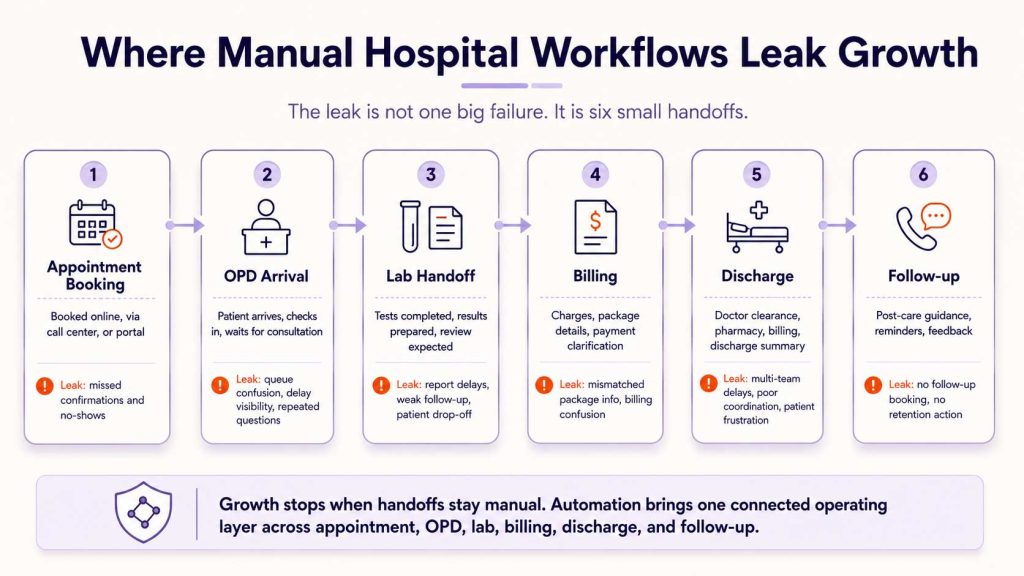
A patient books an appointment online. The slot is confirmed. The doctor’s schedule changes. The patient is not informed properly. The call center handles angry calls. The OPD queue gets overloaded. The patient waits. The experience drops.
Or a lab report is ready. The report sits in one system. The doctor is not alerted. The patient is not guided. The follow-up opportunity is missed.
Or an IPD patient is ready for discharge. Billing, pharmacy, nursing, insurance, and doctor clearance move at different speeds. The patient waits for hours. Nobody reports it as a growth issue.
But it is.
Because every delay trains patients to look elsewhere next time.
Manual workflows do not fail loudly. They leak quietly.
What is AI-driven healthcare process automation?
AI-driven healthcare process automation uses automation, rules, data signals, workflow triggers, and AI-assisted intelligence to reduce manual work across hospital operations and patient journeys.
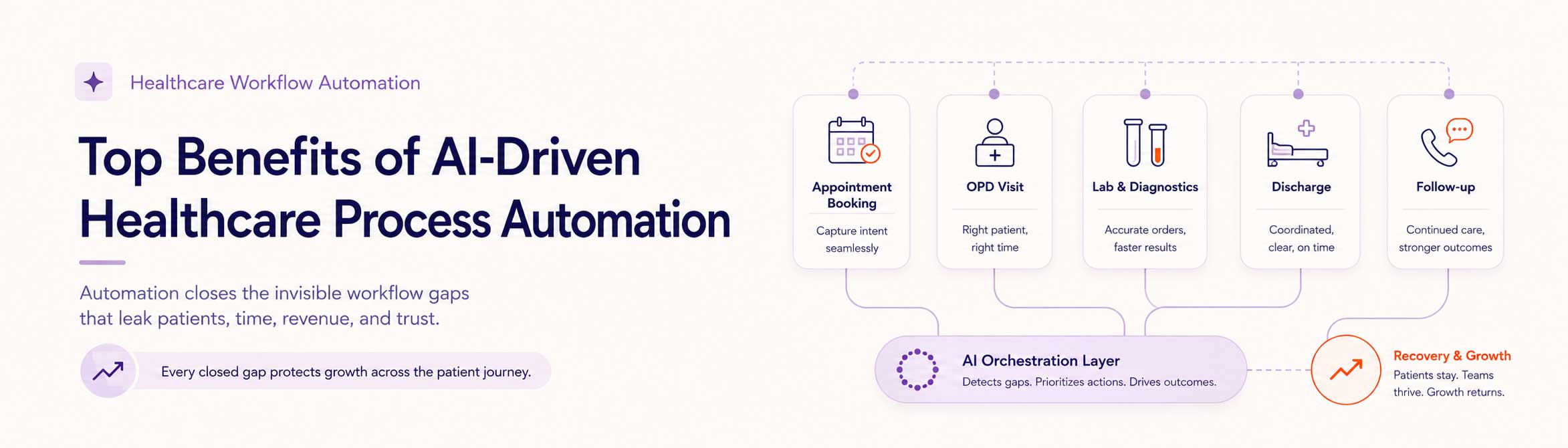
It can support workflows such as:
Appointment reminders
No-show prediction and recovery
OPD queue communication
Lab report alerts
Follow-up reminders
Discharge process coordination
Feedback collection
Patient reactivation
Campaign response routing
Call center task assignment
Billing query escalation
Doctor availability updates
Patient portal nudges
SOP-based task routing
The key is not automation alone.
The key is intelligent automation connected to systems, data, and operations.
A WhatsApp reminder is useful. But if it is not connected to appointment status, doctor schedule, patient history, CRM, and follow-up workflow, it is just a message.
That is not a transformation.
That is patchwork.
Top benefits of AI-driven healthcare process automation
1. Reduced no-shows and stronger appointment discipline
No-shows are not just empty slots.
They are lost capacity, lost revenue opportunity, and avoidable patient leakage.
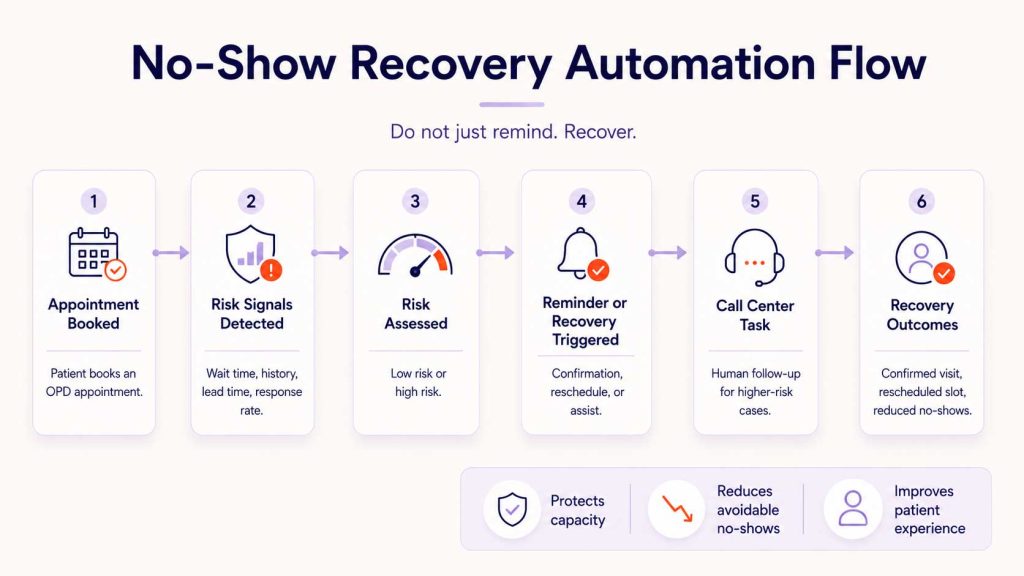
AI-driven healthcare process automation can help hospitals identify appointment risk signals and trigger reminders, confirmations, rescheduling options, and recovery workflows. For example, a patient who has missed previous appointments, has not confirmed the slot, or booked far in advance, may need a stronger reminder flow.
A basic reminder says, “Your appointment is tomorrow.”
A connected automation flow asks, “Are you coming, rescheduling, or needing help?”
That small difference changes the operating rhythm.
No-Show Problem
Manual Approach
Automated Approach
Patient forgets appointment
One SMS reminder
Multi-step reminder with confirmation
Patient cannot attend
Slot remains blocked
Reschedule option triggered
High-risk appointment
No early visibility
Risk-based reminder and call center task
Doctor schedule changes
Manual calls
Automated update and patient notification
Repeat no-shows
No pattern tracking
Patient-level journey intelligence
The patient does not care that scheduling, call center, and CRM are different systems.
They care whether the hospital respects their time.
2. Faster OPD movement and better patient communication
OPD queues are where digital promises meet physical reality.
A hospital may run brilliant campaigns, but if patients arrive and face confusion, the growth story collapses.
AI-driven healthcare process automation can help improve OPD flow through:
Pre-visit instructions
Digital check-in prompts
Token updates
Queue delay alerts
Doctor availability notifications
Department-specific routing
Post-consultation next-step reminders
This does not remove human care.
It removes unnecessary uncertainty.
When patients know where to go, what to carry, how long to wait, and what happens next, the hospital feels more organized.
The board sees growth.
The floor feels controlled.
3. Better lab report handoffs and follow-up completion
Lab report handoffs are a classic growth gap.
The test is done. The report is ready. But the patient does not know what to do next. The doctor may not see it quickly. The call center may not have context. The patient may go to another provider for interpretation.
That is leakage.
AI-driven automation can trigger:
Patient report-ready alerts
Doctor review tasks
Follow-up booking prompts
Abnormal-result escalation workflows
Care coordinator notifications
Patient education content based on test type
This is where automation becomes experience.
Not because it sends a message.
Because it closes the loop.
Workflow Gap
Patient Impact
Business Impact
Automation Fix
Report ready but not communicated
Anxiety and repeated calls
Call center load
Automated report-ready alert
No follow-up prompt
Patient delays care
Lost consultation opportunity
Follow-up booking trigger
Abnormal report not escalated
Clinical risk
Trust and safety concern
Priority workflow escalation
Doctor lacks visibility
Delayed decision
Poor experience
Review task creation
If the patient carries context, your systems are not connected.
The growth stop nobody reports: discharge delays
Discharge delays rarely appear in marketing dashboards.
But patients remember them.
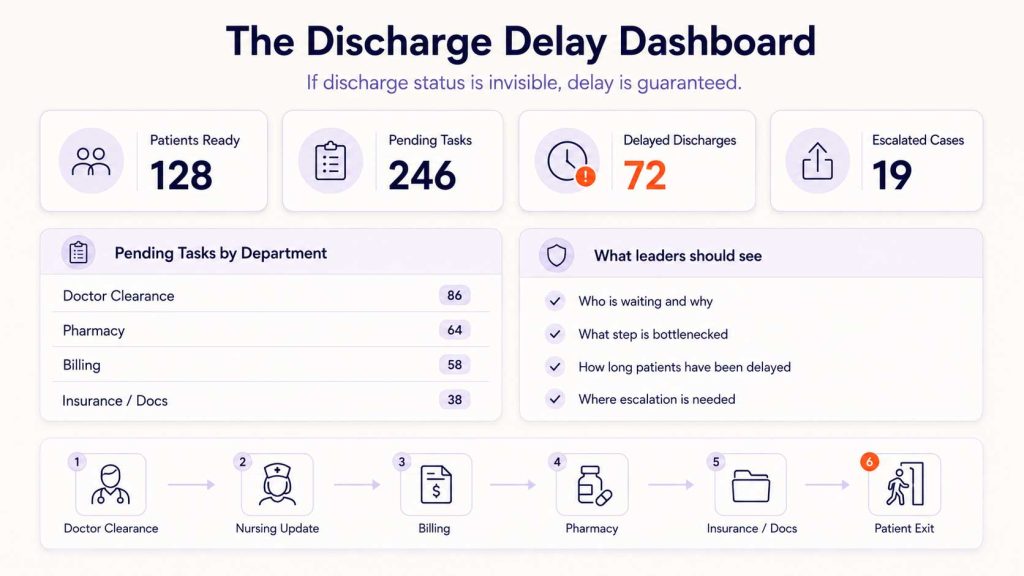
A discharge process may involve doctor clearance, nursing updates, pharmacy returns, billing, insurance, documentation, and patient communication. If each team works in isolation, the patient sits in uncertainty.
Automation can help coordinate discharge milestones by notifying the right teams, tracking pending tasks, escalating delays, and keeping the patient informed.
This is not just operational efficiency.
It is brand experience.
A patient can receive excellent clinical care and still leave frustrated because the last six hours were chaotic.
That frustration enters reviews, family conversations, and future decision-making.
Growth stops at the gap.
Healthcare workflow automation framework for CXOs
Before investing in automation, hospitals should identify workflows that are high-volume, repetitive, delay-prone, and patient-visible.
Use this framework:
Workflow Type
Good Automation Candidate?
Why
Appointment reminders
Yes
High-volume, repeatable, patient-facing
No-show recovery
Yes
Direct impact on capacity and leakage
Emergency clinical decision-making
Needs expert governance
High-risk, should not be blindly automated
Lab report alerts
Yes, with escalation rules
Improves follow-up and communication
Discharge coordination
Yes
Multi-team workflow with delay risk
Billing disputes
Partially
Routing and escalation can be automated
Medical diagnosis
Not as simple automation
Requires clinical oversight
Feedback collection
Yes
Standardized, measurable, journey-linked
The best automation strategy is not “automate everything.”
It is “automate where the gap is repetitive, visible, and expensive.”
The WeAddo way: automation connected to patient experience, data, and intelligence
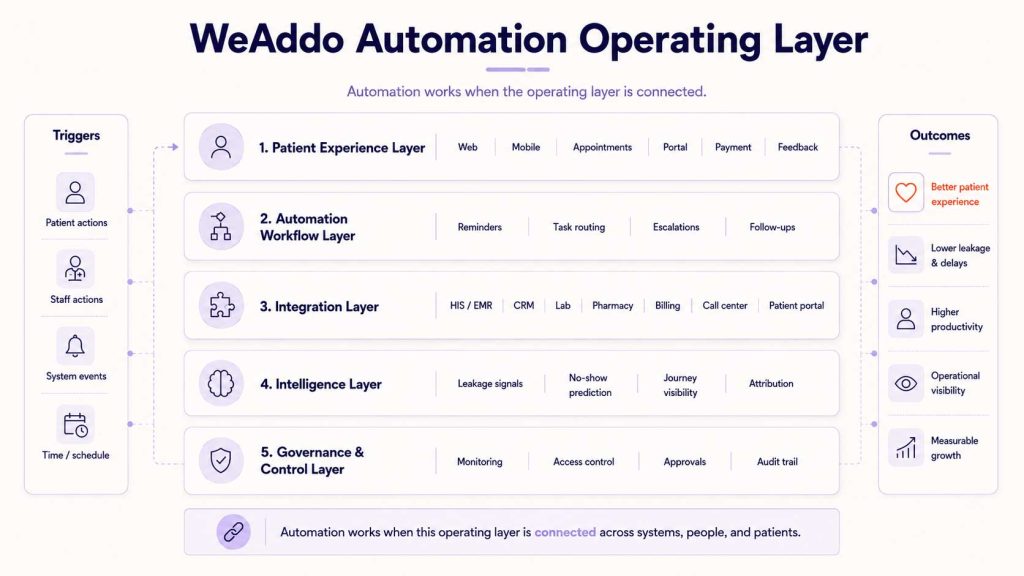
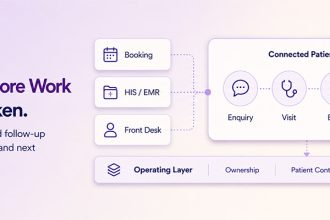
WeAddo helps healthcare businesses move from disconnected workflows to one connected operating layer.
For AI-driven healthcare process automation, this means automation is not treated as a standalone tool.
It connects to the larger hospital growth system.
The Automation Layer helps automate reminders, OPD/IPD workflows, no-show recovery, lab alerts, discharge flows, feedback, and follow-ups.
The Patient Experience Layer connects these workflows to web, mobile, appointment, portal, payment, feedback, and post-care journeys.
The Integrations Layer connects HIS, EMR, CRM, labs, pharmacy, billing, call center, telehealth, chatbot, and patient portal systems.
The Intelligence Layer gives leadership visibility into leakage, campaign performance, patient journeys, retention, attribution, and operational signals.
The Governance Layer adds monitoring, access control, audit trails, compliance readiness, and reliability.
That is the difference.
Not automation for activity.
Automation for visibility, recovery, and growth.
AI-ready, not AI-decorated.
Practical checklist: is your hospital ready for automation?
Use this checklist before implementing AI-driven healthcare process automation.
Question
Why It Matters
Are appointment, CRM, HIS, and call center systems connected?
Automation needs reliable triggers
Are patient records clean and deduplicated?
Poor data creates poor automation
Are workflow owners clearly defined?
Automation without ownership fails
Are escalation rules documented?
Delays need accountable routing
Are SOPs centralized?
Automation should follow approved processes
Are patients segmented by journey stage?
Different patients need different nudges
Can leadership see workflow performance?
What is invisible cannot improve
Are compliance and access controls defined?
Healthcare automation needs governance
If the report arrives tomorrow, the leak has already happened.
Automation should help leadership see the leak while it can still be fixed.
Key takeaways
AI-driven healthcare process automation is most useful when it fixes real workflow gaps.
No-shows, OPD delays, lab handoffs, discharge delays, and follow-up gaps are growth issues.
Healthcare workflow automation should connect with HIS, EMR, CRM, labs, billing, pharmacy, portal, and call center systems.
AI should not be placed on messy workflows without data quality and governance.
WeAddo helps hospitals unify automation, patient experience, integrations, intelligence, and governance into one operating layer.
FAQs
1. What is AI-driven healthcare process automation?
AI-driven healthcare process automation uses automation, workflow triggers, data signals, and AI-assisted intelligence to improve hospital processes such as appointments, reminders, lab alerts, discharge flows, follow-ups, and patient communication.
2. How is it different from basic healthcare workflow automation?
Basic workflow automation executes predefined tasks. AI-driven automation can use data patterns, patient signals, and operational context to support smarter prioritization, routing, recovery, and visibility.
3. Can automation reduce hospital no-shows?
It can help reduce avoidable no-shows by triggering reminders, confirmations, rescheduling options, and recovery workflows. Results depend on data quality, patient behavior, workflow design, and adoption.
4. Is AI-driven automation safe for hospitals?
It can be safe when applied to the right use cases with governance, access controls, monitoring, human oversight, and clear escalation rules. Clinical decision-making requires expert review and should not be treated as simple automation.
5. Which hospital workflows should be automated first?
Start with high-volume, repetitive, patient-visible workflows such as appointment reminders, no-show recovery, OPD communication, lab report alerts, discharge coordination, feedback, and follow-ups.
A Final Thought
Where does your growth stop?
If it stops at no-shows, manual follow-ups, OPD confusion, discharge delays, lab handoff gaps, or invisible workflow leakage, automation is not an optional decoration. It is an operational discipline.
Book a Meeting with us to know more about how WeAddo helps hospitals build AI-driven healthcare process automation across one connected operating layer.