The demo agent closed the deal. The real agent updated the wrong account.
A sales leader asks the CRM agent for a renewal brief.
The agent pulls account value from one record. Contract date from an old note. Support risk from nowhere. Decision-maker details from a contact nobody has updated since 2023. The summary looks confident. It is also wrong.
That is the problem with agentic CRM inside real businesses.
The agent can move fast. But speed is dangerous when the truth underneath is broken. In a demo, the data behaves. In an enterprise, the data argues with itself.
There are duplicate accounts.
Old fields.
Missing permissions.
Unclear owners.
Untracked exceptions.
Slack context.
Support tickets.
Finance rules.
Regional approval logic.
And customer history sitting in places the CRM cannot fully explain.
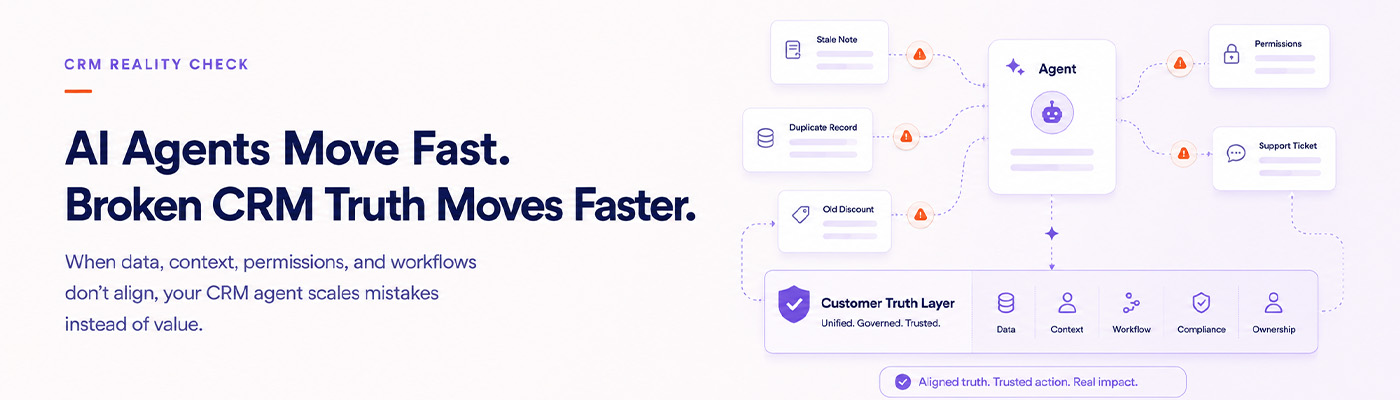
The problem is not that agents are useless. The problem is that many businesses are trying to make agents act before the customer truth layer is ready.
Growth stops where the business cannot trust its own customer data.
The agent era is real. The truth layer is not.
Let us be clear.
AI agents are not hype by default.
They can search.
Summarize.
Draft.
Route.
Update.
Trigger workflows.
Recommend next steps.
Detect risk.
Assist sales, marketing, service, and success teams.
That is useful. But only if the agent knows what truth to trust.
For a CRO, the risk is wrong pipeline visibility.
For a CMO, it is broken attribution.
For RevOps, it is workflow chaos at scale.
For Customer Success, it is missing churn signals.
For a CIO/CTO, it is permission, governance, and audit risk.
For the CEO, it is a business that looks AI-ready but cannot answer basic revenue questions reliably.
Agentic CRM does not fail only when the AI gets confused.
It fails when the business has not decided which data, workflow, and rulebook the AI should believe.
The lie companies tell themselves
The boardroom version says: “Agents will automate CRM work.”
The RevOps version says: “Great. But which field is trusted?”
The sales version says: “Can it update my opportunity?”
The compliance version says: “Not without permissions, approval logic, and audit trails.”
The AI hype version says: “The agent can take action.”
The business reality says: “Action on bad truth creates faster damage.”
That is the uncomfortable part. The agent did not hallucinate. It trusted the CRM.
That was the problem.
A business cannot become AI-ready by placing agents on top of bad data, broken handoffs, and unclear ownership. That is not transformation. That is giving admin access to confusion.
A short tour of the CRM junk drawer
1. The duplicate account problem
A sales manager asks the agent for the latest status on a key account. The agent finds three records.
One created by sales.
One created by marketing.
One created during a migration.
It picks the one with the latest activity: a bounced email campaign. The agent says the account is cold. The real deal is active under another record.
The agent was not lazy. It was lost inside the CRM junk drawer.
For B2B SaaS, this can distort pipeline.
For enterprise services, it can weaken account strategy.
For healthcare networks, it can fragment patient or partner relationships.
For EdTech, it can split learner, parent, counsellor, and payment history.
For e-commerce, it can break customer identity across order, support, and retention systems.
Different industry. Same issue. No single truth.
2. The discount that should not have happened
A rep asks the agent to recommend a renewal offer. The agent sees an old 20% discount and suggests matching it.
What it misses:
That discount was a one-time exception.
Finance approval was required.
Legal had flagged the account.
The new region follows different rules.
The customer now has a different contract structure.
This is where agentic CRM becomes risky. The agent did not just summarize. It recommended an action.
And action without business rules, permission design, and approval workflows is not intelligence. It is automation wearing a blindfold.
3. The churn signal nobody connected
A Customer Success leader asks which accounts are at risk. The agent checks CRM notes and finds nothing urgent. But the real risk is elsewhere.
An unresolved support ticket. A negative NPS comment. A billing complaint. Low product usage. A Slack thread where the CSM wrote, “They are getting frustrated.”
The truth was not missing. It was scattered.
This is why customer data architecture matters. If CRM, support, billing, product usage, marketing, and success data do not connect, agents cannot see the full relationship.
They can only act on the part of the truth they were allowed to reach.
The truth stack nobody wants to build
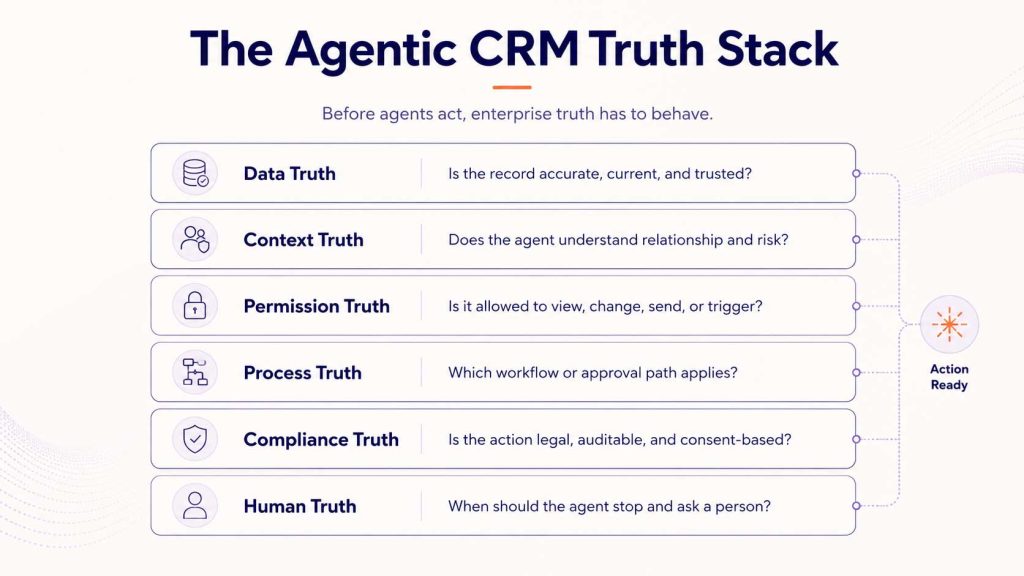
Before AI agents can act safely, the business needs a truth stack. Not just more fields. Not just cleaner dashboards. A real operating layer that tells the agent what is accurate, current, allowed, governed, and worth escalating.
Data Truth: Is the record accurate, current, deduplicated, and trusted?
Context Truth: Does the agent understand relationship history, customer risk, commercial value, and recent interactions?
Permission Truth: What is the agent allowed to view, change, send, trigger, or recommend?
Process Truth: Which workflow, SLA, escalation, or approval path apply?
Compliance Truth: Is the action legal, auditable, consent-based, and regionally valid?
Human Truth: When should the agent stop and ask a person?
This is the difference between a business that has agents and a business that is actually agent-ready.
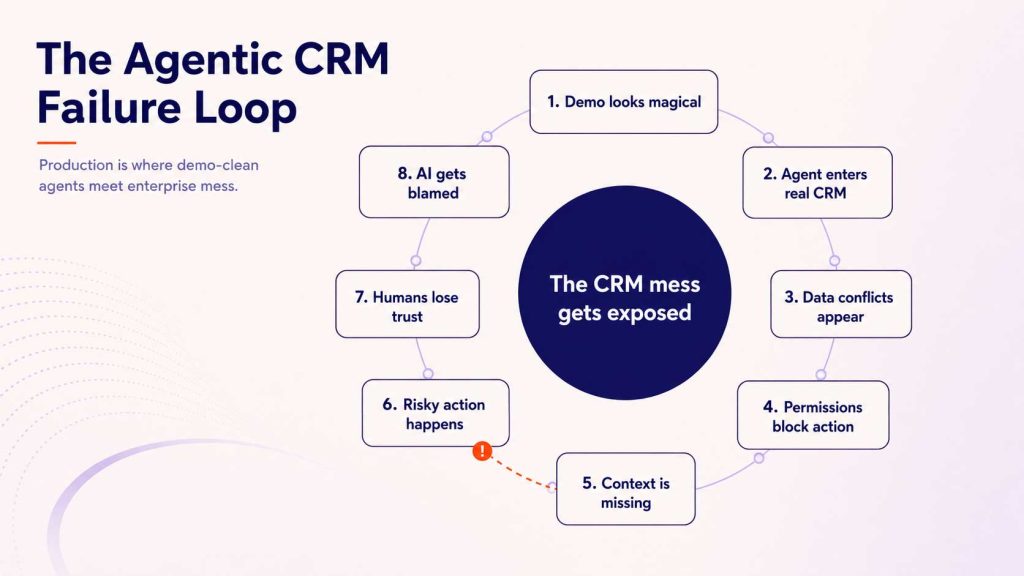
The failure loop is brutally predictable
The company launches a CRM agent. The demo looks magical. Then the agent enters real CRM.
Data conflicts appear.
Permissions block action.
Context is missing.
The agent makes a risky recommendation.
Humans lose trust.
Adoption drops.
Leadership blames AI.
But AI was not the first failure. The operating layer failed earlier.
What leadership saw: productivity.
What RevOps saw: bad data with admin confidence.
What the customer felt: another brand that does not know them.
The agent did not break the CRM. It exposed the mess CRM had been hiding.
Where this problem shows up by industry
1. B2B SaaS and Enterprise Sales
The CRM may show pipeline, but the real deal context is spread across calls, emails, demos, product usage, proposals, support tickets, and CS notes.
Weaddo Offers: Integrations, RevOps workflows, CRM governance, data warehousing, and intelligence dashboards help teams connect campaign, pipeline, onboarding, adoption, renewal, and expansion.
2. Healthcare
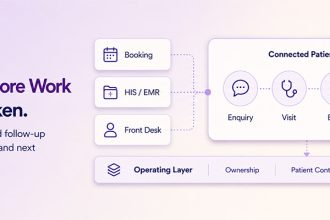
Hospitals, clinics, diagnostics chains, and wellness brands often have HIS, EMR, CRM, call centre, lab, pharmacy, billing, and patient communication systems working separately.
Weaddo Offers: Integration Hub, Unified Patient View, workflow automation, patient data platform, and BI dashboards help create connected patient and business context before AI is introduced.
3. E-commerce and D2C
Customer truth sits across ads, storefront, OMS, inventory, payment, delivery, support, returns, reviews, and retention platforms.
Weaddo Offers: Customer data unification, commerce workflow automation, marketing analytics, segmentation, and retention intelligence help brands connect demand to revenue and repeat purchase.
4. EdTech
Lead source, counsellor follow-up, demo status, payment, LMS activity, student progress, engagement, and renewal data often live in different systems.
Weaddo Offers: CRM integration, journey automation, learner segmentation, engagement intelligence, and retention dashboards help EdTech teams move from lead generation to learner growth.
Agentic CRM needs better plumbing, not less ambition
Weaddo should not sound cautious about agentic CRM.
The opportunity is real. But before brands give AI agents more action, they need the operating layer underneath to behave.
That means:
Source-of-truth rules
Permission design
Audit trails
Data quality
Workflow logic
Escalation triggers
Compliance boundaries
Human-in-the-loop controls
The future of CRM is not just agentic.
It is unified, intelligent, and ready.
Unified, because systems and data need to work from the same customer truth.
Intelligent, because leaders need signals they can actually act on.
Ready, because AI should only act when the business has designed the rules, context, and accountability behind the action.
Where Weaddo fits into the fix
At Weaddo, the better path is simple: Build the truth layer before the action layer.
That means connecting the systems, workflows, data, permissions, content, and intelligence that agents depend on.
Agents can help research, summarize, draft, route, enrich, detect risk, and suggest next-best actions. But humans still own judgment, exceptions, relationship nuance, sensitive accounts, strategic negotiations, and final accountability.
Weaddo helps businesses move from fragmented CRM activity to connected customer operations. Not by adding another tool into the stack. By helping the stack work as one operating layer.
That is how businesses become AI-ready without turning CRM into a faster source of confusion.
The rule is simple
If your CRM agent can send emails, update deals, trigger workflows, and recommend actions, but cannot tell which truth to trust; you have not built an intelligent revenue engine.
You have built a very fast intern with admin access. Before you give agents more action, audit the truth they are acting on.
Because growth stops where truth breaks.
And the businesses that win the next stage will not be the ones that rush agents into every workflow.
They will be the ones that Bridge the Future Gap by making their customer operations Unified. Intelligent. Ready.
So Ask Yourself..
Where does your growth stop?
If your CRM, customer data, workflows, and revenue teams are not working from the same truth, your AI agents will only move faster inside the mess.
Talk to Weaddo to identify where your customer truth layer needs to be connected before agentic CRM can scale.








Leave a Reply