Search Is Becoming Bookings: Why Your customer may decide before they reach your store.
by
vikas weaddo
Your customer may decide before they reach your store.
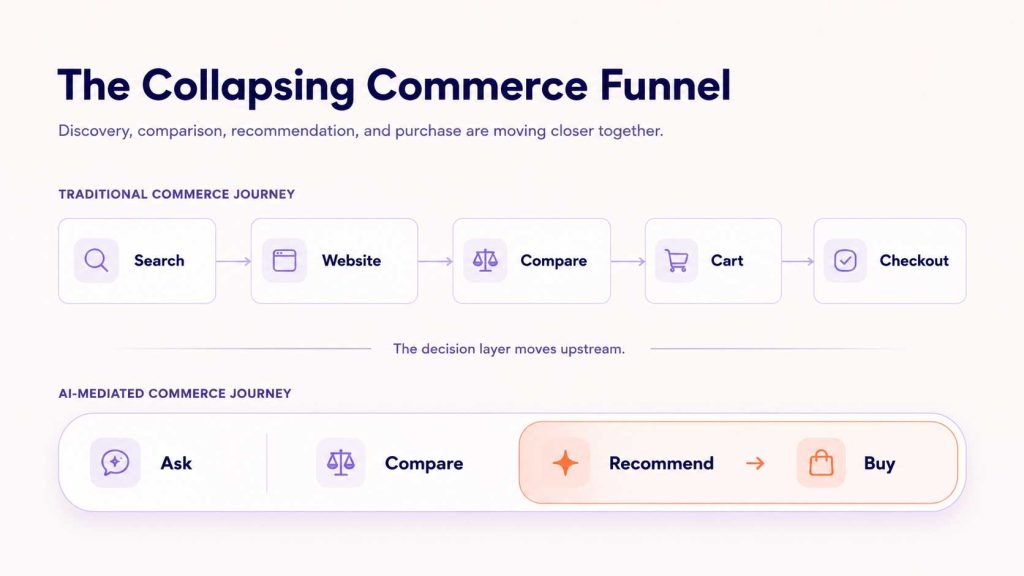
The old e-commerce journey was easy to understand. A customer searched, clicked an ad or organic result, landed on your product page, compared options, added to cart, and checked out if the experience held up. That model is not dead, but it is no longer the only journey that matters.
AI search is starting to compare products, summarize reviews, check fit, understand preferences, evaluate delivery, and recommend what to buy before the customer gives your website a full chance to persuade them.
For a Head of E-commerce, this is not just an SEO trend. It is a revenue problem. If the customer makes up their mind inside an AI answer, marketplace surface, chat interface, or shopping assistant, your store may become only one stop in a wider decision environment.
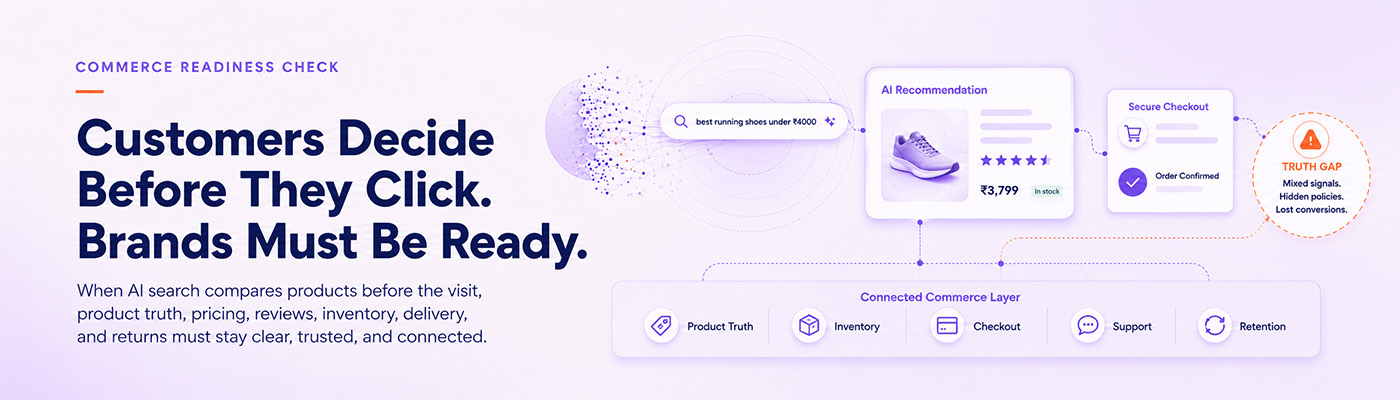
The dangerous part is simple: the customer may still buy from you, but the decision may happen somewhere else. That means your product truth, pricing, reviews, availability, delivery promise, return policy, and brand authority must be clear before the click.
Your website is no longer the only place where conversion happens.
Your website still matters. Product pages, collection pages, search, filters, cart, checkout, payment, offers, reviews, and post-purchase journeys still matter. But agentic commerce changes the pressure around them.
A customer may ask an AI assistant, “Which serum is best for sensitive skin under ₹1,500?” or “Which running shoes have the best reviews and fastest delivery?” The assistant may compare products, summarize pros and cons, pull review signals, check availability, and recommend a brand before the customer lands on your PDP.
That means the new competition is not only for traffic. It is for recommendation. Your brand has to be easy for machines and humans to understand, trust, compare, and act on. If your product feed says one thing, your website says another, your marketplace listing is outdated, your reviews are scattered, and inventory signals are unreliable, the AI layer will not create clarity for you. It will expose the mess faster.
The new game is recommendation readiness.
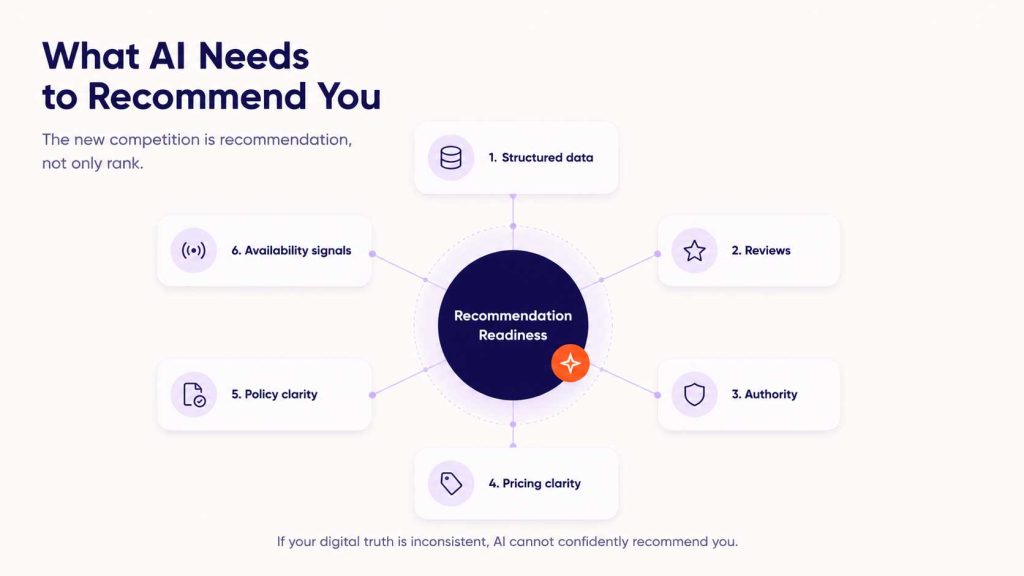
Traditional SEO asked, “Do we rank?” Agentic commerce asks a sharper question: “Would an AI shopping agent recommend us when the customer is not searching for us directly?”
That depends on more than keywords. It depends on structured product data, clean categories, strong PDP content, accurate pricing, current inventory, trustworthy reviews, clear delivery timelines, transparent return policies, comparison-ready content, and consistent brand signals across search, marketplaces, social, and your own website.
A beautiful product page cannot save a messy product truth. If your shade names are inconsistent, product benefits are vague, size charts are unclear, delivery promises vary by platform, and return rules are hidden, you are not ready for AI shopping agents. The assistant does not need your brand story first. It needs clarity. It needs proof. It needs signals it can trust.
Where e-commerce growth usually leaks.
The click is not the finish line. The leak can happen after the ad, after the search result, after the product view, after add-to-cart, after payment failure, after delivery delay, after return request, or after the first order.
A customer may like the product but leave because size information is weak. They may add to cart but drop because shipping cost appears late. They may buy once but not return because support, returns, and retention are disconnected.
This is why search experience and checkout journey can no longer be treated separately. Search creates intent. Product content shapes confidence. Inventory affects trust. Checkout captures value. Fulfilment protects the promise. Support and returns decide whether the customer comes back. If your e-commerce stack cannot connect these steps, you are not just losing conversions. You are leaking growth across the journey.
The checkout moment is becoming less visible.
In the old model, checkout was clearly inside your store. In the new model, checkout can start inside a marketplace, payment link, WhatsApp flow, social commerce surface, chat assistant, or AI-mediated buying journey. This does not mean your website is dead. That is lazy thinking. It means your website is now one node in a larger commerce operating system.
The risk is not only losing traffic. The risk is losing context. If the customer discovers in one place, compares in another, buys somewhere else, raises a support request on WhatsApp, returns through a courier workflow, and receives retention nudges from a separate tool, your team will struggle to see one customer journey.
That is where conversational commerce becomes useful only if it is connected to product data, CRM, OMS, support, and retention. Otherwise, it becomes another disconnected channel.
What should be fixed?
First, clean your product truth. Product titles, descriptions, attributes, images, videos, FAQs, ratings, reviews, pricing, offers, inventory, delivery timelines, and return policies must be consistent across your store; marketplaces, ads, feeds, and support scripts.
Second, connect search to checkout. Your site search, product discovery, PDPs, cart, payment, shipping, CRM, support, and retention journeys must not behave like separate teams.
Third, build for both post-click and no-click journeys. Some customers will land on your store. Some will decide before they arrive. Both need a strategy.
This is where Weaddo’s operating-layer approach matters. E-commerce does not need another isolated tool. It needs connected execution across product content, customer data, campaigns, search, checkout, support, returns, and retention. Growth stops when the customer journey breaks after demand is created.
Where Weaddo comes into play?
Weaddo helps e-commerce and D2C businesses move from fragmented digital activity to connected commerce growth.
For someone like a Head of E-commerce, that means connecting the systems and signals behind the buying journey: product information, CMS, landing pages, CRM, CDP, marketing automation, analytics, order data, support, returns, and retention.
The goal is not just to improve traffic. It is to connect the journey from discovery to repeat purchase. Weaddo helps commerce teams become Unified. Intelligent. Ready.
Unified, so product, customer, order, and support context can move together.
Intelligent, so teams can see where conversion, margin, retention, and attribution are leaking.
Search is becoming a checkout. Discovery, comparison, recommendation, and purchase are moving closer together. If your product’s truth is unclear, your reviews are weak, your inventory is unreliable, your policies are hidden, your checkout is disconnected, and your post-purchase journey is fragmented, you will not just lose clicks. You will lose customers before your store gets a chance to convert them.
The future-ready e-commerce brand will not be the one with the prettiest website alone. It will be the one whose product truth is easy to find, easy to trust, easy to compare, easy to buy, and easy to continue after the order.
Where does your growth stop? If it stops between search, product page, cart, checkout, fulfilment, support, returns, and repeat purchase, Weaddo helps you Bridge the Future Gap.
Next step is simple…
Talk to Weaddo to identify where your search-to-checkout journey is leaking and how a connected commerce operating layer can help your team turn demand into revenue, retention, and repeat purchase.







Leave a Reply