The AI Layoff Boomerang: Why the Fastest Way to Kill CX Is to Call It Efficiency
by
vikas weaddo
They called it efficiency. The customer called it “being trapped.”
A customer has a billing issue. The bot sends an FAQ. The customer asks for a human. The bot sends the same FAQ again, with warmer punctuation. After six messages, the customer stops typing. Somewhere, a dashboard calls this successful deflection.
That is the uncomfortable part of the new AI customer experience story. The spreadsheet sees fewer tickets. The customer sees a company that suddenly became harder to reach.
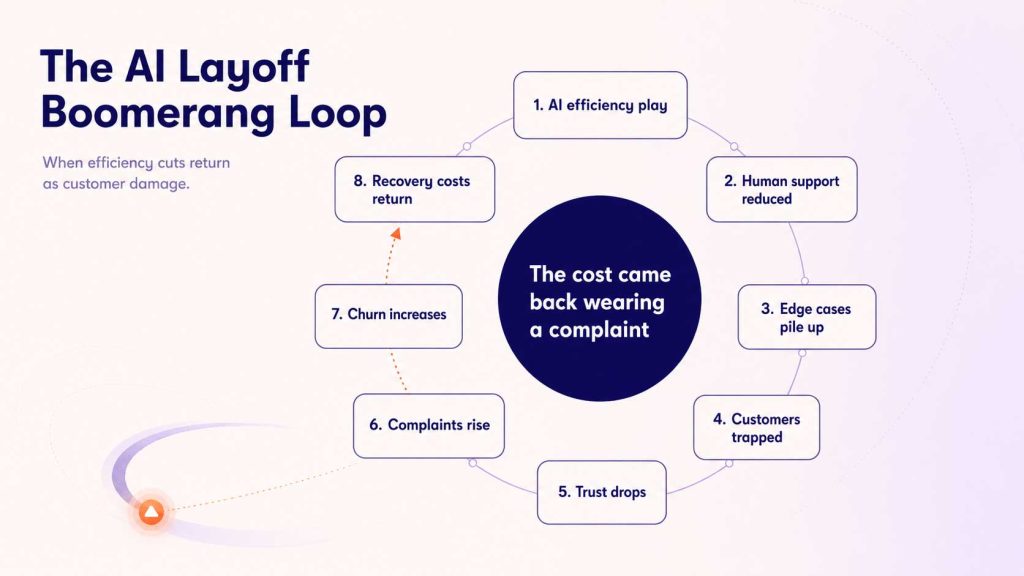
The AI Layoff Boomerang happens when a business cuts human capacity in the name of efficiency, then spends more fixing the damage caused by the cut. Churn, angry posts, refund exceptions, service recovery, re-hiring, retention campaigns and human agents cleaning up bot mistakes.
The cost did not disappear. It moved departments.
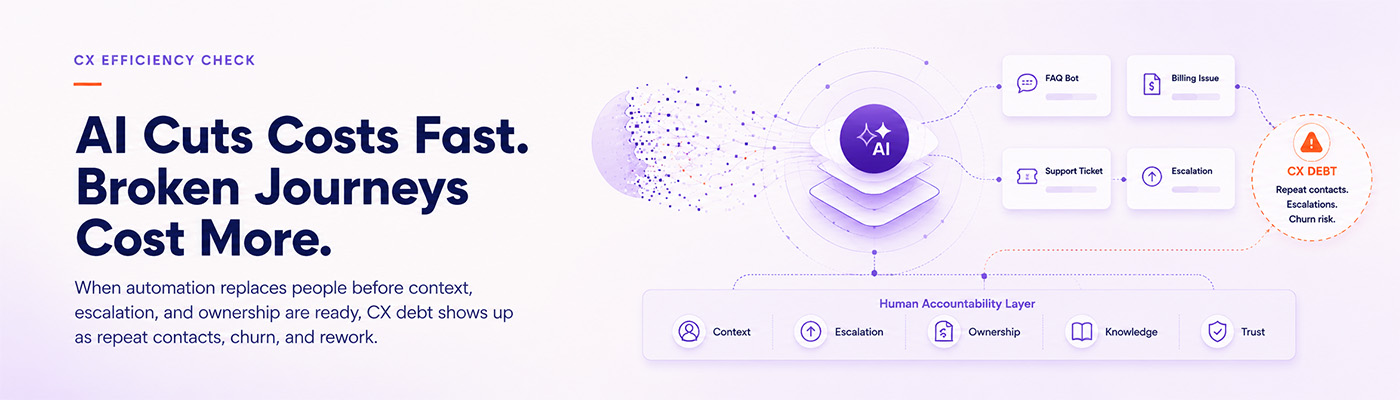
Here is the real issue: the damage rarely shows up where the automation dashboard is looking. It leaks into repeat contacts, angry screenshots, missed renewals, stalled orders, unresolved complaints and the quiet moment when a customer decides the brand is no longer worth the effort.
The problem is not AI. The problem is automation before operating maturity.
AI should absolutely be inside modern service, sales, and customer operations. It can triage, route, retrieve knowledge, summarize cases, assist agents, detect risk, personalize communication, and speed up resolution.
But AI becomes damaging when a company removes people before it fixes the journey behind the touchpoint.
If customer data is scattered, AI inherits scattered context. If workflows are broken, AI scales broken workflows. If escalation rules are unclear, AI traps customers in loops. If knowledge is outdated, AI answers faster with the wrong answer.
That is where growth stops. Not because customers disappeared. Because the journey stopped carrying them forward.
The boardroom version sounds clean. The customer version does not.
In the boardroom, the story sounds logical: lower support cost, higher deflection, faster response time, fewer agents, more automation, better scale.
But the customer version is different: “I got the wrong answer instantly.”
A bot without an escape hatch is not innovation. It is a customer trap with better branding. Customer service automation only works when judgment, escalation, ownership and accountability are designed into the journey.
Three questions every CX leader should ask before cutting human capacity
1. What should AI handle, and what should it escalate?
AI should handle repetitive, low-risk and context-ready tasks.
Humans should handle exceptions, anger, ambiguity, high-value accounts, compliance-sensitive issues and trust repair.
If the escalation path is unclear, do not automate the moment yet.
2. Does AI have the full customer context?
Can it see order history, payment status, support history, CRM notes, product usage, service level, renewal risk and previous complaints?
If not, the AI is guessing with confidence.
A confident wrong answer is still a bad experience.
3. Can leadership see where the journey is leaking?
If the dashboard only proves cost reduction, it may be hiding CX debt.
Where the AI Layoff Boomerang shows up by industry
This is not just a support problem. It shows up differently depending on the business model.
Healthcare
Patient books online but still has to repeat information at the front desk.
A billing or report query gets stuck in a bot loop.
A discharge update depends on manual chasing.
A no-show or follow-up opportunity disappears because the system did not trigger the right action.
Weaddo Offers: Integration Hub, Patient Portal, Appointment Engine, Automation Platform, Health CMS, and Intelligence Layer help healthcare leaders connect HIS, EMR, CRM, labs, pharmacy, call centre, appointments, reports, billing and follow-ups into one operating layer.
E-commerce and D2C
A customer has a return issue, and the bot cannot see order, payment, and logistics context together.
Support delays create angry reviews and repeat tickets.
Marketing sees ROAS, but leadership cannot connect acquisition to repeat purchase, returns, support load and margin.
Weaddo Offers: CDP, Marketing Automation, BI Dashboards, Integration Hub, PIM and Asset Centralization help commerce teams connect customer, order, inventory, support, returns and retention signals.
EdTech
A lead comes in, counselling chases manually, payment follow-up happens on WhatsApp and LMS engagement data arrives too late.
The learner journey leaks between enquiry, demo, enrollment, payment, course start, completion and renewal.
AI cannot fix a student journey if the business cannot see where the learner is dropping.
Weaddo Offers: Journey Orchestration, Automation Platform, CDP, Intelligence Layer, Landing Page Builder and KMS help EdTech teams connect lead source, counselling, payment, LMS activity, engagement and retention.
B2B SaaS and Services
Marketing creates demand, sales carries context, onboarding starts late and customer success inherits the gap.
AI support answers tickets, but cannot understand account value, product usage, renewal risk or previous escalations.
A full CRM can still hide a broken revenue journey.
Weaddo Offers: CRM Integrations, Workflow Automation, Attribution, BI, KMS, Data Warehousing and Customer Journey Intelligence help B2B teams connect campaign, pipeline, onboarding, usage, support, renewal and expansion.
The boomerang cost is bigger than the support budget
The CFO may see a lower support cost. The customer may feel ignored. The business may get a cheaper model that makes people leave faster.
The real cost often appears in places the automation business case did not count:
Repeat contacts because the first answer did not solve the issue.
Refund exceptions because the customer had to fight for resolution.
Escalation load because agents receive angrier cases later.
Churn and missed renewals because trust quietly drops.
Negative reviews and social posts because the customer feel abandoned.
Re-hiring and retraining because the cut went too deep.
Retention campaigns to win back customers the service model pushed away.
This is why deflection is not success if the customer leaves angry. Faster wrong answers are still wrong answers.
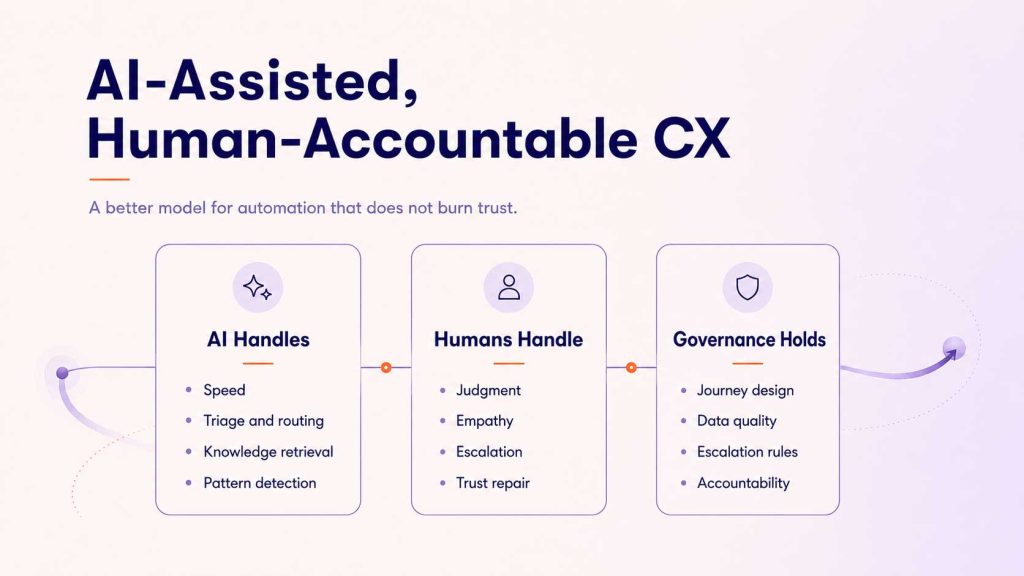
The better model: AI-assisted, human-accountable, journey-led
The future of CX strategy is not bot-only. It is not human-only either.
Governance holds it together through data quality, escalation rules, knowledge management, journey design, role ownership, audit trails, and measurement.
Where Weaddo fits into the uncomfortable fix
At Weaddo, AI is not treated as a headcount eraser. It is a way to make the business Unified. Intelligent. Ready.
The brands that win will not be the ones that replace humans the fastest. They will be the ones that know exactly where automation creates speed, where humans create trust, and where the customer journey needs both.
Unified: connect the journey before automating it
Integration Hub connects systems such as CRM, HIS, EMR, LMS, OMS, ERP, lab, pharmacy, call centre, support tools and third-party platforms.
Data Warehousing and CDP create a clearer view of customer, patient, learner or account behavior.
Health CMS, PIM, Digital Asset Management and KMS help teams work from approved content, accurate knowledge and governed assets.
Intelligent: see the leakage before it becomes churn
BI Dashboards, Marketing Analytics, Attribution, segmentation and journey analytics help leadership see where demand, service, retention and revenue are slipping.
The point is there are no more dashboards. The point is earlier signals and better decisions.
Ready: automate the right work with the right guardrails
Journey Orchestration and Automation Platform help teams trigger reminders, routing, notifications, no-show recovery, lead follow-up, renewal nudges, support workflows and escalation paths.
AI readiness starts with connected data, trusted knowledge, governed workflows, and clear escalation.
The rule is simple
Do not use AI to hide a broken journey.
Use AI to expose the break, route the work, support the team, and protect the customer relationship.
Before you automate another touchpoint, ask the question that actually matters: Where does your growth stop?
If it stops where systems do not talk, where context disappears, where teams chase manually or where escalation arrives too late, the answer is not just more AI.
The answer is a better operating layer.
Bridge the Future Gap by connecting the journey first. Then automate what is ready to scale.
Finally…
Before your AI efficiency plan becomes a CX debt machine, talk to Weaddo. We will help you identify where the journey breaks, where automation can help, where human escalation must stay, and which operating layer needs to be connected first.





Leave a Reply