There is a strange problem inside many growing businesses: everyone is busy, but the customer is still waiting.
Marketing has done its job. Sales has a queue. Operations is processing requests. Digital is resolving tickets. Managers are approving work. Teams are sending messages all day. Yet an enquiry may still sit unanswered, a request may still wait for the right owner, or a customer may still have to ask what happens next.
That usually does not mean people are working slowly. It often means the work between them is disconnected.
This is where digital experience operations becomes a business issue rather than an internal process issue.
Customers do not see departments, software ownership or internal queues. They experience one company. If the work behind that experience does not move together, the customer feels the delay.
Busy teams can still create a slow customer journey
Most businesses are organised by function for good reason. Marketing creates demand. Sales qualifies opportunities. Service handles requests. Operations deliver. Finance, legal or another business team may need to review specific decisions.
The problem begins when each team works effectively inside its own boundary but the transition between them depends on manual coordination.
A customer submits an enquiry.
The information enters one system.
Someone sees a notification.
Another person needs additional context.
The next team is not sure whether it owns the request.
Somebody forwards an email, sends a message or updates a spreadsheet.
Every individual action makes sense. The complete journey still feels slow.
Good customer journey orchestration is not only about sending the right message at the right time. It is also about making sure the context and next action can continue when the journey moves from one part of the business to another.
The delay usually lives between tasks
The most useful place to look is not where work begins or ends. It is what happens between those points.
A request may be created instantly but wait hours for someone to notice it. A form may collect the right information but the receiving team may still ask the customer for it again. An approval may exist, but nobody knows who needs to act once the approval is complete.
These are not dramatic failures. That is exactly why they survive.
The business sees routine coordination. The customer sees waiting.
Better digital experience operations makes those transitions more explicit. The right information should move with the work. Ownership should be visible. The next action should not depend on someone remembering to forward a message.
A notification is not ownership
Modern businesses rarely suffer from a lack of notifications.
Email alerts arrive. Chat messages appear. Dashboards change. Tasks are created. People get tagged.
But visibility is not the same as responsibility.
Five people can receive the same notification without any of them knowing who owns the next action. This is one reason simple workflow automation can disappoint when it is added without fixing the underlying operating model.
Automating the alert does not answer the more important question: what happens after the alert?
Useful workflow automation should support a clear route. It should help move routine work forward, preserve relevant context and bring people in where judgement or approval is genuinely required.
Customers should not have to compensate for internal disconnects
One of the clearest signs of disconnected work is repetition.
The customer submits information and gets asked for it again. They explain the issue to one team and repeat it to another. They select a preference on the website, but the next interaction behaves as if nothing happened.
Sometimes repetition is necessary. Security, compliance or a genuinely new decision may require another confirmation.
But unnecessary repetition usually means context did not travel with the customer.
That is why customer journey orchestration matters beyond channel consistency. A connected journey should allow the next step to begin with what the business already knows where that information can appropriately be reused.
The result is not simply a smoother interface. It is less customer effort.
More activity does not automatically mean more progress
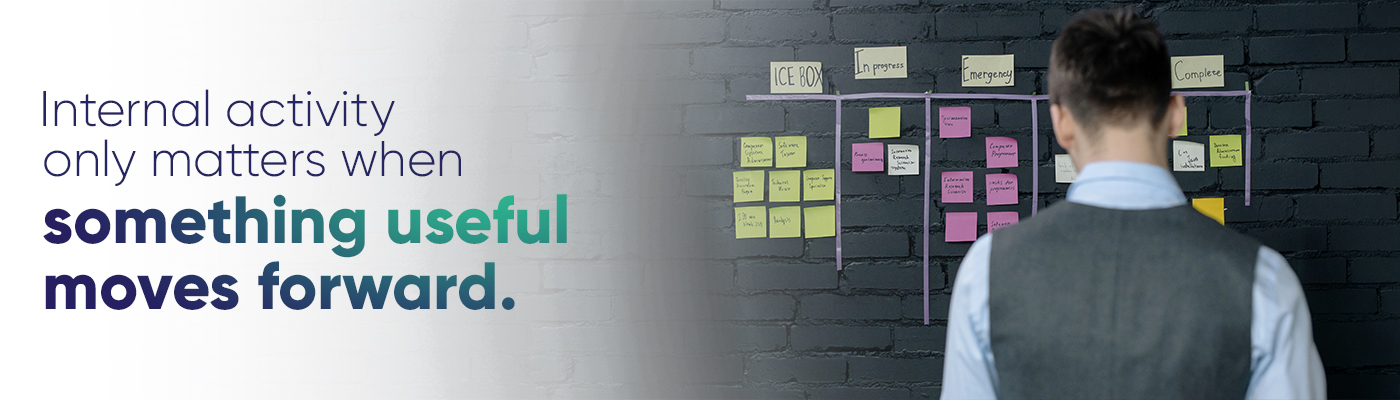
Internal activity is easy to see: emails sent, tasks completed, meetings held, tickets updated.
Progress is different.
Did the enquiry receive a useful response?
Did the request reach the right person?
Did the approval lead to action? Did the customer have to follow up?
That distinction becomes more important as volume grows. If every additional customer creates more manual coordination, the business becomes busier faster than it becomes more effective.
Strong digital experience operationsshould reduce the amount of human effort required merely to keep familiar work moving. That gives teams more capacity for decisions, exceptions and customer needs that genuinely require attention.
How WeAddo Bridges the Gaps
WeAddo connects digital operations around the systems a business already uses. The idea is not to replace every CRM, website, analytics platform or operational system simply because the journey crosses them.
The goal is to help the work around those systems move with clearer context, ownership and next actions.
This is where workflow automation and customer journey orchestration can work together. One helps routine work progress. The other helps the wider customer journey retain continuity as it moves across touchpoints and teams.
The useful outcome is simple: less time spent coordinating the operation and more effort spent moving the customer forward.
The question worth asking
Take one important customer action: an enquiry, booking, request, purchase or service issue.
Follow what happens after the customer acts.
Do not start by asking how busy each team is. Ask where the customer waits, where context disappears and where someone has to manually reconnect the work.
That is often where digital experience operations need attention first.
Because a busy business is not necessarily a moving business.






Leave a Reply