Why Growth Creates More Coordination Work Than Customer Value
by
vikas weaddo
Growth naturally creates more activity. More customers. More locations. More channels. More data. More people. More systems.
That is normal.
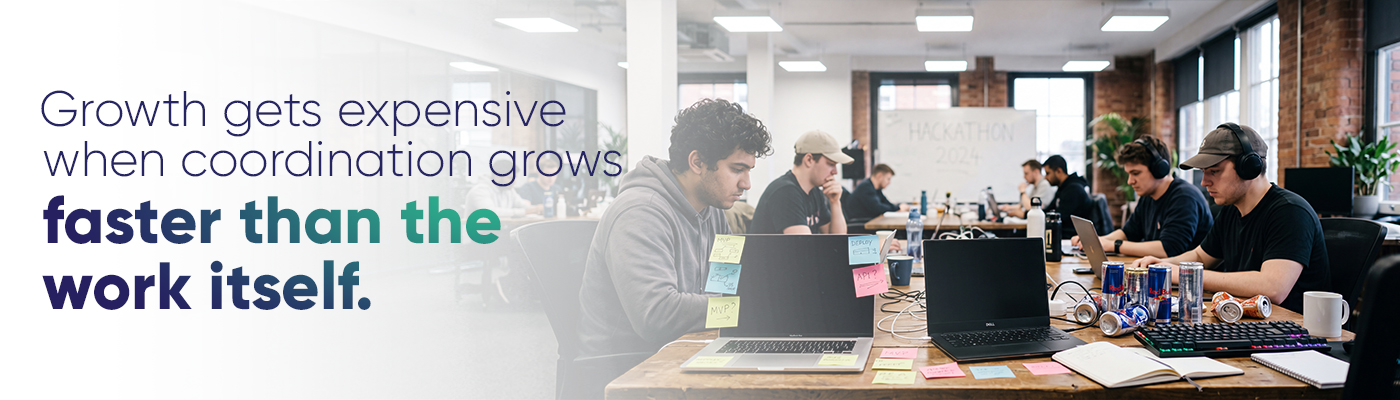
What is less useful is when every increase in business volume also creates a similar increase in coordination.
A request that once needed two people now touches four teams.
A routine update requires multiple approvals.
People spend more time checking status, moving information and reconciling different systems.
The business has grown but so has the amount of work required simply to keep the operation connected.
That is one of the problems enterprise automation is supposed to address. But automation only creates leverage when the underlying work is clear enough to automate.
Complexity usually arrives one reasonable decision at a time
Businesses rarely choose complexity deliberately.
A new system solves an immediate problem.
An agency adds capacity.
Another team takes ownership of a channel.
A spreadsheet fills a gap.
A new approval gets introduced after a mistake.
Another dashboard gives leadership a different view.
Each decision may be completely reasonable on its own.
The cost appears later when one piece of work needs to move across all of them.
One request may need information from one platform, approval in another place and action from a different team. Somebody then becomes responsible for keeping those steps connected manually.
That is where growth starts producing coordination overhead.
The hidden work behind digital work
Consider how much time people spend on activities such as asking for an update, forwarding information, checking whether somebody acted, copying data between tools, finding the current version or reminding another team.
These actions are rarely described as a strategic process.
They are simply how the organisation gets things done.
That makes them easy to ignore.
Good digital experience operations exposes this hidden work because it looks at the activity behind the customer-facing experience, not just the final page, app or message.
If a simple customer action requires five manual checks behind the scenes, the experience may look digital while the operating model underneath it remains highly manual.
Status calls are useful until they become the workflow
Meetings, chat and email are not problems by themselves. Teams need to communicate.
The warning sign appears when communication becomes the mechanism keeping routine work alive.
“Who has this?”
“Did that get approved?”
“Which version is final?”
“Has somebody responded?”
“Can you check whether it moved?”
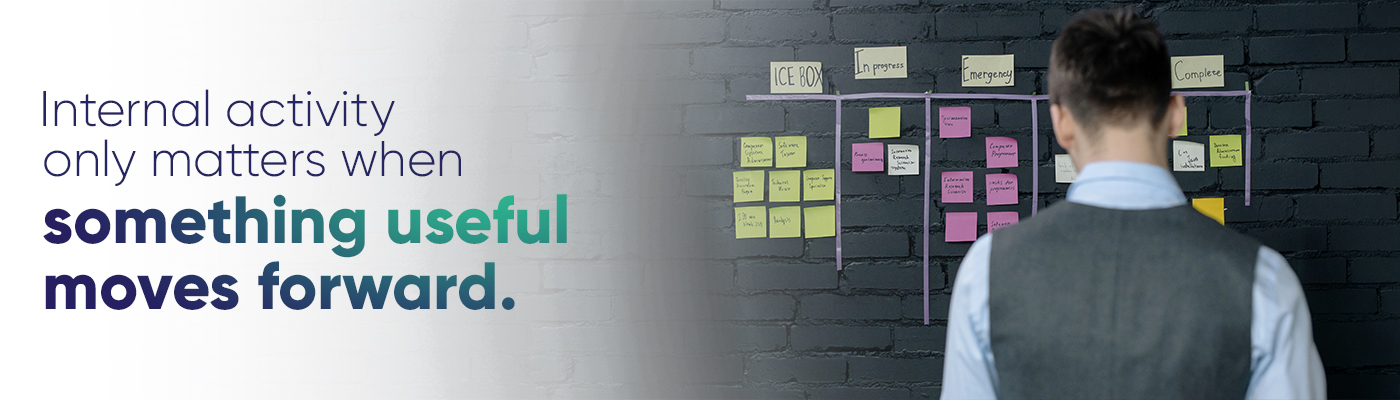
At that point, people are spending time reconstructing the status of work rather than progressing it. This is where workflow automation should help, but only if ownership and the sequence of work are understood first.
Automating a confused process does not remove confusion. It can simply make the same confusion move faster.
More tools do not automatically create a more connected business
Another common response to operational friction is software. Sometimes a new tool is exactly what the business needs. But every system also creates another place where information, ownership or activity can sit.
The important question is therefore not how modern the stack looks. It is how much human effort is still required to make that stack behave like one business.
If teams constantly copy information, reconcile numbers or manually move tasks between systems, the organisation may have sophisticated technology without connected digital experience operations.
The goal of enterprise automation should be to reduce this coordination burden, not add another layer that needs to be coordinated.
Scale should make familiar work easier
A growing organisation will always face new problems. That is part of growth. But familiar work should become increasingly repeatable.
Known information should not need to be recreated every time. Routine actions should have clear owners. Common approval paths should be understood. Existing systems should continue doing the jobs they already handle well.
This is where effective workflow automation creates leverage. It helps routine actions move without unnecessary intervention while allowing people to stay involved where judgement, risk or business context matters.
That balance matters. The goal is not an organisation where people disappear from the workflow. It is an organisation where people spend less time doing work that exists only because systems and teams are disconnected.
What enterprise automation should actually improve
Useful enterprise automation should make the operating model easier to run as volume increases.
That can mean fewer manual transitions, clearer ownership, context reaching the next team, routine actions progressing automatically where appropriate and required approvals appearing at the right point.
The effect should be visible in how the business operates, not just in how many processes have an automation label attached to them.
The important question is not, “How much have we automated?”
It is, “What work no longer needs to be manually carried from one step to another?”
That is a more useful test of operational leverage.
Where WeAddo bridges the gap
WeAddo connects digital operations across the systems already running the business. That matters because growth rarely depends on only one system. Customer experience, operations, data and decisions all interact.
Connected digital experience operations can help those pieces work with more shared context rather than forcing teams to recreate or manually move information.
Combined with appropriate workflow automation, that gives familiar work a clearer route while keeping people involved where their judgement matters.
The point is not automation for its own sake. It is making sure growth creates more customer value than coordination work.
Growth should create leverage
More business will always create more work. The question is what kind.
If each new customer, location or channel creates proportionally more checking, chasing and reconciliation, scale is increasing complexity rather than leverage.
Strong enterprise automation should change that equation. As the business grows, routine work should become easier to move, not harder to coordinate.
That is what scale without unnecessary complexity actually means.



Leave a Reply