Your SOP Is Standard. Every Location Runs It Differently.
Head office has approved the SOP. The document is stored in the shared drive. Every hospital, clinic, diagnostic centre and regional team has received the same version.
Yet the process changes from one location to another.
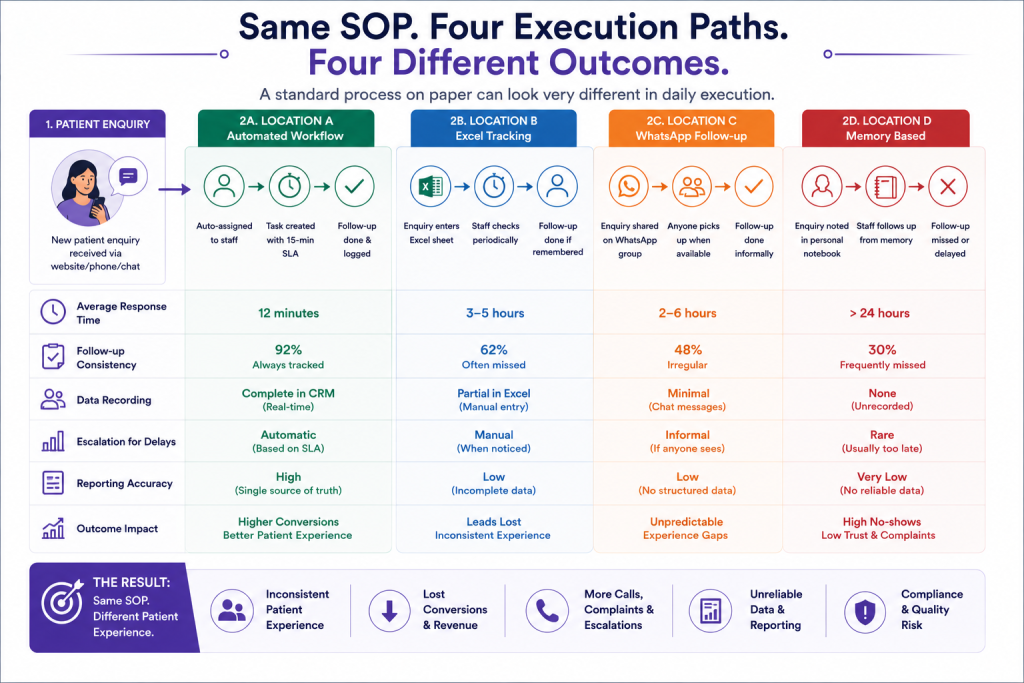
One branch calls every new enquiry within ten minutes. Another waits until the following morning. One hospital records patient no-shows in the CRM and begins a recovery journey. Another maintains a handwritten list. One diagnostic centre follows a defined escalation process for delayed reports. Another depends on the branch manager remembering whom to contact.
The SOP is standard. Execution is not.
Leadership eventually sees the result through different conversion rates, waiting times, complaints, repeat calls and revenue outcomes. The natural conclusion is that some teams perform better than others.
Sometimes that is true. But often the real problem is simpler: the process exists as a document, while daily execution still depends on local memory.
A healthcare workflow optimization platform should close that gap by turning approved operating procedures into visible tasks, ownership rules, escalation paths and measurable outcomes.
Publishing an SOP Does Not Create Adoption
Most organisations treat SOP publication as the final step. The document is approved, uploaded and circulated. Employees may also attend a training session or sign an acknowledgement.
But receiving a document is not the same as following the process consistently.
A working SOP must answer practical questions during daily operations:
- Who performs the first step?
- What information must be recorded?
- Which system should be updated?
- How quickly must the next action happen?
- What happens if the owner is unavailable?
- When should the case be escalated?
- What evidence proves that the step was completed?
- How does the next team know that it can proceed?
If these answers remain inside a PDF, employees must interpret the process themselves. Experienced staff create personal shortcuts. New employees ask colleagues. Busy branches skip steps that appear less urgent. Over time, each location develops its own operating version.
The document remains standard. The business process fragments.
Why the Same SOP Produces Different Outcomes
The process is described, but not built into the work
An SOP may say, “Contact every new patient enquiry within 15 minutes.” But the enquiry enters a shared inbox, and no individual owner is assigned automatically.
The process tells the team what should happen. The system does not make it happen.
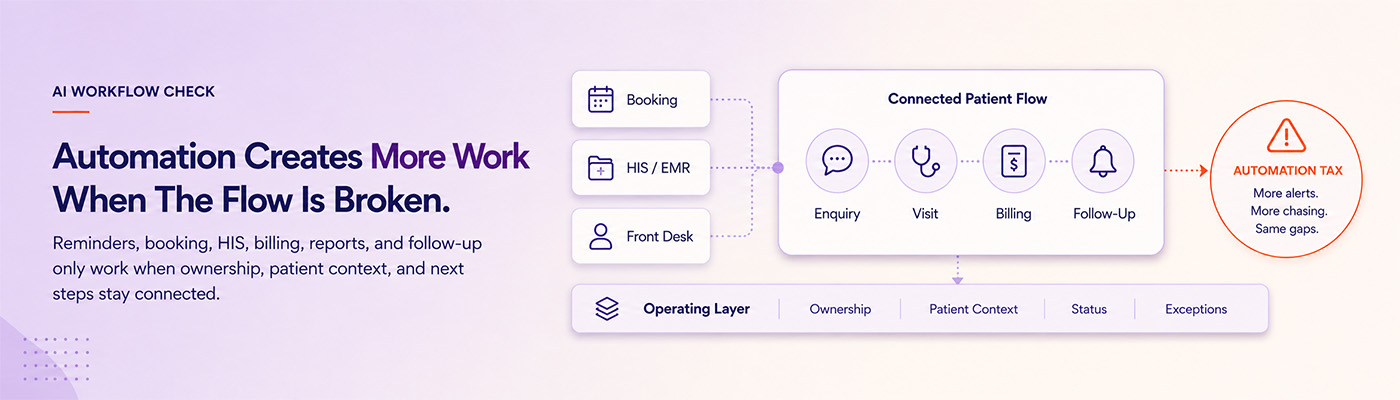
A hospital workflow automation platform should convert that instruction into a timed task with ownership, status and escalation.
Different locations use different tools
One branch works inside the central CRM. Another maintains an Excel tracker. A third uses WhatsApp groups for updates. A fourth records activity only after the patient journey is complete.
Even when every team follows the same broad process, the evidence, timing and visibility differ. Leadership cannot compare performance reliably because the work is not being recorded in a consistent way.
Local teams fill gaps with personal judgement
SOPs cannot cover every situation. Staff must still make decisions. The problem begins when normal operating gaps are also left to interpretation.
For example, the SOP may explain how to confirm an appointment but not what to do when the patient does not answer, requests another location or has already contacted the call centre.
Each location creates its own solution. What begins as flexibility becomes uncontrolled variation.
Escalation depends on who notices the delay
A report remains pending. A payment is unmatched. A patient complaint has no update. A high-intent enquiry has not been contacted.
If no system tracks ageing and ownership, escalation depends on a manager checking manually. Some managers check often. Others discover the issue only after the patient calls again.
Performance is measured only at the final outcome
Leadership sees conversions, no-shows, turnaround time and complaints. It does not see where locations skipped steps, delayed action or moved work outside the defined process.
Without process-level visibility, the organisation knows which location underperformed but not why.
A Knowledge Base Is Not an Operating System
Centralising SOPs, circulars and training documents is important. Employees need one approved source they can trust.
But document centralisation solves only one part of the problem.
The organisation also needs to connect the approved process to daily work. That means translating the SOP into:
- Required fields
- Assigned roles
- Task sequences
- Service-level timelines
- Approval requirements
- Exception categories
- Escalation rules
- Customer updates
- Completion evidence
- Performance reporting
Asset Centralisation and knowledge management establish the current version of the process. The Operations Suite must then convert that version into repeatable execution.
This is where a healthcare workflow optimization platform becomes operationally useful. It does not replace the SOP. It ensures the SOP appears inside the systems, tasks and decisions where employees need to follow it.
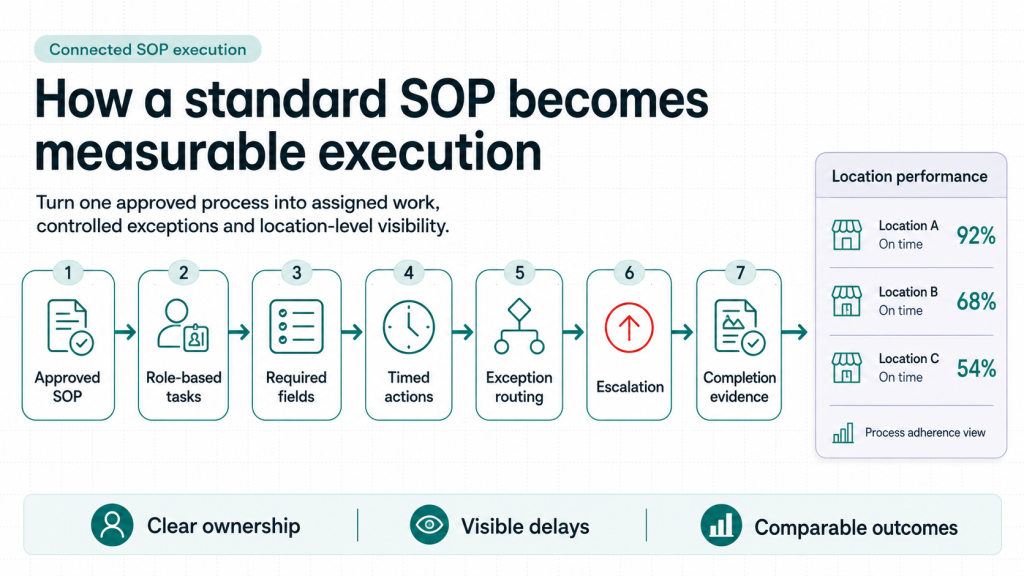
What a Connected SOP Execution Model Should Look Like
1. Establish one approved process source
Every workflow should link to the current SOP, owner, effective date and version. Employees should not search email threads or local folders for instructions.
2. Translate each step into system actions
If the SOP requires patient verification, callback, approval or escalation, the relevant workflow should create and track those actions.
3. Assign role-based ownership
Tasks should be assigned to roles such as counsellor, branch coordinator, call-centre executive, billing team or clinical operations—not left in a generic queue.
4. Define time and escalation rules
The system should know when a task becomes overdue and who must be alerted. Escalation should not rely on a manager checking every case manually.
5. Record evidence of completion
Completion may require a CRM status, uploaded document, call outcome, approval, payment confirmation or patient communication.
A simple “Done” status is not enough when the next team depends on a specific output.
6. Handle exceptions without leaving the workflow
Unusual cases should enter defined exception paths rather than disappearing into email and messaging groups.
7. Compare process adherence with outcomes
A healthcare operations efficiency platform should show whether locations that complete the required steps also achieve better conversion, turnaround time, recovery or patient satisfaction.
Standardisation Should Not Remove Necessary Local Flexibility
Not every hospital or branch operates under identical conditions. Locations may differ by specialty, staffing, language, service availability, operating hours and patient volume.
The objective is not to force every location into an unrealistic identical process. It is to distinguish between controlled variation and uncontrolled variation.
A central workflow might define the mandatory steps:
- Enquiry captured
- Owner assigned
- First response attempted
- Outcome recorded
- Follow-up scheduled
- Escalation triggered when overdue
A location may then configure approved details such as working hours, available services, response teams or language templates.
A hospital workflow automation platform should preserve the mandatory business rules while allowing authorised local configuration. That creates consistency without ignoring operational reality.
Measure Process Adoption, Not Document Distribution
Many organisations can report how many employees received or acknowledged an SOP. Fewer can prove whether the process is being followed.
Useful measures include:
- Percentage of cases following the required workflow
- Tasks completed within the defined timeline
- Cases handled outside the approved system
- Locations with high manual intervention
- Exceptions without a named owner
- Overdue tasks escalated automatically
- Variation in completion time between locations
- Repeat customer contact caused by missed steps
- Conversion or resolution outcomes by process adherence
These measures allow a healthcare operations efficiency platform to separate three different problems: the SOP is unclear, the system does not support it or the team is not following it.
Without this distinction, every performance issue becomes a training problem.
Run This Audit Across Five Locations
Choose one process that has a clear customer and business impact. It could be enquiry follow-up, appointment confirmation, no-show recovery, patient document collection, delayed-report escalation or complaint resolution.
Review the process across five locations and ask:
- Which system does each location use?
- Who owns the first step?
- How is completion recorded?
- What happens when the customer does not respond?
- When is the case escalated?
- Which steps happen outside the system?
- How many employees must manually follow up?
- Can leadership see where the process stopped?
- Do stronger outcomes correlate with better process adherence?
The differences will reveal whether the organisation has one operating process or several local interpretations of the same document.
Where Does Your Growth Stop?
Growth can stop at the location where a new enquiry waits until tomorrow, where a no-show list remains inside a spreadsheet or where a complaint has no escalation owner.
The problem is not always that employees ignored the SOP. The process may never have been converted into a system they could follow consistently.
WeAddo’s Operations Suite brings workflow automation, integrations and operational control into the work behind the customer experience. Asset Centralisation provides the approved SOPs and institutional knowledge, while the Data Suite helps leadership compare execution and outcomes across locations.
Unify experience, operations and data so the exact point where growth stops becomes visible and actionable.
Conclusion
A standard document does not create a standard operation.
A reliable healthcare workflow optimization platform translates approved processes into tasks, ownership, timelines, escalation and evidence. A connected hospital workflow automation platform ensures that mandatory steps move through the organisation without depending on individual memory. A measurable healthcare operations efficiency platform helps leadership see where locations follow the process, where they deviate and how that affects business and patient outcomes.
Choose one high-impact SOP and compare how five locations execute it.
The differences between the document and the real workflow are where operational control is being lost.
Audit one standard process across five locations and identify every step that still depends on a spreadsheet, message or employee remembering what happens next.
FAQs
A healthcare workflow optimization platform helps hospitals convert operating processes into assigned tasks, timelines, escalation rules and measurable workflows across teams and locations.
A hospital workflow automation platform embeds required process steps into daily systems so employees receive clear assignments, deadlines and next actions instead of relying only on documents.
A healthcare operations efficiency platform can compare task completion, process delays, manual work, exceptions and operational outcomes across hospital locations.
Variation often occurs because locations use different tools, ownership is unclear, exceptions are unmanaged or the documented process has not been built into operational systems.
Start with one high-impact process, define its mandatory steps, assign clear ownership, create escalation rules and compare execution across several locations.






Leave a Reply