

Your CRM Has the Lead. The Right Team Never Got It.
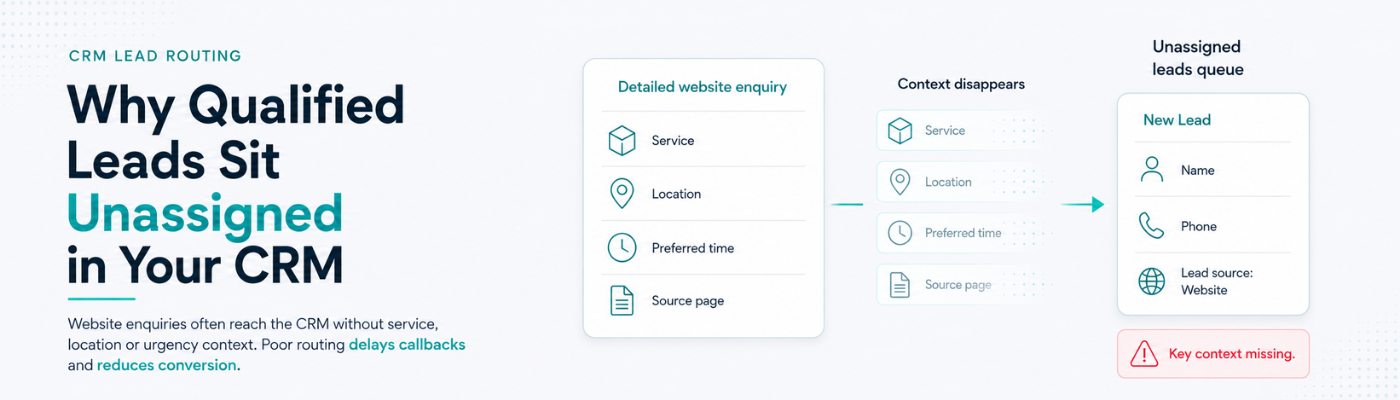
A customer visits your website, reads about a specific service, chooses a location, selects a preferred time and requests a callback. Your website records a conversion. Your CRM records a new lead. Your marketing dashboard records a successful campaign.
But the team that can actually help the customer never receives the full request.
Instead, the lead lands in a generic queue with a name, phone number, email address and the source marked as “Website.” The service is missing. The selected location is missing. The preferred time is missing. The page the customer visited is missing. Someone now has to open the record, guess what the customer wanted and manually forward it.
By the time the correct person calls, the customer may already have contacted a competitor.
The form worked. The handoff did not.
A Submitted Form Is Not a Completed Handoff
Businesses often treat a form submission as the end of the digital journey. It is actually the point where the customer-facing experience hands responsibility to the business.
That handoff succeeds only when the correct person receives the customer’s details, the specific requirement, enough context to act, a clear next step and a response deadline. Without those elements, the CRM has captured a contact rather than a usable opportunity.
Customers rarely submit generic requests. A patient wants one test at one diagnostic centre. A car buyer wants one model from one dealership. A student wants information about one course at one campus. A business buyer wants a demonstration of one solution.
The request becomes generic only after the business captures or transfers it badly.
This is why CRM lead routing should not be treated as a minor administrative function. It decides whether visible customer intent becomes an owned business action or an unassigned record.
What the Customer Submitted Versus What the CRM Received
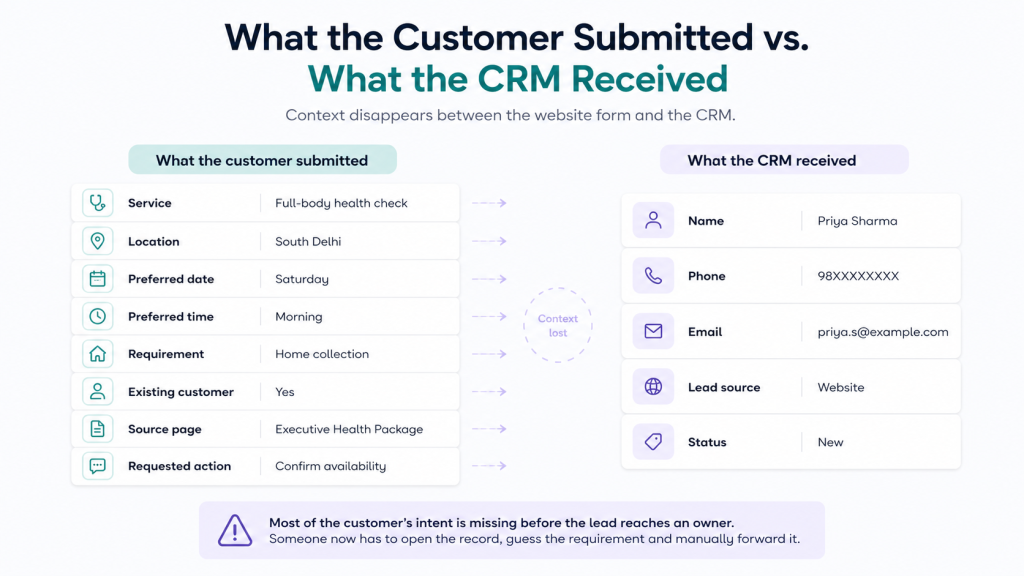
Consider a customer who submits:
- Service: Full-body health check
- Location: South Delhi
- Preferred date: Saturday
- Preferred time: Morning
- Requirement: Home collection
- Existing customer: Yes
- Source page: Executive Health Package
- Requested action: Confirm availability
But the CRM record contains:
- Name: Priya Sharma
- Phone: 98XXXXXXXX
- Lead source: Website
- Status: New
The business has technically stored the lead. Operationally, it has lost most of its value.
The call-centre executive must now ask Priya which package she selected, where she lives, whether she wants home collection and when she is available. Priya has already answered those questions. From her perspective, the company was not listening.
This happens across industries. In automotive, a buyer selects a vehicle and dealership, but the lead is routed only by postcode. In education, a student enquires about one programme at one campus, but the counselling team receives “course enquiry.” In B2B services, a prospect requests a demo from one solution page, but sales sees only “organic website lead.”
The problem is not a lack of intent. The intent did not survive the handoff.
The Five Types of Context Most CRMs Lose
- Product or service context
The receiving team needs to know exactly what the customer viewed, selected or requested. “Product enquiry” is not enough. The CRM should capture the specific product, service, package, course, vehicle, property or solution.
Without this information, the first response becomes another discovery call instead of a useful next step.
- Location context
Location is essential for multi-location lead management. The correct destination may be the branch chosen by the customer, a serviceable postcode, a dealer territory, a hospital, a campus or an account region.
Many businesses capture the city but lose the branch, location page or service area. That small gap creates incorrect assignments, delays and duplicate calls.
- Requested action
A customer downloading a brochure is not at the same stage as someone trying to book, pay or schedule a demo. Yet many CRMs convert every action into the same status: “New lead.”
The system should distinguish between actions such as:
- Book an appointment
- Request a callback
- Check availability
- Get a quotation
- Schedule a demo
- Apply
- Make a payment
- Speak to a specialist
Good lead routing rules should reflect what the customer wants next, not merely where the form was submitted.
- Timing and urgency
A customer requesting a call today should not enter the same queue as someone seeking general information for next quarter. The CRM should retain preferred callback time, appointment date, delivery date, deadline or urgency level.
This is why lead response time should be measured against the customer’s requested timing, not only from the moment the record was created.
- Source-page and campaign context
“Website” is not a useful source description. The receiving team should know which page generated the enquiry, which campaign brought the customer there, which offer they saw and which CTA they clicked.
A strong website CRM integration transfers this information as structured data instead of burying it inside a note or dropping it entirely.
Why This Gets Misdiagnosed as a Lead-Quality Problem
When website enquiries fail to convert, marketing says sales did not follow up. Sales says marketing generated poor-quality leads. Operations says the CRM did not contain enough information.
All three teams may be partly correct, but the real failure often sits between their systems.
The website may have captured the request correctly. The CRM may have created the record successfully. The context simply failed to travel from the page to the record and then to the owner.
That failure is difficult to spot because each system appears to be working. The form was submitted, the integration created a record and someone received a notification. No obvious technical error occurred.
The problem surfaces later as:
- An unassigned lead
- An incorrect branch assignment
- A duplicate callback
- A customer asked to repeat information
- A reassigned record
- A lead marked “not interested”
This is where better CRM lead distribution matters. Distribution should not mean pushing every website record into one shared queue. It should mean transferring the lead, its context, the correct owner and the required next action together.
Your Routing Rules May Be Designed for Internal Convenience
Many companies build routing logic around the easiest internal setup:
- All website leads go to one national inbox.
- All enquiries from one city go to one branch.
- All product requests go to one sales queue.
- All service requests go to the call centre.
- All partner leads are exported into a spreadsheet.
These processes are easy to configure, but they do not always reflect what the customer requested.
Effective lead routing rules should consider what the customer wants, where the service can be delivered, which team has the right capability, whether the customer is new or existing, how urgent the request is and what should happen if the first owner does not respond.
Assignment is not simply sending a record to a CRM user. It is deciding who should act, what they should do and how quickly they should do it.
Four Numbers That Reveal Whether Routing Is Broken
- Unassigned lead time
Measure how long a new lead remains without a named owner. A record sitting in a shared queue is not being worked, even if it exists inside the CRM.
- Reassignment rate
Measure how many leads move from one user, branch or team to another. A high reassignment rate usually means the original CRM lead routing logic is missing important information.
- Time to first relevant response
Do not measure only the first automated message or outbound call. Measure the first response from someone who can actually progress the request. True lead response time ends when the right team provides a useful next step.
- Correct-owner conversion rate
Compare conversion for leads assigned correctly on the first attempt with leads that required reassignment. This shows whether poor performance is genuinely a lead-quality problem or a routing problem.
What a Connected Lead Handoff Should Look Like
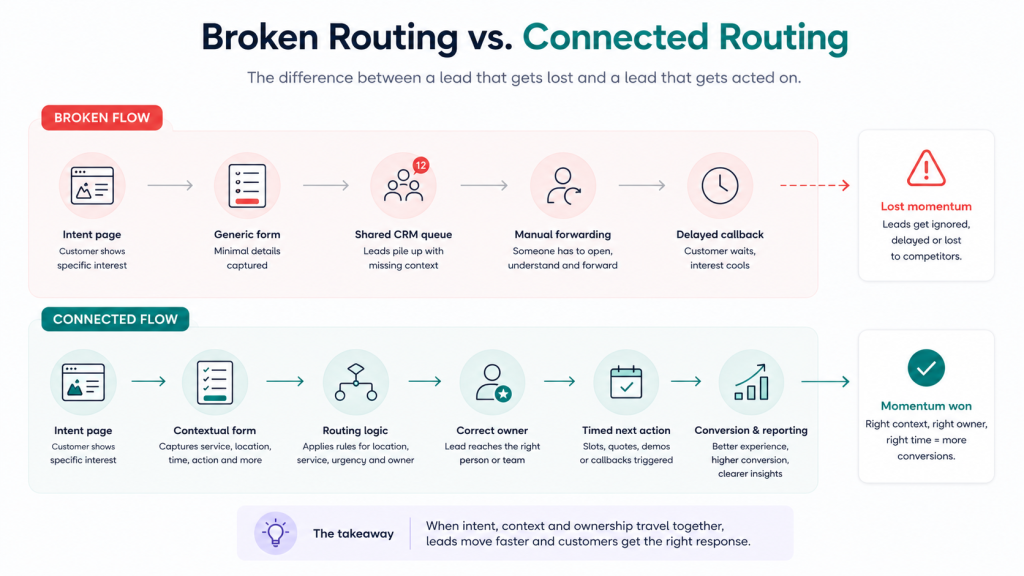
Step 1: Capture the intent
The page and CTA should tell the system what the customer is trying to do. A request from a test-drive page should not be treated like a newsletter registration.
Step 2: Capture only what is needed to act
Long forms create friction, but empty forms create operational confusion. Capture the minimum information required:
- Product or service
- Location
- Contact details
- Preferred date or time
- Requested action
- Existing-customer status
- One or two qualifying fields
Step 3: Transfer structured context into the CRM
A good website CRM integration should create separate CRM fields rather than sending everything as free text. Structured information supports routing, prioritization, reporting, escalation and lead assignment automation.
Step 4: Assign one clear owner
Every lead should have a named owner or a clearly managed queue with a response SLA. In multi-location lead management, ownership should account for service availability, customer choice, branch capacity and territory rules.
Step 5: Trigger the correct next action
The system should do more than assign a record. It should trigger the action the customer expects, such as sharing appointment slots, assigning a counsellor, creating a quotation, sending a payment link or scheduling a demo.
This is where lead assignment automation becomes useful rather than cosmetic.
Step 6: Escalate when the lead stops moving
If the owner does not respond within the expected time, the system should escalate, notify a manager or reassign the lead. Effective CRM lead distribution includes fallback ownership, not just first assignment.
Run This Audit on Your Last 50 Website Leads
Open 50 recent website enquiries and check:
- Did the CRM capture the exact product or service?
- Did it capture the selected location?
- Did it record the requested action?
- Did it retain the original page and campaign?
- Was the lead assigned automatically?
- Was the first owner correct?
- How long did assignment take?
- Was the lead reassigned?
- Did the customer repeat information?
- Was a useful next action triggered?
This exercise will quickly show whether the real problem is traffic, lead quality, CRM lead routing, ownership or follow-up.
Where Does Your Growth Stop?
Sometimes the customer has done everything correctly. They found the right service, selected the right location, submitted the required information and requested a clear next step.
Growth stopped because the business turned a specific customer request into a generic CRM record.
WeAddo’s Experience Suite is designed for this exact seam: the point where customer attention must become business action. It connects content, request flows, CRM context, routing and lifecycle automation instead of treating them as separate investments.
Your CRM had the lead. The right team never got it.
Conclusion
A lead becomes valuable only when someone can act on it. Capturing a name and phone number is not enough. The business must preserve product, service, location, timing and action context from the website to the CRM and from the CRM to the correct owner.
Take one recent enquiry and follow it from the CTA click to the first useful response. Count every time information is lost, re-entered, forwarded, reassigned or delayed.
That is where the real lead leak sits.
Audit your last 50 website enquiries. Find out how many reached the correct owner with the correct context and without manual forwarding.
CRM lead routing is the process of assigning a new enquiry to the correct person, team, branch or workflow based on product, service, location, urgency, customer type and requested action.
Leads often remain unassigned because required information is missing, lead routing rules are incomplete or the website does not transfer enough customer context into the CRM.
A website CRM integration should transfer contact details, selected product or service, location, requested action, preferred timing and the page or campaign that generated the enquiry.
Effective multi-location lead management captures the customer’s chosen branch or service area and combines that preference with availability, capacity and territory logic. ntent
Useful measures include unassigned lead time, reassignment rate, lead response time, first-owner accuracy and conversion after initial assignment.








Leave a Reply