Your First-Party Data Is Worthless If Customers Do Not Trust You
by
vikas weaddo
B2B teams keep saying “first-party data” like it fixes the whole revenue engine.
Pipeline attribution? First-party data. Personalization? First-party data. Account-based marketing? First-party data. Retention? First-party data. AI readiness? First-party data with a cleaner slide title.
First-party data matters. But it is not magic. A larger database does not automatically create better customer relationships. Sometimes it only gives a company more ways to send irrelevant messages with confidence.
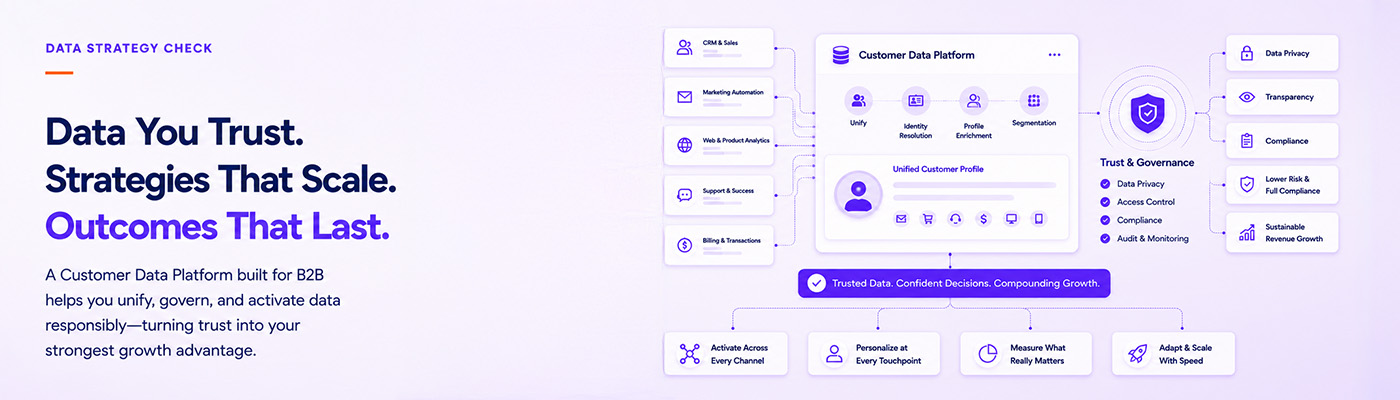
That is the uncomfortable truth for B2B growth teams. Your customer data platform is only valuable if customers, users, buyers, and accounts trust you enough to keep sharing data, updating preferences, engaging with journeys, and allowing you to use that data responsibly.
The problem is not only data scarcity. It is trust scarcity. A unified customer data platform can connect records, but it cannot repair a relationship where the customer feels over-targeted, misunderstood, or treated like a segment instead of an account with context.
Permission is not ownership.
This is where B2B teams lose the plot. A prospect downloads a whitepaper, attends a webinar, fills a demo form, joins a product trial, clicks a preference, talks to sales, or becomes a customer. The business quietly treats long-term permission to nurture, retarget, upsell, cross-sell, score, automate, and personalize forever.
That is not a relationship. That is a form fill with ambition.
Consent is not a trophy. It is a living agreement. In B2B, customers often withdraw emotionally before they withdraw legally. They stop opening emails. They stop replying to sales. They ignore product nudges. They block tracking. They give vague data. They use generic inboxes. They disengage while still technically sitting inside the CRM.
This is why a customer data management platform is not enough. If the journey does not feel useful, respectful, and relevant, the data may still exist, but its commercial value starts dying quietly.
The problem is not data scarcity. It is value scarcity.
B2B buyers are not against sharing data. They are against sharing data into a black box that gives them nothing useful back.
If a buyer tells you their role and still receives generic campaigns, the trust account drops. If an account shares product goals and still gets irrelevant upsell prompts, it drops. If a customer shares onboarding preferences and still has to repeat context to support, it drops. If a user gives product signals and the business responds with noisy automation instead of useful help, it drops faster.
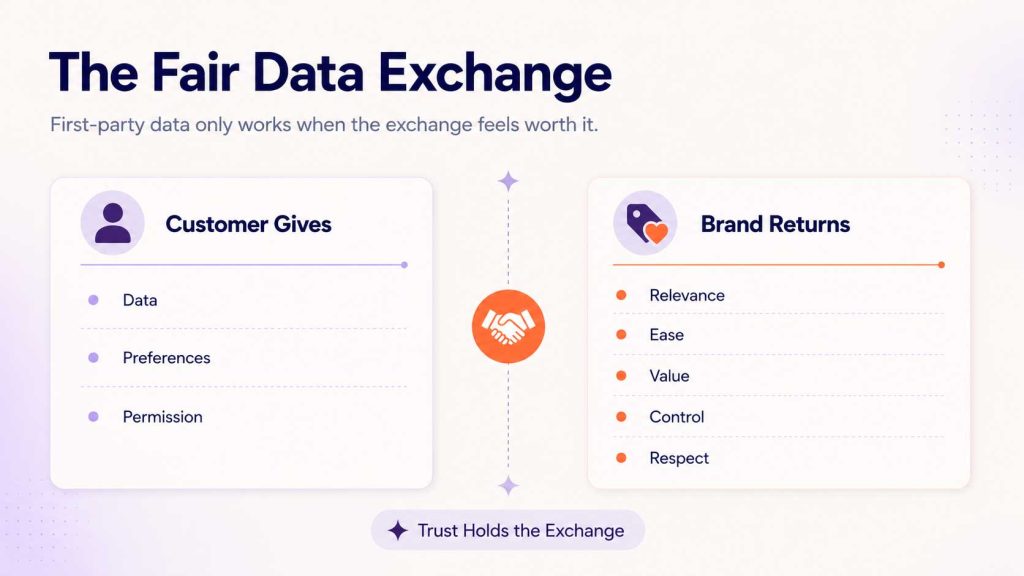
A strong data exchange has to feel fair. The customer gives data, preferences, usage signals, intent, permissions, and context. The brand must return relevance, ease, value, control, and respect. That is what turns a single customer view platform from a database into a growth asset.
Useful personalization feels like service. Bad personalization feels like surveillance with a pipeline target.
What B2B teams misunderstand about personalization.
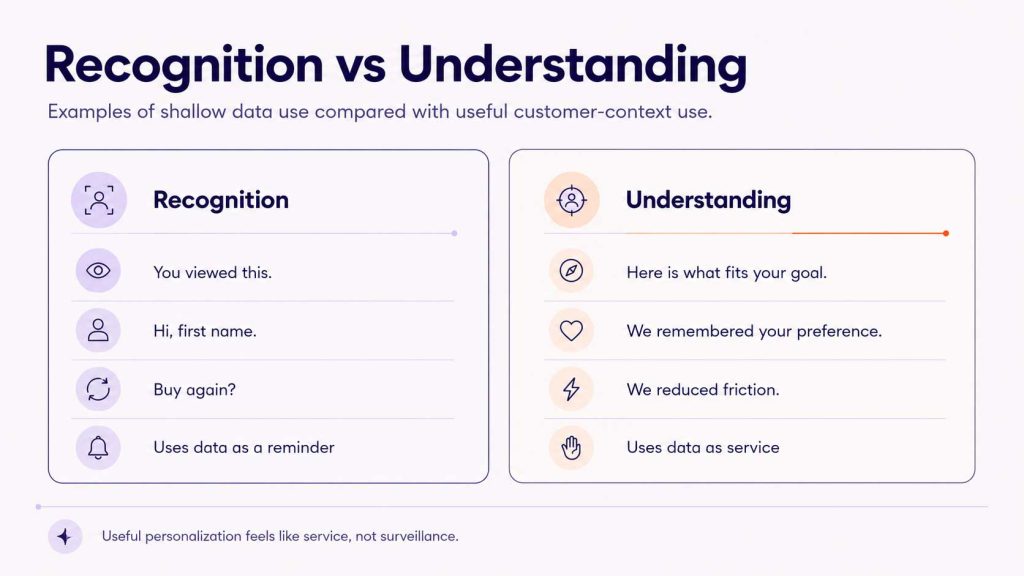
Personalization is not putting someone’s first name in a subject line. It is not showing the same case study to every account in a “similar” industry. It is not triggering five emails because someone visited a pricing page once.
Real personalization is the discipline of reducing friction. It helps the buyer solve a problem faster. It helps a customer continue a journey without repeating context. It helps sales understand the account without making the prospect explain everything again. It helps customer success to see risk before the renewal call becomes uncomfortable.
Most bad personalization fails because the business confuses recognition with understanding. “We saw you view this page” is recognition. “Here is the right next step based on your role, account stage, use case, product usage, and previous conversation” is understanding.
That is why B2B companies need more than a customer data 360 system. They need connected interpretation. The better question is not “How much data can we collect?” It is “Which customer problem becomes easier because we know this?”
If the answer is unclear, the data is probably serving the dashboard more than the customer.
A better data strategy starts with restraint.
The strongest B2B data strategy is not always the one that collects the most. It is the one customer are least annoyed to maintain.
Collect less casually. Explain more clearly. Use data in ways customers can feel. Build preference centers people can understand. Connect CRM, marketing automation, support, product usage, billing, success, and renewal data, so the same customer is not treated like a stranger in one channel and a target in another.
This is where a customer data unification platform and data unification platform matter. Not because the business needs another place to store profiles, but because scattered data creates scattered experiences. Marketing sees intent. Sales see pipelines. Products see usage. Support sees tickets. Customer Success sees risk. Finance sees renewal. Leadership sees dashboards. The customer sees one company that may or may not remember them properly.
Trust is built when the customer sees boundaries: easy opt-downs, clear reasons, relevant messaging, fewer pointless forms, and a visible sense that the company remembers selectively rather than obsessively.
Data governance is not the boring part. It is the trust layer.
A B2B company cannot build serious personalization, retention, or AI readiness on messy permissions and unclear data rules. If teams do not know which data is trusted, which consent applies, which source should win, or which customer signals can be used for which journey, personalization becomes risky.
This is where data governance and data privacy governance stop being back-office language. They become growth requirements. A buyer may not care what your governance model is called, but they do care when your company uses their data in a way that feels careless, confusing, or out of context.
For the CMO, governance protects brand trust. For RevOps, it protects attribution and lifecycle logic. For Customer Success, it protects account context. For the CIO or CTO, it protects architecture and AI readiness. For the customer, it protects the feeling that the business knows enough to help, but not so much that it becomes uncomfortable.
AI will make this more important, not less. An AI-ready enterprise platform cannot run on scattered consent, duplicate records, broken preferences, and unclear customer truth. AI does not fix weak data relationships. It exposes them faster.
Where the B2B growth journey usually breaks.
The first break happens after lead capture. Marketing collects the lead, but sales gets incomplete context. The buyer repeats what the company should already know.
The second break happens after demo or trial. Product usage signals do not connect with CRM or lifecycle campaigns. The account is active in one system and cold in another.
The third break happens after onboarding. Support tickets, success notes, training gaps, and stakeholder changes are not connected into one view. The customer has to carry the context.
The fourth break happens before renewal. Usage data, value realization, support sentiment, commercial risk, and expansion potential sit in different places. The business talks about retention, but the signals do not move early enough.
This is why a customer journey orchestration platform matters. B2B growth does not stop only at acquisition. It stops when the customer journey stops carrying context.
Where Weaddo fits?
Weaddo helps B2B businesses move from data collection to data relationship design. That means connecting CRM, customer data, consent, segmentation, content, automation, product signals, support, success, analytics, and retention into one operating layer.
For a CMO / Growth Head, Weaddo helps connect campaigns to customer journeys and revenue outcomes. For RevOps, it helps reduce fragmented account truth. For Customer Success, it helps make customer context visible before risk turns into churn. For CIOs and CTOs, it helps build cleaner foundations for governance, automation, and AI readiness.
The goal is not another pile of profiles. The goal is a connected customer journey where data is used with purpose, restraint, and value.
A unified customer journey platform should help the business become Unified. Intelligent. Ready. Unified, so customer context travels across teams. Intelligent, so data turns into useful signals. Ready, so automation and AI can scale without damaging trust.
The rule is simple.
First-party data is not the asset. Customer willingness is the asset.
Treat that badly and the database will still exist. It will just stop meaning anything.
A B2B company does not become smarter because it captures more data. It becomes smarter when customer context helps the journey become easier, clearer, more relevant, and more respectful.
Where does your growth stop? It may stop where your customer data becomes disconnected from customer trust.
The next stage of B2B growth will belong to companies that Bridge the Future Gap by building customer data systems that are connected, governed, useful, and trusted.
Find out where does your growth stop?
Talk to Weaddo to identify where your B2B customer data, CRM, consent, personalization, automation, and customer journeys are disconnected, and how to build a trust-aware operating layer before scaling AI, retention, and revenue automation.








Leave a Reply