

The Offer Changed at Head Office. Your Website, Chatbot and Branch Did Not.
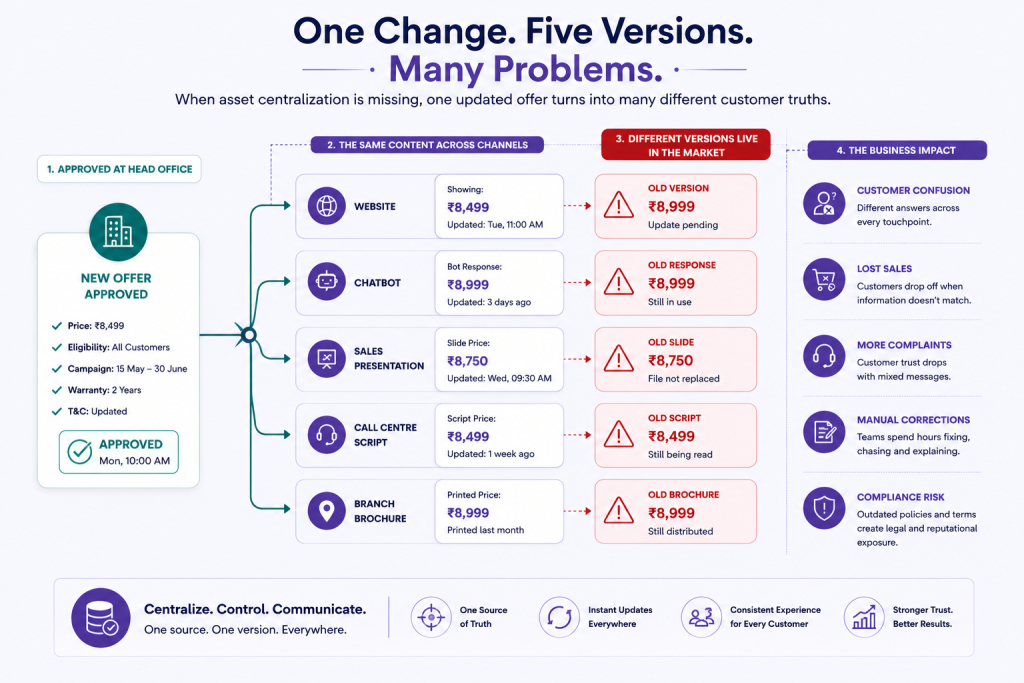
Head office approves a new offer on Monday. The revised price, eligibility rules and campaign dates are sent to marketing, sales, branches, agencies and customer service.
The website is updated on Tuesday. The sales deck is replaced on Wednesday. The chatbot continues quoting the old terms. One branch uses a brochure saved last month. The call centre reads from an outdated script, while a marketplace listing still shows the previous price.
The business made one change. Customers received five different versions of it.
This is not simply a slow-content problem. It is what happens when product information, policies, offers and customer communication are managed as separate files instead of one connected business change.
Without asset centralization, publishing the latest version does not guarantee that the older versions stop being used.
One Change Creates Work Across the Entire Business
A price, policy or offer rarely exists in one place. It may appear across:
- Website pages
- Mobile applications
- Customer portals
- Chatbot responses
- Email and SMS journeys
- Sales presentations
- Product brochures
- Branch posters
- Dealer and partner portals
- Marketplace listings
- Call-centre scripts
- Internal FAQs and SOPs
When the business changes one fact, every relevant touchpoint must change with it.
Most organisations handle this through instructions. A central team shares the revised file, asks channel owners to update their systems and follows up until everyone confirms completion.
The process appears manageable until one team misses the email, one agency edits the wrong master, one branch uses a downloaded copy, or one system requires a separate ticket.
The problem is not that employees refuse to use the latest information. The problem is that the organisation has no dependable mechanism for moving the approved change across every place where it appears.
Uploading the Latest File Is Not Enough
A shared folder may contain the new offer. That does not update the chatbot, website, portal, CRM template or local presentation automatically.
Older information may continue to remain active in:
- Email attachments
- Download folders
- Local desktops
- Messaging groups
- Agency workspaces
- CMS pages
- Knowledge bases
- Saved sales decks
- Printed materials
- Third-party platforms
Once a file is copied, the central team may not know where it has travelled or whether it is still being used.
This is why asset centralization must cover more than file storage. The business needs to know which information is approved, where it is used, what it replaced, when it becomes effective and when the old version must stop appearing.
The Customer Sees a Company That Cannot Agree with Itself
Customers do not care which team owns the website or who manages the branch brochure. They see one organisation.
When channels disagree, the customer may experience:
- One price online and another at the branch
- A chatbot quoting an expired policy
- A salesperson offering a discontinued package
- A portal displaying an old eligibility rule
- A customer-service agent denying an offer shown in an email
- A marketplace listing containing outdated product details
The result is not only confusion. It creates abandoned purchases, complaints, escalations, refunds, compliance risk and additional work for employees who must explain which version is correct.
A business may spend heavily creating a connected customer journey while allowing the most basic facts inside that journey to remain disconnected.
Why Content Updates Break Between Teams
Nobody owns the complete change
Product owns the offer. Marketing owns the campaign. Digital owns the website. Operations owns the branches. Customer service owns the scripts. Compliance owns the disclaimer.
Each team updates the part it controls, but no one confirms that the complete customer-facing change has been implemented.
Approval and distribution are treated as the same thing
Approving a new version does not mean it has been distributed successfully. The business may know when the new file was signed off but not when every channel adopted it.
Information is copied instead of reused
The same price, product description or policy text is recreated across several systems. Every copy becomes another place that must be found and changed.
The old version remains available
Even after the update, employees can still download, search or forward the previous asset. Without a clear replacement relationship, people choose whichever version is easiest to find.
Customer-facing systems update at different speeds
A website update may take hours. A chatbot knowledge base may refresh overnight. A dealer portal may require manual publication. Printed materials may remain active for weeks.
A dependable process must account for these differences instead of assuming every channel changes at the same time.
What a Single Source of Truth Should Actually Mean
A single source of truth does not mean forcing every channel to use the same file format or replacing every existing system.
It means the business can identify one approved source for the underlying information.
For every important offer, policy or product fact, the organisation should be able to answer:
- Who owns it?
- Which version is approved?
- When does it become effective?
- When does it expire?
- Which channels use it?
- What may local teams change?
- Which version did it replace?
- Has the previous version been withdrawn?
- Can the organisation prove where it was published?
The approved source may contain structured information such as price, validity period, eligibility, participating locations, mandatory disclaimer and CTA. Each channel can then present that information in the format it needs without inventing its own version.
What a Connected Change Process Should Look Like
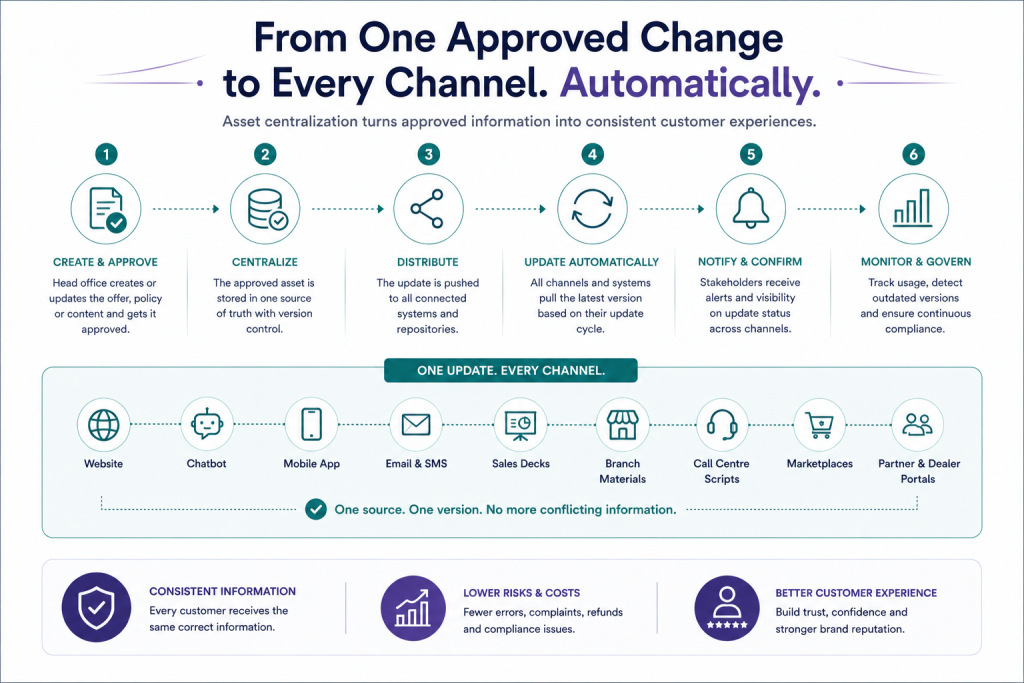
1. Create the approved master
The business owner submits the revised offer, product information or policy with the effective date, expiry date, affected locations and required disclosures.
2. Complete one controlled approval process
Brand, commercial, product and compliance teams review only the parts relevant to them. The final approved version receives a clear status and owner.
3. Map every affected channel
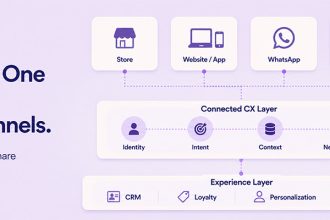
The system identifies where the information appears: website, app, chatbot, portal, email, branch material, sales deck and partner channels.
4. Publish through an omnichannel content delivery system
An omnichannel content delivery system should help distribute approved information to the relevant customer and employee touchpoints instead of relying entirely on separate manual updates.
5. Control local adaptation
Branches and regional teams may need to change approved fields such as location, contact number, language or participating service. Core pricing, claims and compliance statements should remain locked.
6. Withdraw the previous version
The old asset should be marked as replaced, removed from normal search and blocked from further use wherever possible.
7. Record completion
The central team should be able to see which channels have updated, which remain pending and where manual action is still required.
Asset Control Must Extend Beyond Marketing
This problem is often given to the brand or content team, but the impact reaches operations, revenue, compliance and customer service.
Marketing needs current campaign information. Sales needs current product and pricing material. Branches need valid local assets. Customer service needs approved answers. Compliance needs evidence that outdated terms were withdrawn.
That is why asset centralization belongs inside a broader operating model. The asset must connect with approvals, workflows, permissions, customer channels and audit history.
WeAddo’s Operations Suite brings asset centralisation, document governance and workflow automation into the work behind customer experience. The Experience Suite then uses the approved information across websites, portals, commerce and lifecycle journeys. Governance provides access controls, compliance and version reliability across the system.
Measure How Long One Change Takes to Reach the Customer
Do not measure only how quickly the master asset was approved. Track the complete change.
Useful measures include:
- Time from approval to full channel update
- Number of affected systems and teams
- Channels still displaying the old version
- Use of expired assets after replacement
- Customer complaints caused by inconsistent information
- Manual follow-ups required per update
- Local versions created outside the approved process
- Time required to withdraw the old information
These measures show whether the organisation has a single source of truth that drives execution or only a folder containing the latest file.
Run This Audit on One Recent Change
Choose one offer, policy, product detail or price updated during the last three months. Check:
- Where did the information appear before the change?
- Was every affected channel identified?
- How long did each channel take to update?
- Could employees still access the previous version?
- Did branches or agencies create local copies?
- Did the chatbot and call centre use the new information?
- Were customers shown conflicting versions?
- Can you prove when the old version stopped being active?
The audit will quickly reveal whether the change was controlled or merely announced.
Where Does Your Growth Stop?
Growth can stop when the customer reaches the right product but sees the wrong price. It can stop when a branch rejects an offer still promoted online, or when the chatbot answers using a policy that head office already replaced.
The business does not need more versions of the truth. It needs one governed source connected to every place where the truth is used.
Conclusion
A business change is not complete when head office approves it. It is complete when every relevant customer and employee channel reflects it, and the previous version is no longer active.
Effective asset centralization establishes ownership, approval, replacement and lifecycle control. A dependable single source of truth gives every team the same approved business information. An omnichannel content delivery system helps move that information consistently across websites, apps, portals, chatbots, branches and sales channels.
Choose one recent offer change and trace how long it took to reach every customer touchpoint.
Every conflicting version is an operational leak.
Audit one recent offer or policy update and identify every channel that continued using the old information after approval.
FAQs
Asset centralization brings approved content, documents and campaign materials into one governed environment with ownership, version, access and lifecycle controls.
A single source of truth is the approved source for information such as pricing, offers, product details and policies, even when that information appears across several systems.
An omnichannel content delivery system distributes approved information across customer and employee channels while reducing separate manual updates.
They may use different source files, update processes or systems. Local copies and delayed publication can keep old information active.
Track time to full channel adoption, outdated-version usage, manual follow-ups, customer complaints and the number of unofficial local variations.





Leave a Reply