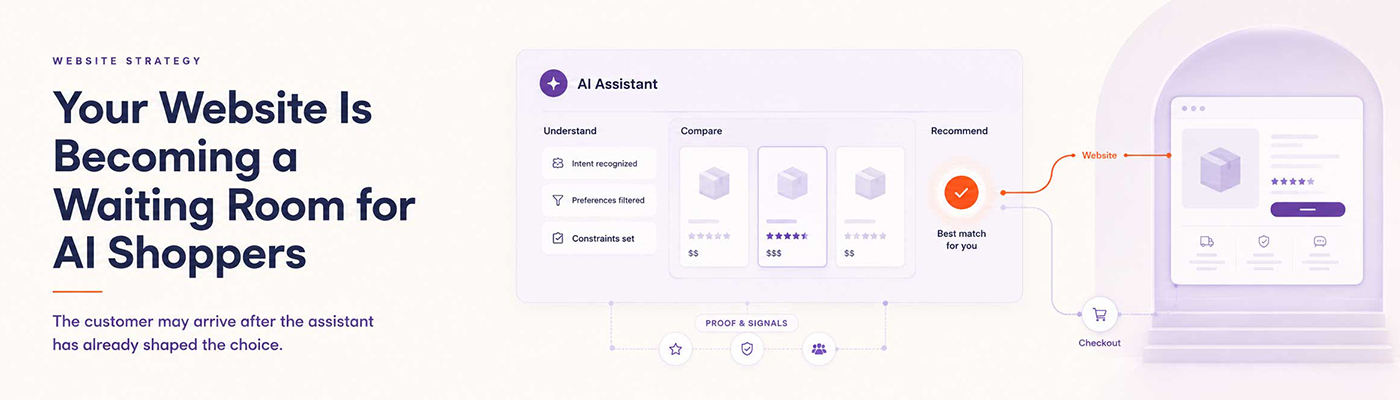
Your Website Is Becoming a Waiting Room for AI Shoppers
by
vikas weaddo
Your website is still open. The shopper may just arrive late.
For years, the website was the center of e-commerce gravity. Campaigns drove traffic to it. SEO fed it. Product pages carried the pitch. Reviews supported confidence. Cart and checkout closed the sale. Every redesign promised better conversion, better UX, better speed, better brand experience.
That model still matters. But it is no longer the full journey.
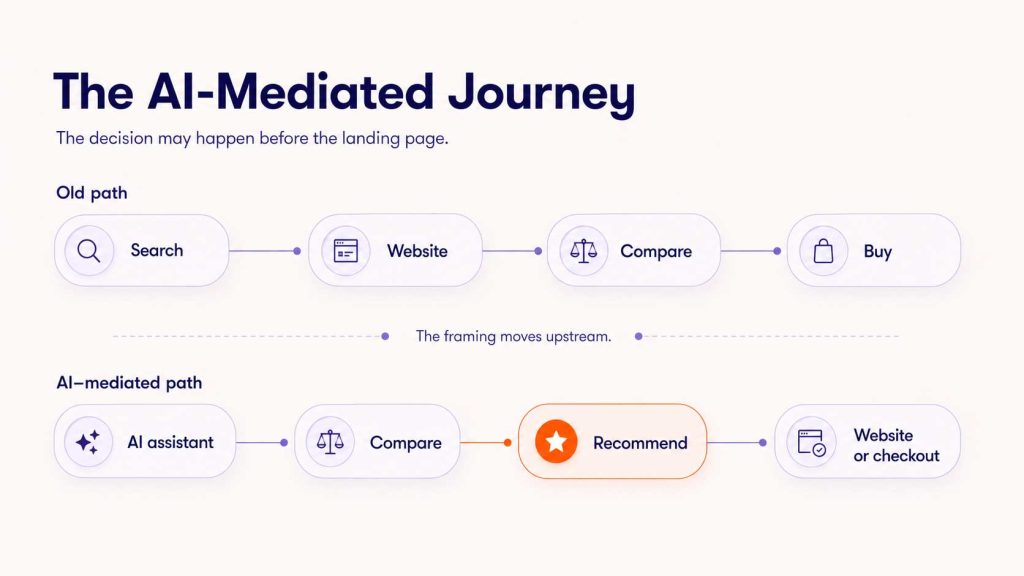
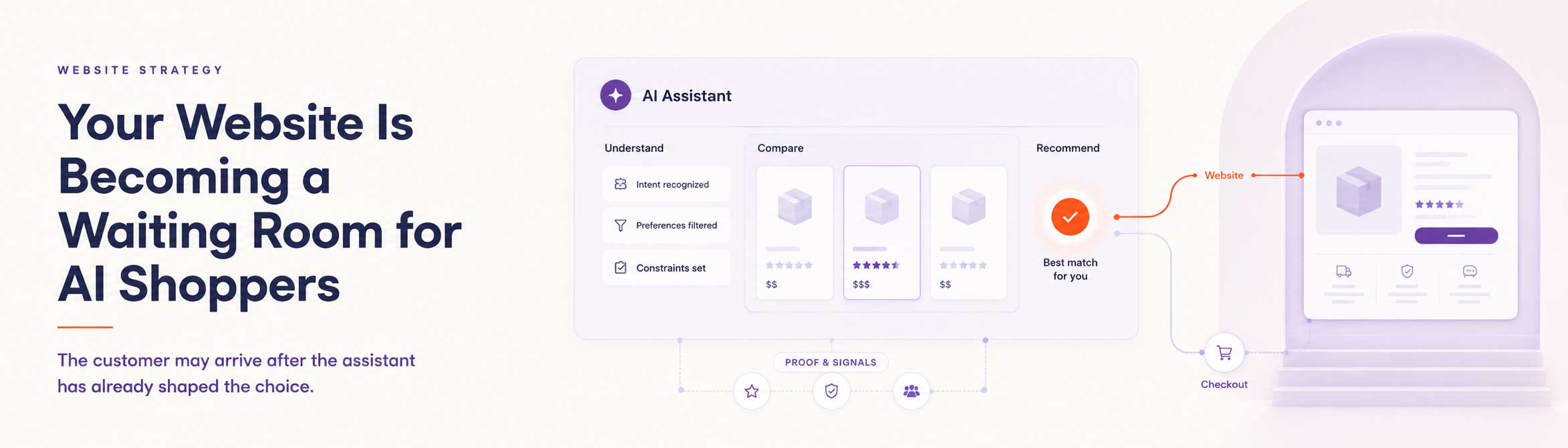
AI shoppers are changing the sequence. A customer can ask an assistant to compare products, filter by budget, summarize reviews, check delivery options, evaluate return policies, understand fit, and shortlist brands before reaching your website. The shopper may still buy from you, but the decision may be shaped before your homepage, PDP, or offer gets a clean chance to persuade.
That is the uncomfortable shift for a Head of E-commerce. The website is not dead. But it may be becoming a waiting room. If the buyer has already compared, filtered, trusted, or rejected you upstream, your store is no longer the first decision layer. It is one touchpoint inside a much larger commerce experience platform reality.
The scary part is not losing traffic. It is losing the framing.
When shoppers arrive through your website, you control the story. You frame the product. You explain the benefit. You show the proof. You guide the offer. You design the next step.
When an AI assistant frames the choice first, you enter later. Maybe as the recommended brand. Maybe as one option among five. Maybe as the cheaper alternative. Maybe as the brand with unclear reviews, confusing return policy, incomplete product data, or weak availability signals. Maybe not at all.
That is not just a traffic problem. It is a framing problem. E-commerce brands cannot keep treating website strategy, product data, reviews, marketplaces, social proof, support content, CRM, and checkout as separate things. AI shoppers do not see your org chart. They see the evidence layer around your brand.
This is where an omnichannel commerce platform mindset matters. The customer journey is not only what happens after a shopper lands. It is what the market learns about you before they land.
A beautiful website cannot compensate for messy digital truth.
Most brands still over-invest in the visible store and under-invest in the signals around it. The homepage is polished. The product feed is stale. The PDP copy is emotional, but the specifications are incomplete. The reviews are inconsistent across channels. The return policy is hard to compare. The marketplace listing says one thing. The website says another. Support gives a third answer.
AI shoppers need clean facts. Product names, attributes, pricing, availability, delivery timelines, return policies, size guides, benefits, reviews, FAQs, and proof need to be clear and consistent. If those signals are messy, an AI-assisted journey will not magically understand your brand better. It will expose the gaps faster.
The new question for e-commerce leaders is simple: can your brand be understood, trusted, and chosen when the customer never gives your homepage the courtesy of a visit?
A unified commerce platform retail approach helps because it treats product data, customer data, content, commerce workflows, and customer experience as connected parts of the same growth system.
The new website job is different.
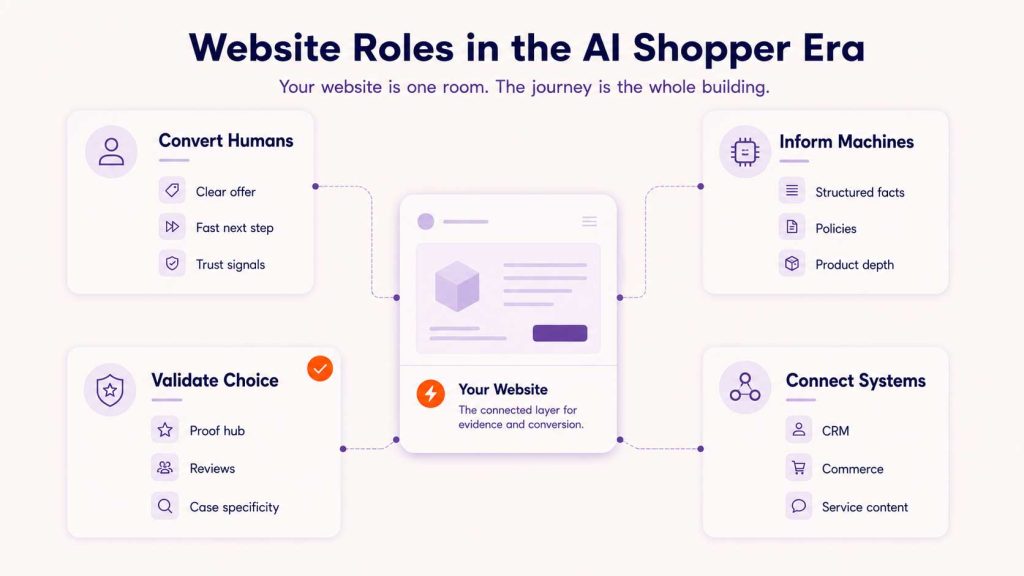
The website still matters. It just has a harder job now. It has to convert humans, inform AI systems, validate recommendations, support comparison, reduce uncertainty, connect to CRM, feed product truth, carry service clarity, and continue the journey into purchase, support, returns, and retention.
That means product pages need more depth. FAQs need real answers. Reviews need to be part of the experience, not just a widget. Support content needs to explain what happens after the sale. Comparison content needs honesty. Return and delivery policies need clarity. Product feeds need discipline. Structured content needs to be maintained. Personalization needs to respond to current shopper context, not stale assumptions.
A website that only sells to humans may underperform in a world where machines help decide what humans see. That is why commerce orchestration platform thinking matters. The website has to connect with discovery, CRM, product data, customer data, support, automation, analytics, and retention.
The no-click journey still creates business consequences.
Some shoppers will not click when you expect them to. They will ask, compare, shortlist, and decide in an AI surface, marketplace, social search, review layer, or assistant-led journey. That does not mean your brand has no influence. It means influence is happening through signals AI systems and customers can read.
Owned content, marketplace data, product feeds, public reviews, social proof, creator content, support knowledge, delivery promises, return policies, and customer service experiences are now part of the same visibility system. Your website is one room. The customer journey is the whole building.
This is why e-commerce brands need stronger retail customer data platform, retail CDP platform, and customer data platform retail foundations. If shopper signals are scattered across website, marketplace, ads, CRM, support, loyalty, WhatsApp, app, and email, the brand cannot see the real journey. It may know traffic. It may know orders. But it will struggle to understand how shoppers decide before the click and what makes them return after the order.
Where e-commerce growth usually leaks in AI-mediated journeys.
The first leak is product discovery. Shoppers compare before landing, but product data is not strong enough to be trusted outside the website. The second leak is validation. Reviews, ratings, policies, and third-party proof are inconsistent, so the shopper gets doubt instead of confidence.
The third leak is conversion context. A shopper lands after already comparing options, but the website treats them like a cold visitor. The fourth leak is post-purchase memory. The brand captures the order but fails to connect delivery, returns, support, loyalty, replenishment, and retention signals into one shopper journey.
This is where a customer 360 platform retail or shopper 360 platform becomes important. E-commerce teams need to know not just who bought, but what the shopper compared, what problem they were solving, which product signals mattered, what happened after delivery, and whether the relationship continued.
Traffic is not growth. A completed, repeatable, profitable shopper journey is growth.
What e-commerce leaders should fix now.
First, clean the digital truth around the brand. Product feeds, PDPs, marketplaces, reviews, FAQs, delivery promises, returns, pricing, size guides, and product attributes should not contradict each other. Second, design for AI-mediated discovery, not just website sessions. Some shoppers will land. Some will decide before they land. Both journeys need a strategy.
Third, connect customer and product intelligence. A retail customer insights platform, customer intelligence platform retail, and retail data intelligence platform should help the business see which products, channels, claims, policies, and experiences create real conversion and repeat purchase.
Fourth, make personalization useful after the click. A retail personalization platform should not just show “recommended products.” It should use shopper context to reduce friction, improve fit, recover intent, support replenishment, and make the next step easier.
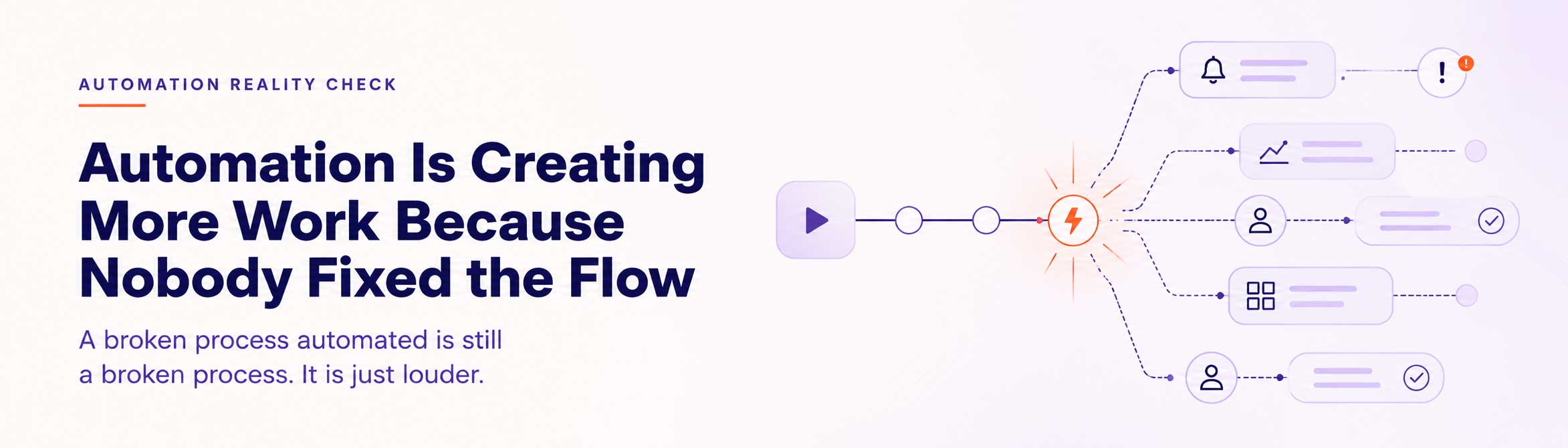
Fifth, connect automation to operations. An ecommerce automation platform and ecommerce workflow automation layer should help teams act when product interest rises, inventory drops, support friction increases, returns spike, or repeat purchase slows down. The future-ready store is not just good-looking. It knows what is happening and responds.
Where Weaddo fits.
Weaddo helps e-commerce and D2C brands treat the website as one node in a connected commerce operating layer, not the entire journey. That means aligning product data, content strategy, SEO, customer data, CRM, personalization, reviews, support knowledge, automation, analytics, and conversion flows around how shoppers now discover, compare, validate, buy, and return.
For a Head of E-commerce, Weaddo helps connect discovery to checkout and repeat purchase. For a CMO or Growth Head, it helps connect paid, organic, marketplace, and owned signals into clearer growth visibility. For Retention and CRM teams, it helps turn shopper data into useful journeys. For CIOs and CTOs, it helps create the integration and data foundation needed before AI-mediated commerce scales.
The goal is not to panic about every AI surface. The goal is to become easier to understand, recommend, validate, and buy from across the surfaces that matter.
That is how e-commerce brands become Unified. Intelligent. Ready. Unified, because product, customer, content, and commerce signals connect. Intelligent, because teams can see where shoppers decide and where they drop. Ready, because AI shoppers will reward brands whose truth is clear before the click.
The rule is simple.
Your website is not dead. But it is no longer the whole journey.
AI shoppers may compare, filter, validate, and frame the decision before they arrive. If your product truth, reviews, policies, customer data, support content, and commerce workflows are scattered, the brand may lose before the homepage loads.
Where does your growth stop? It may stop where the shopper decides upstream and your commerce operating layer is not ready to influence that decision.
The e-commerce brands that win the next stage will Bridge the Future Gap by building a connected commerce system that is easy to find, easy to trust, easy to compare, easy to buy from, and easy to come back to.
Talk To Us
Talk to Weaddo to identify where your e-commerce website, product data, customer journeys, reviews, personalization, automation, and retention systems need to connect before AI shoppers make the decision upstream.





Leave a Reply