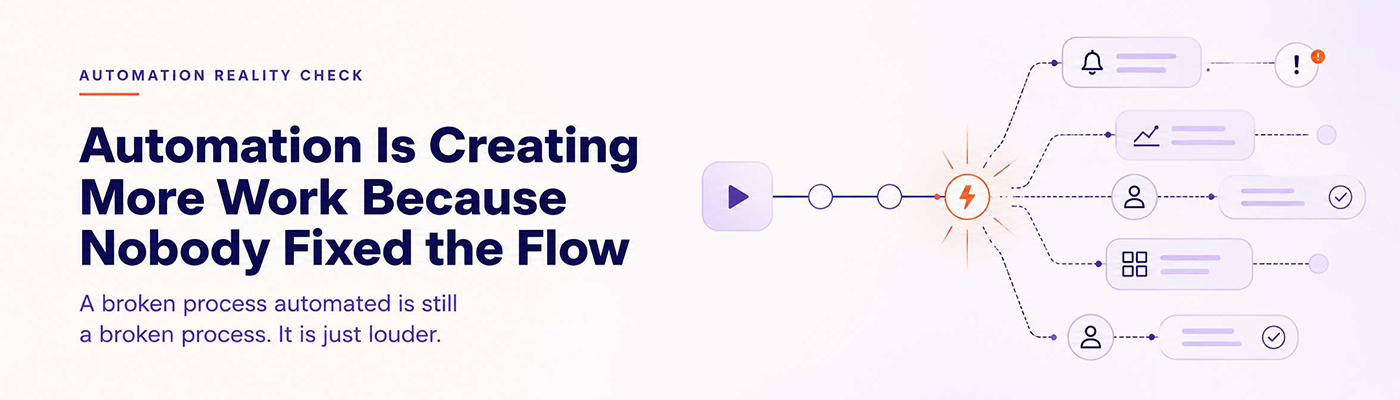
Automation Is Creating More Work Because Nobody Fixed the Flow
by
vikas weaddo
Automation was supposed to make hospital work easier. In many places, it only made the chasing faster.
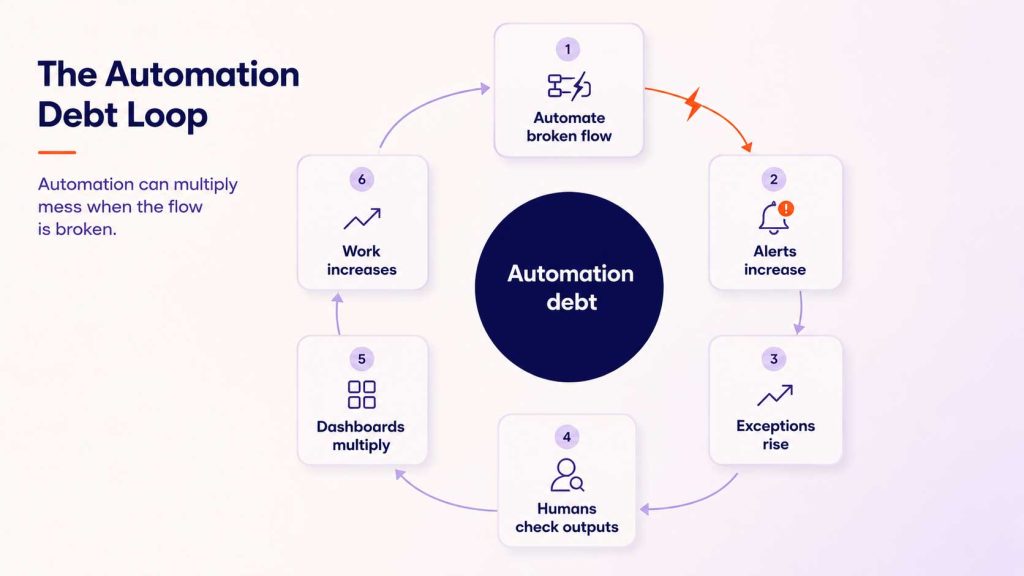
Every healthcare business has a version of this story. A reminder is automated. Then someone adds a second reminder because the first one is missed. Then a dashboard tracks missed reminders. Then an exception queue appears. Then the front desk still calls manually. Then WhatsApp becomes the backup system. Then the operations team holds a meeting to understand why the “automated” process still needs people chasing it every day.
Congratulations. The work did not disappear. It became coordination.
The problem is not automation itself. The problem is automating a patient flow nobody fixed first. If enquiry, booking, front desk, HIS, billing, lab, pharmacy, reports, and follow-up are already disconnected, healthcare workflow automation will not magically create order. It may simply move confusion faster.
A bad patient flow does not become intelligent because a trigger fired.
A bad patient flow does not become intelligent because software touched it.
Healthcare teams often automate because the process is painful. That sounds logical. But pain is usually a signal, not a task list.
If appointment ownership is unclear, automation will notify everyone and make nobody accountable. If patient data is messy, automation will move bad data faster. If the CRM and HIS do not talk, automation will create more duplicate checks. If front desk, call center, lab, billing, and pharmacy work from different views, automation will not create one patient truth. It will create faster handoffs with the same gaps.
This is where a healthcare workflow automation platform must be judged carefully. Does it fix the flow, or does it simply add triggers to a broken system? Does it reduce manual work, or does it create a new job called “checking whether the automation worked”?
A hospital cannot scale on screenshots, reminders, and heroic coordinators. Your care team should not be your workflow software.
The automation tax is real in healthcare.
Automation creates work when every patient action creates a new alert. It creates work when teams do not trust the system and still verify everything manually. It creates work when exceptions are more common than standard cases. It creates work when a reminder goes out, but nobody owns the next step. It creates work when the patient gets a message, but the front desk, billing team, or lab team does not have the same context.
This is where many efficiency projects become operational debt.
The dashboard says time saved. The team says, “Then why are we busier?”
In healthcare, the automation tax shows up everywhere. Appointment reminders still need calls. Missed follow-ups still need manual chasing. Lab reports still need someone to coordinate. Discharge workflows still depend on WhatsApp. Billing queries still bounce between teams. Patients still repeat information that the hospital already collected.
The useful rule is simple: if the flow is broken, automate later. Otherwise you are not removing work. You are multiplying it with better timing.
The mistake is starting with tasks instead of patient flow.
Task automation feels satisfying because it is visible. Send reminder. Update CRM field. Assign callback. Trigger WhatsApp. Move lead. Generate report. Escalate case. Nice.
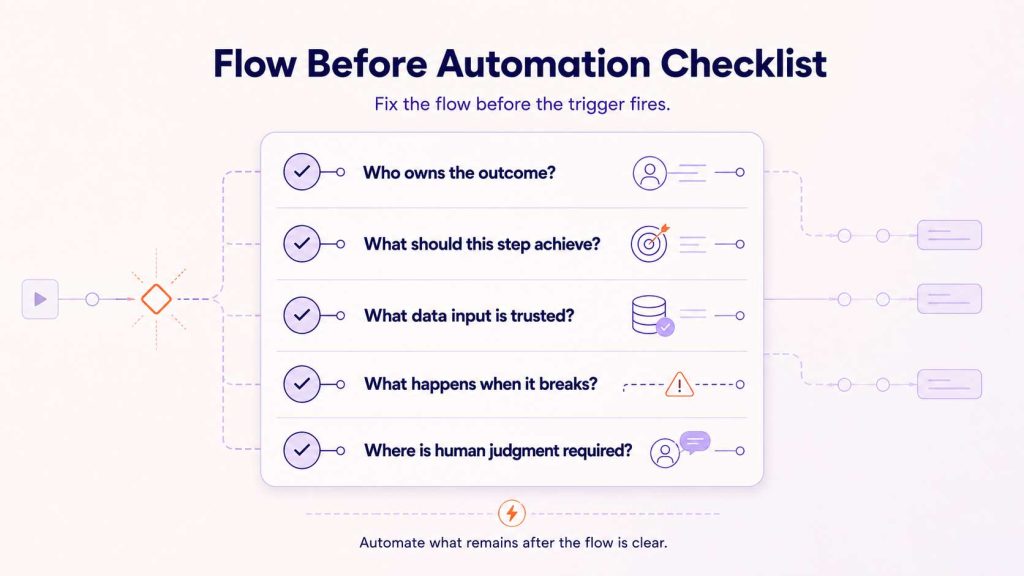
Patient flow design is less glamorous. It asks harder questions. Should this step exist? Who owns the patient at this stage? What information is needed before action? What happens when the patient does not respond? What happens when the doctor reschedules? What if reports are delayed? Who handles no-shows? Who follows up after consultation? Which step needs human judgment? Which update should go to the patient? Which handoff should never depend on memory?
Those questions are why flow design gets skipped. They are also why business process automation in healthcare often underperforms.
A patient journey automation platform is useful only when the journey has been designed. Otherwise, automation becomes a faster way to expose that no one agreed how the patient should move.
Where healthcare automation usually creates more work.
The first break is enquiry-to-booking. Leads come from website, ads, WhatsApp, doctor pages, call center, SEO, referrals, and packages. But the context does not move into one owned flow. Someone still has to chase, verify, assign, update, and follow up.
The second break is booking-to-visit. The patient gets reminders, but slot availability, doctor changes, prep instructions, rescheduling, and no-show recovery are not connected clearly enough. So the team still calls manually.
The third break is visit-to-billing. The patient comes in, but billing, package details, diagnostics, pharmacy, and payment follow different workflows. Automation may send updates, but teams still reconcile the truth manually.
The fourth break is reports-to-follow-up. Lab reports, prescriptions, next appointments, care plans, and retention nudges are scattered. The patient journey continues, but the system forgets to carry it.
This is why healthcare workflow orchestration system thinking matters. The goal is not to automate isolated tasks. The goal is to orchestrate the patient journey so fewer things break.
A better automation strategy starts by removing nonsense.
Before automating, simplify. Remove redundant steps. Clarify ownership. Fix data inputs. Define exception paths. Reduce approvals that exist only because nobody trusts the process. Decide where humans add value and where they are being used as glue.
Then automate what remains.
That means a hospital should not begin by asking, “Which reminder can we automate?” It should ask, “Why does this reminder need manual recovery every day?” It should not ask only, “Can we automate report communication?” It should ask, “Why does report status not move cleanly across lab, doctor, front desk, patient portal, and follow-up?”
A strong healthcare automation platform should reduce friction, not create a new layer of work. A strong healthcare operations automation platform should help teams see ownership, status, exceptions, and next steps. A strong patient communication workflow automation model should make communication clearer for patients and lighter for teams.
And no, the answer is not more alerts. Alerts are not accountability. They are noise with a timestamp.
What healthcare leaders should fix now.
First, map the patient flow from enquiry to booking, visit, billing, diagnostics, pharmacy, reports, follow-up, and retention. Do not start with automation. Start with the journey.
Second, identify where manual chasing happens. Every repeated call, WhatsApp reminder, spreadsheet, screenshot, duplicate entry, and status check is a signal that the flow is not ready.
Third, connect the systems that carry patient context. CRM, HIS, EMR, call center, appointment engine, lab, pharmacy, billing, reports, patient portal, and communication channels should not behave like separate businesses. This is where HIS CRM integration platform and healthcare data unification platform thinking becomes critical.
Fourth, define ownership. Every patient stage should have an owner, a next step, a status, and an escalation path. If everyone is notified, nobody owns it.
Fifth, use analytics to find where work is multiplying. A healthcare analytics platform should show where no-shows, delays, report gaps, follow-up misses, billing issues, and manual coordination are costing time and revenue.
Automation should not make the hospital louder. It should make the patient journey clearer.
Where Weaddo fits?
Weaddo helps healthcare businesses move from tool-led automation to flow-led transformation. That means mapping patient journeys, internal workflows, CRM logic, HIS connections, data quality, handoffs, escalation paths, communication rules, analytics, and measurement before building more triggers.
For a Healthcare COO / Operations Head, Weaddo helps reduce manual chasing, unclear ownership, and operational overload. For CIOs and CTOs, it helps connect systems before automation scales. For Patient Experience leaders, it helps make communication and follow-up more consistent. For Growth and Marketing leaders, it helps connect patient acquisition to actual patient movement, not just lead dashboards. For CEOs and founders, it helps show where growth is leaking inside operations.
The strongest automation systems are not the ones with the most workflows. They are the ones where fewer patients wait, fewer teams chase, fewer exceptions pile up, and fewer coordinators become the hidden operating system.
That is how healthcare businesses become Unified. Intelligent. Ready. Unified, because patient context moves across teams. Intelligent, because leaders see leakage and workload early. Ready, because automation and AI can scale only when the patient flow is connected.
The rule is simple.
Before you automate the next step, ask whether the step deserves to survive.
If the process depends on memory, automation will not fix it. If patient context is scattered, automation will move confusion faster. If ownership is unclear, automation will notify people without creating accountability. If exceptions are common, automation will create another queue for someone to manage.
Where does your healthcare growth stop? It may stop where automation begins before the patient flow is ready.
The healthcare businesses that win the next stage will Bridge the Future Gap by fixing the flow before scaling the trigger. Not more alerts. Not more dashboards. Not more coordination disguised as efficiency. One connected patient journey that teams can operate, and patients can feel.
Weaddo Knows the Way
Talk to Weaddo to identify where your healthcare automation, CRM, HIS, patient communication, booking, billing, reports, and follow-up workflows are creating more work; and how to build a connected operating layer before scaling automation.




Leave a Reply