The Great Martech Roll-Up: Why B2B Leaders Need Architecture Before Consolidation
by
vikas weaddo
Your stack is not a stack anymore. It is a power struggle.
B2B marketing teams used to buy tools to solve specific problems. One tool for email. One for CRM. One for attribution. One for analytics. One for automation. One for landing pages. One for intent data. One for customer engagement. One for reporting. One more for the workflow gap nobody wanted to admit existed.
Now the question is changing. Vendors do not just want to be useful. They want to become the place where work happens. The CRM wants to be the customer operating system. The automation platform wants to own journeys. The analytics layer wants to own intelligence. The suite wants to own data, workflow, AI, governance, and decision-making.
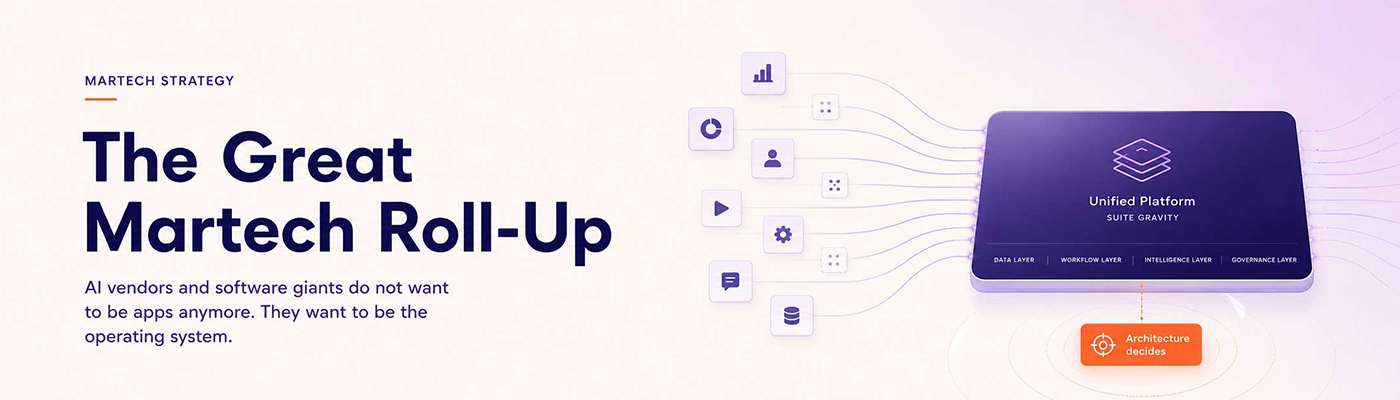
That is the Great Martech Roll-Up: the move from scattered tools toward suite gravity, bundled AI layers, and platforms that want to become the growth operating system. For a CMO / Growth Head, this is not just a procurement issue. It is a growth architecture issue. If the wrong platform becomes the center of gravity, your campaigns, CRM, workflows, attribution, content, and customer journeys start bending around the vendor’s logic instead of your business logic.
The seductive lie is simple: fewer tools always means a cleaner business. Sometimes it does. Sometimes it just means one platform quietly makes every decision harder to question.
Consolidation is not as simple as fewer logos.
The martech conversation loves easy advice: too many tools, consolidate the stack, cut waste, simplify everything. Fine. Most B2B stacks do need cleanup. But the answer is not automatically “move everything into one suite.”
AI is creating new categories while large platforms are absorbing more functions. New point tools appear at the edge, then the useful ones get copied, bundled, acquired, or made irrelevant by bigger suites. The result is not a clean stack. It is stack gravity.
This is why B2B leaders need more than a tool audit. They need architecture. A B2B digital transformation platform should not just reduce vendor count. It should help the business connect customer data, campaigns, CRM, sales workflows, service signals, content, reporting, automation, and governance into one clearer operating model.
The real question is not “How many tools do we have?” The better question is: “Where does work actually happen, where does data move, and where does growth leak?”
The suite pitch sounds seductive.
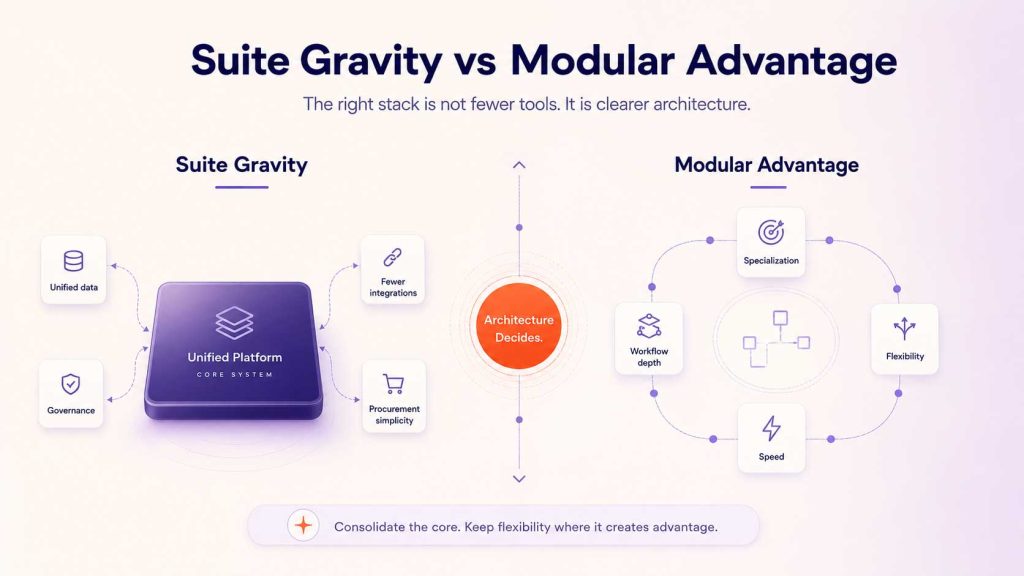
One platform. Unified data. Native AI. Fewer integrations. Less vendor management. Cleaner procurement. Better governance. A dashboard that makes leadership feel briefly safe.
That pitch is not wrong. It is just incomplete.
Suites can reduce chaos, but they can also create dependency. They make some things easier and some choices harder. They improve data flow inside their own garden while making it harder to stay neutral outside it. They simplify vendor sprawl while increasing platform gravity.
For B2B companies, this matters because growth is rarely owned by one team. Marketing creates demand. Sales carries context. RevOps manages the process. Customer “Success” owns adoption. Support sees friction. Finance sees revenue. Leadership sees the outcome. If one suite defines the workflow for all of them, the business may gain convenience but lose flexibility.
The sharper question is this: are you buying integration, or are you outsourcing architectural judgment because the stack became too annoying to think about?
Point tools are not dead. They just need a better reason to exist.
Point tools still matter when they are meaningfully better, faster, more specialized, or closer to a workflow than the suite. But the bar is rising. A tool can no longer survive because it has a clever demo, a cleaner UI, or one feature the suite has not copied yet.
In B2B, a point tool needs to prove that it improves the operating model. Does it connect cleanly to CRM? Does it enrich the customer data layer? Does it reduce manual work or create more of it? Does it improve attribution? Does it help sales, marketing, success, or support move faster? Does it create insight the core platform cannot? Does it work inside a customer journey orchestration platform, or does it become another disconnected source of truth?
If the answer is unclear, it is probably not a strategic tool. It is a subscription-shaped habit.
This is where Weaddo’s lens matters. The goal is not suite worship or point-tool addiction. The goal is connected execution. A B2B customer experience platform should help teams carry customer context across the full journey, not create another place where context gets stuck.
The real risk is not buying too much software. It is losing architectural judgment.
B2B teams often swing between two bad extremes. One extreme is tool maximalism: buy every shiny thing and call it innovation. The other is suite surrender: let one platform define every process because integration sounds hard.
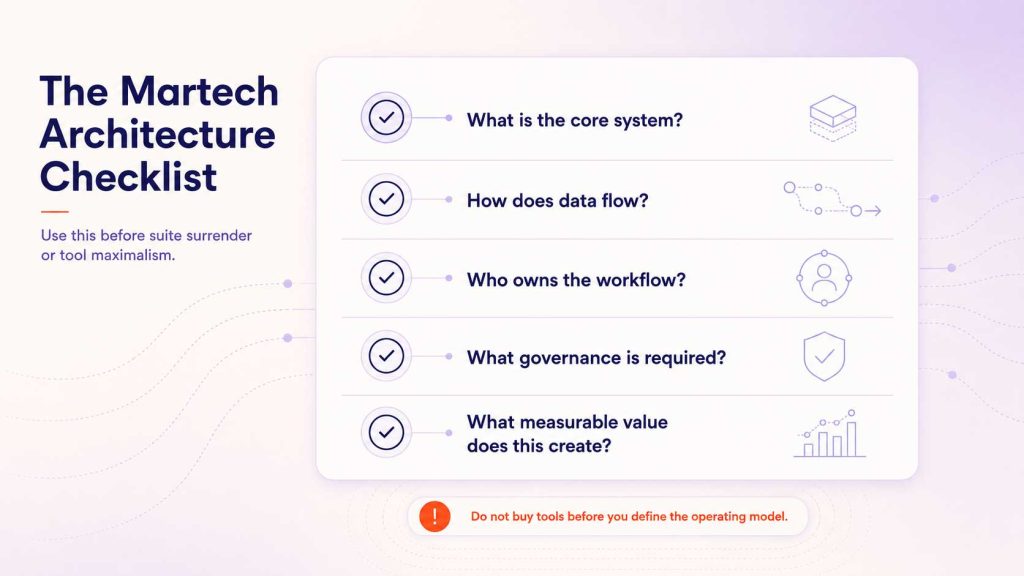
The useful middle is architecture. Decide what should be core, what should be modular, what data must be shared, what workflows must remain flexible, and which teams own which decisions.
That means asking practical questions before the next renewal or consolidation push. What is the core system of record? Where should customer data live? How should CRM, ERP, marketing automation, analytics, service, and customer success tools connect? Which workflows need deep specialization? Which tools create real business value? Which dashboards actually change decisions? What governance is required? What does the business need to become AI-ready?
This is where keywords like enterprise integration platform, business system integration platform, CRM ERP integration platform, and data governance stop sounding like IT language. They become growth requirements. If your systems do not connect, your teams keep working from different truths. If teams work from different truths, growth leaks between handoffs.
The martech roll-up will expose weak operating models.
Consolidation looks clean from the top. It gets messy inside the work. A CMO may see too many tools. RevOps may see broken handoffs. Sales may see the missing context. Customer Success may see adoption risk. IT may see integration debt. Finance may see recurring cost. Leadership may see dashboards but still not see truth.
That is the problem. The stack is not just a set of tools. It is how the business works.
A workflow management platform or business process automation software layer can only help if the workflows are designed properly. A B2B customer engagement platform only works if engagement is connected to real customer context. An AI-ready enterprise platform only works if the data, workflows, governance, and customer journey are ready before AI starts making decisions.
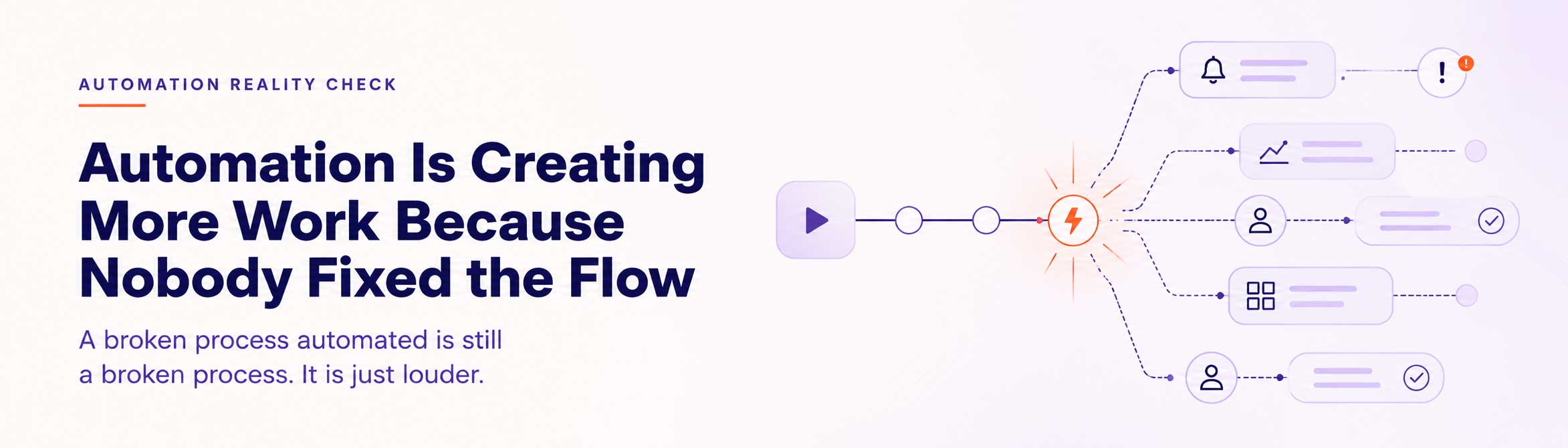
AI will make stack confusion more expensive. If AI is layered on top of disconnected CRM, scattered campaign data, unclear ownership, weak attribution, and messy customer records, it will not create intelligence. It will automate confusion faster.
What B2B leaders should fix before consolidating.
First, map the customer journey across marketing, sales, onboarding, support, success, renewal, and expansion. Do not start with the tools. Start with the journey.
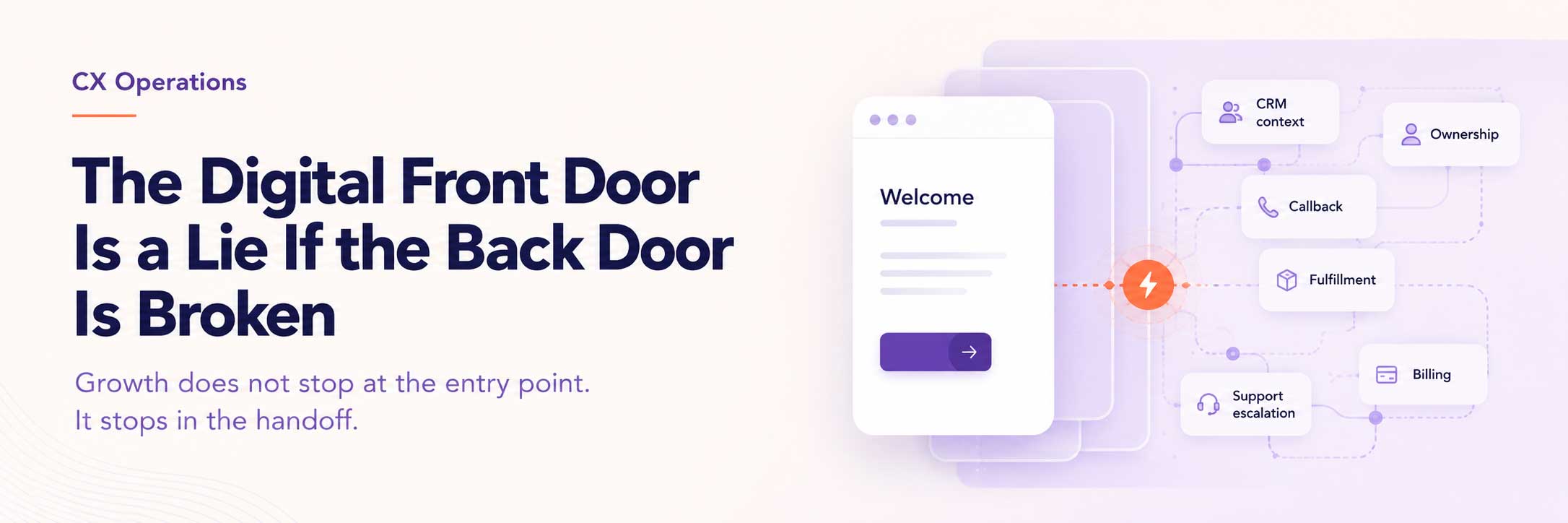
Second, identify where growth stops. Does lead context stop moving after form fill? Does sales lose campaign context? Does onboarding start without promise history? Does Customer Success inherit weak account data? Does support know what was sold? Does leadership see revenue signals late?
Third, define what belongs in the core suite and what should stay modular. Some workflows need depth. Some tools need to disappear. Some systems need integration, not replacement. Some teams need governance before automation.
Fourth, connect the operating layer. A unified customer journey platform should help customer context move across teams, not just centralize activity. The right architecture should support attribution, segmentation, automation, reporting, workflow ownership, content operations, and customer intelligence.
Fifth, make AI-readiness a business condition, not a feature claim. AI needs connected data, clean workflows, and clear governance. Without that, AI becomes another layer in the tool storm.
Where Weaddo fits.
Weaddo helps B2B companies turn the martech roll-up into a strategy, not a panic. The question is not “Which tool is trendy?” or “Which suite is safest?” The question is: “What should our growth operating system actually do?”
For CMOs and Growth Heads, Weaddo helps connect campaigns, customer journeys, content, CRM, attribution, and revenue visibility. For RevOps, it helps connect handoffs, workflows, customer data, and lifecycle logic. For CIOs and CTOs, it helps bring architecture, integration, governance, and AI-readiness into the conversation before tool decisions become expensive. For Customer Experience and Success leaders, it helps make customer context travel beyond the first conversion.
Weaddo does not push the idea that every business needs more tools. It pushes the harder truth: the business needs a clearer operating layer. That may mean consolidating some systems, keeping specialized tools where they create advantages, integrating the stack better, removing dead weight, and designing workflows around how growth actually happens.
This is how a B2B company becomes Unified. Intelligent. Ready. Unified, because systems and teams work from the same customer’s truth. Intelligent, because signals turn into better decisions. Ready, because AI and automation can scale on top of connected operations instead of messy stack gravity.
The rule is simple.
The Great Martech Roll-Up will not reward the company with the fewest tools. It will reward the company with the clearest architecture.
Too many tools can create chaos. One suite can create dependency. The right answer is not tool maximalism or suite surrender. The right answer is operating model clarity.
Where does your growth stop? It may stop where your stack looks powerful, but your customer’s journey still breaks. It may stop where marketing, sales, success, support, finance, and leadership all see different truths. It may stop where AI is added before the business is connected enough to use it.
The B2B companies that win will Bridge the Future Gap by designing the stack before the stack designs them.
What do you do now?
Talk to Weaddo to identify where your B2B martech stack, CRM, workflows, customer data, integrations, and reporting are creating growth leakage, and how to build a connected operating layer before the next consolidation decision.




Leave a Reply