The growth hackers found AI search. Of course they did.
Every important discovery channel eventually attracts shortcuts. SEO got keyword stuffing. Social engagement bait. App stores got fake reviews. Now AI search gets GEO, or generative engine optimization. The idea is not wrong. If a B2B buyer asks ChatGPT, Gemini, Perplexity, or AI Overviews for “best customer data platforms for mid-market teams” or “top RevOps tools for SaaS companies,” your brand needs a shot at appearing in that answer.
For a B2B SaaS CMO / Growth Head, that matters because AI answers can influence shortlists before your SDR, landing page, or nurture sequence gets involved.
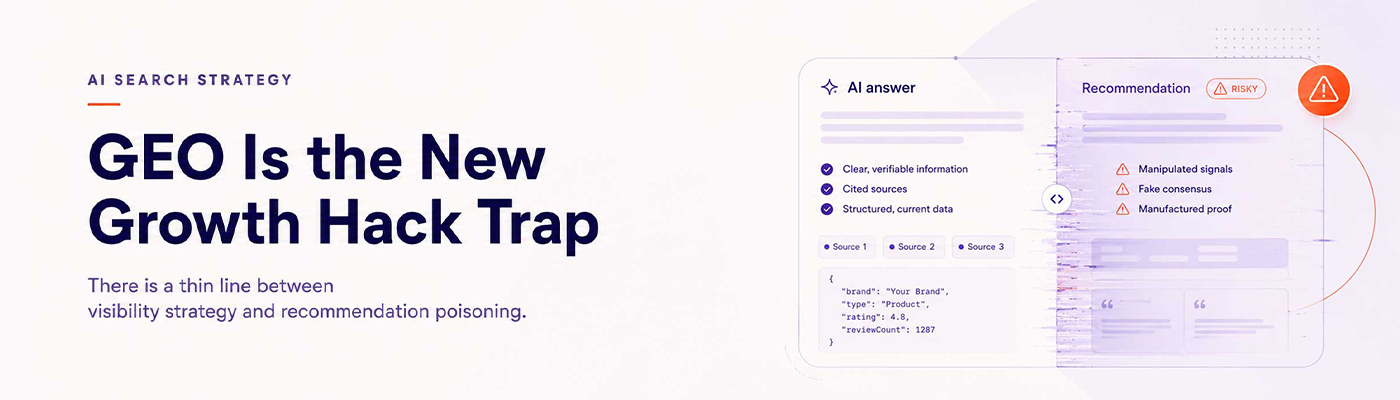
The problem starts when AI visibility becomes manipulation with better vocabulary. Some teams will try to mass-produce “best tools” pages, manufacture comparison signals, stuff pages with machine-targeted claims, or create fake consensus around their category position. That shortcut may create temporary visibility, but it will not create defensible trust.
In B2B SaaS, the buyer does not only want a name. They want proof. They want category clarity, use-case fit, pricing confidence, implementation of reality, customer evidence, and risk reduction. If your content is designed only to trick the answer layer, it will age badly.
Optimizing for AI is not the issue. Poisoning the recommendation layer is.
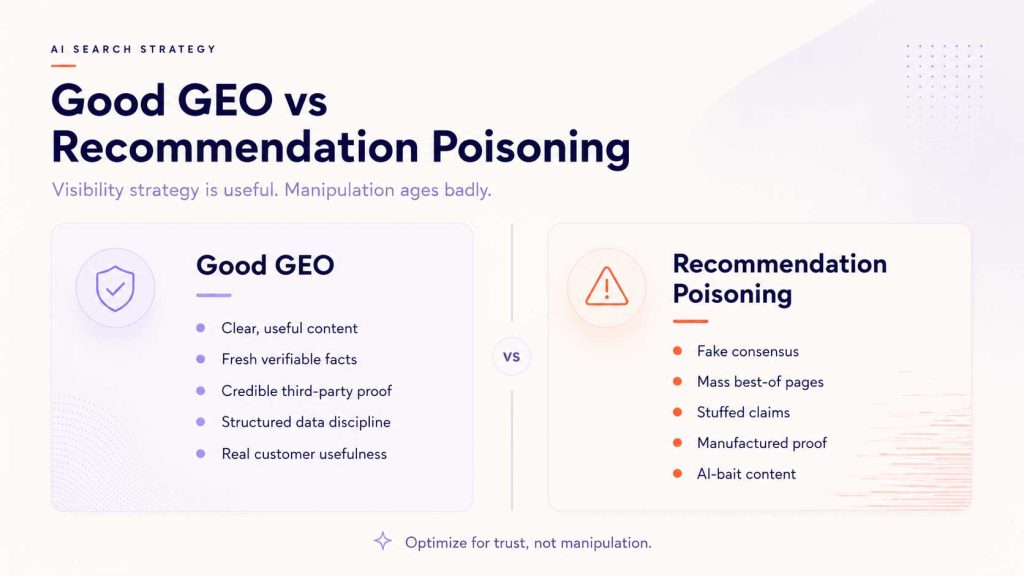
Good generative engine optimization is not the villain. B2B SaaS brands should absolutely make their positioning, use cases, product pages, integration pages, pricing context, comparison content, customer stories, review profiles, and help content easier for humans and answer engines to understand. That is useful. That is a strategy.
The trap is treating answer engine optimization like a new spam channel. Mass “best-of” pages with thin analysis are not strategy. Fake review momentum is not a strategy. Overloaded category claims are not strategy. AI-bait content that says everything and proves nothing is not strategy.
For SaaS buyers, this is especially risky because the buying journey is already full of doubt: Will this integrate? Will the team adopt it? Will it show ROI? Will implementation drag? Will the vendor support our use case? Will this become another tool nobody trusts?
If your GEO content does not help answer those doubts clearly, it is not building demand. It creates noise. The better provocation is simple: GEO should not be about tricking machines into mentioning you. It should be about making your brand so clear and useful that machines have a reason to.
The real risk for B2B SaaS is not low visibility. It is low trust.
AI answers feel different from traditional search. Search gives a list. AI gives a sentence. That sentence can feel like judgment. If a buyer sees your SaaS brand recommended by an answer engine, the next question is not just “Did we get mentioned?” The real question is “Can the buyer verify why?”
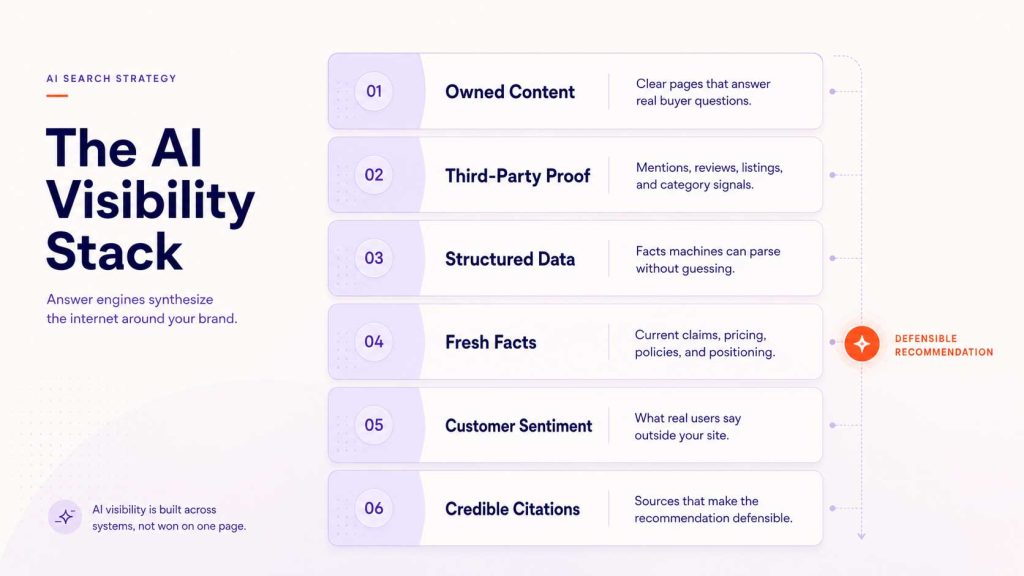
This is where many SaaS brands expose the gap. The homepage says one thing. G2 or Capterra reviews say another. The pricing page is vague. The integration page is thin. The comparison page attacks competitors but gives no useful decision criteria. The case studies are too polished to be believed. The help center is outdated. The category page sounds like everyone else’s. The sales deck has a sharper position than the website. The customer proof sits in scattered PDFs. AI does not create this confusion. It synthesizes it.
That is where growth stops. Not because the market is not searching. Because the brand truth is not strong enough to be trusted, repeated, cited, and recommended.
B2B SaaS buyers are using AI to reduce research pain.
The B2B SaaS buyer has too much to compare. Every category has too many vendors, too many claims, too many demos, and too many “all-in-one” promises. AI search becomes attractive because it compresses research. It can summarize the category, explain trade-offs, compare vendors, highlight risks, surface alternatives, and suggest next steps. That makes AI search optimization a real growth priority.
But the buyer still needs substance. They need to know who the product is for, who it is not for, what use cases it handles best, where it integrates, what proof exists, what implementation looks like, what pricing signals are available, what customers say, and what risks they should consider. If your content does not make those answers easy, AI may either ignore you, misunderstand you, or recommend someone with clearer signals.
For a CMO / Growth Head, this should change the content brief. The goal is no longer only ranking for keywords. The goal is to become recommendation-ready across the buyer’s real questions.
What good GEO should look like for B2B SaaS.
Good GEO starts with clarity. Your category, positioning, use cases, ICP, integrations, pricing context, onboarding model, security posture, customer proof, comparison pages, FAQs, and support content should not contradict each other. If your owned content, review sites, third-party listings, partner pages, social proof, and analyst mentions all tell different stories, answer engines have to guess. Guessing is not a growth strategy.
Good answer engine optimization also means creating content that helps buyers make decisions, not just content that tries to get cited. That means real comparison pages, not attack pages.
Use-case pages that show fit, not generic feature dumps. Integration pages that explain operational reality. Customer stories that include the problem, implementation, outcome, and buyer context. Pricing pages that reduce uncertainty. Support content that proves the product can be adopted. Review management that reflects real customer sentiment, not manufactured applause.
The sharp version: If your content would not help a serious buyer make a better decision, it probably should not be part of your GEO strategy.
Where B2B SaaS growth teams usually get GEO wrong.
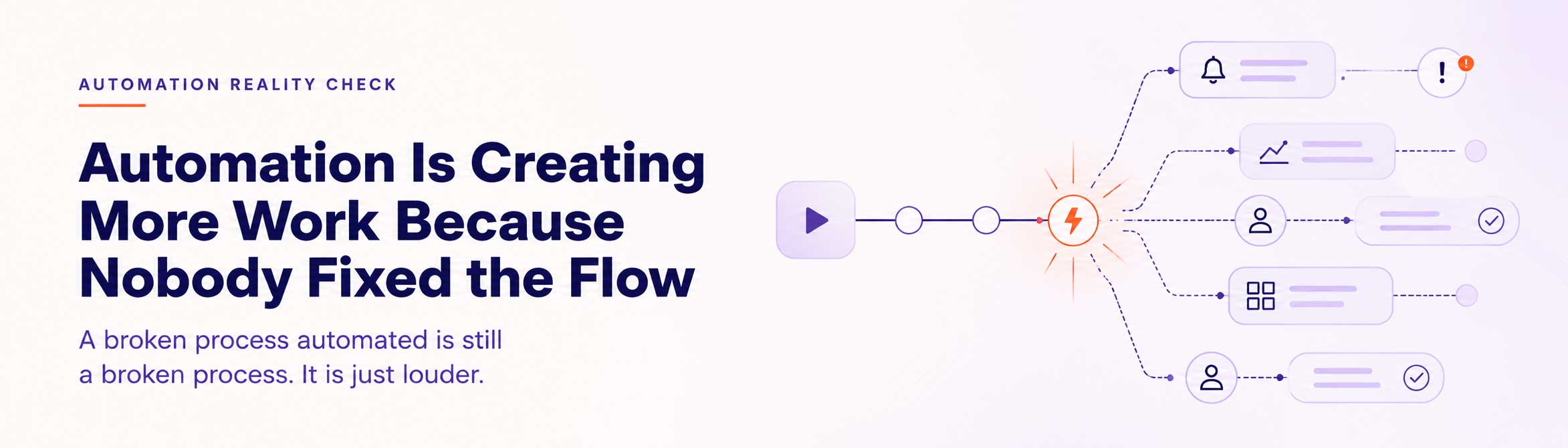
The first mistake is treating generative engine optimization as a content hack owned only by SEO. It is not. In SaaS, AI visibility depends on content, product marketing, customer marketing, RevOps, sales enablement, partner pages, review platforms, support content, pricing clarity, and CRM intelligence. If these teams work from different truths, the answer layer will inherit the confusion.
The second mistake is chasing mentions before fixing proof. A buyer asking for “best platform for X” is not only looking for a list. They are looking for confidence. If your content cannot explain why, you fit a certain ICP, which workflows you support, what outcomes you drive, and where your product should not be used, you are not ready for serious recommendation. You are only hoping for exposure.
The third mistake is ignoring freshness. AI visibility depends on current claims. Outdated pricing, old product screenshots, stale integration lists, abandoned comparison pages, and old case studies weaken trust. In B2B SaaS, outdated content signals operational drift. Buyers notice. Answer engines notice eventually.
What Weaddo helps fix?
Weaddo helps B2B SaaS and enterprise software companies move from scattered brand signals to a connected growth operating layer. For a CMO / Growth Head, that means aligning the systems and content that influence how buyers and AI engines understand the brand: website content, comparison pages, product pages, integration content, customer proof, CRM data, campaign journeys, review signals, analytics, and attribution.
This is not about producing more content for the sake of more content. It is about making the business easier to understand, easier to trust, easier to compare, and easier to recommend. Weaddo helps connect content strategy, SEO, AI search optimization, CRM data, customer journey design, digital experience, analytics, and governance into one operating layer.
That is the difference between AI visibility and AI noise. One creates clarity. The other creates more assets for buyers to ignore.
The rule is simple.
Generative engine optimization is real. But the brands that treat GEO as the next growth hack will create trust debt. They may win a mention, but they will not win durable demand. B2B SaaS buyers are not looking for the loudest vendor. They are looking for the most credible answer to a business problem.
So do not start by asking, “How do we hack AI recommendations?” Start by asking, “Are we worth recommending?” Is your positioning clear? Is your proof current? Are your reviews credible? Are your comparisons useful? Are your claims verifiable? Are your product and pricing signals consistent? Can a buyer understand where you fit without sitting through a demo?
Where does your growth stop? It may stop where your brand’s truth becomes too scattered for buyers, and now AI, to trust. The SaaS brands that win the next stage will not be the ones that spam the answer layer. They will be the ones that Bridge the Future Gap by becoming Unified. Intelligent. Ready.
What would be the next best step?
Talk to Weaddo to identify where your B2B SaaS brand truth is scattered across content, reviews, CRM, product pages, comparison pages, and buyer journeys, and how to build an AI visibility strategy based on trust, not tricks.






Leave a Reply